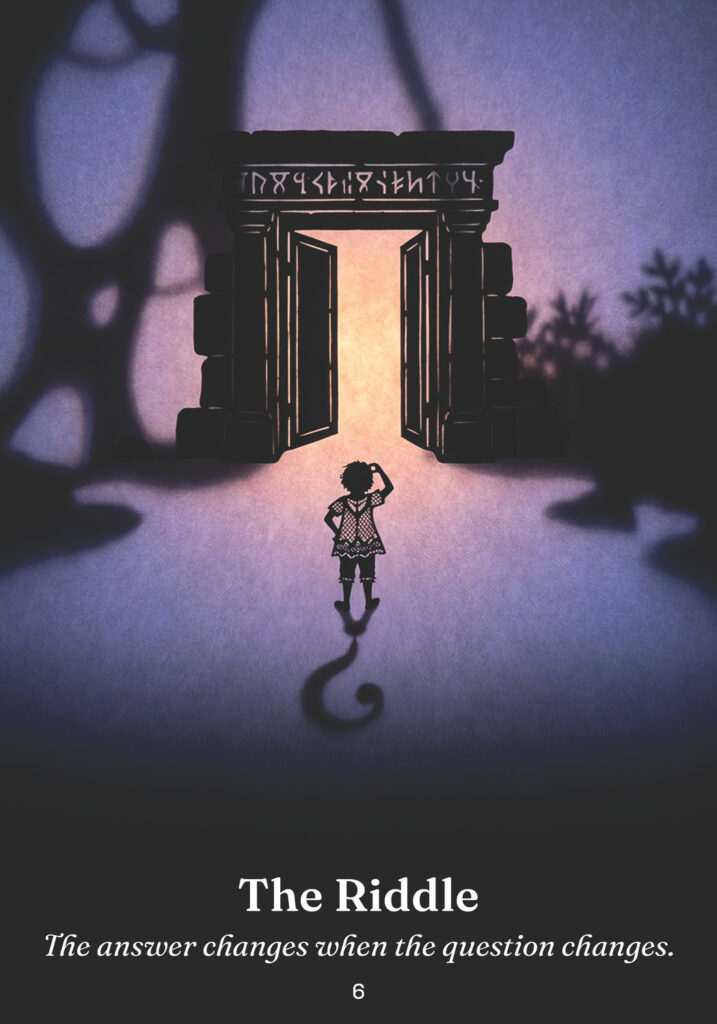
What The Riddle means
From the Sphinx to Nasreddin, tricksters love a question with a trapdoor in it. The riddle works because you accept its premise before you begin answering. Something in your situation is like that. You are answering an impossible question very hard. Stop. Ask what the question assumes, and change one word of it.
The Riddle turns up mid-wrestle, on about day four of a question I have not stopped chewing. Should I stay or go, is this worth it, am I too old for this. Each one has a trapdoor built into it, and I fall through the moment I start answering instead of inspecting. The card says stop. Find the assumption the question is standing on, then move one word and see whether the trapdoor closes.
In shadow, The Riddle becomes cleverness used to dodge an obvious truth. Reframing is a real skill and it can be abused. I can rewrite a question all afternoon to avoid the simple answer I already have and do not like. When the new question is more elegant than the old one but no closer to action, I have been outwitted by myself, which is the most trickster outcome available.
I question the question before I answer it.
When The Riddle appears in a reading
In a reading, The Riddle sends me back to the question I brought to the table, not forward to an answer. I read the question aloud and listen for the word doing the most work. "Should" is the usual culprit, followed by "still" and "ever." Whichever word it is, that is the trapdoor, and the rest of the reading happens on the far side of it.
In a spread, The Riddle changes how I read the cards around it. Their answers stay provisional until the question is fixed, so I read the line twice: once against the question I brought to the table, once against the question after I changed a word in it. The second pass is usually the real one.
A practical tell: if changing a word in the question produces relief, the question was the problem. If it produces a new excuse, the answer was.
One small sideways move
Ask someone you trust to tell you what your question assumes before you explain why you are asking it.
The Riddle in the Crossroads Spread
The Trickster Oracle guidebook’s three-card Crossroads Spread does not find the correct road. It exposes the structure of the choice: the threshold that is actually present, the route you overlooked, and the cost you have not counted. In each position this card tends to say:
- The Threshold. The threshold is a question with a trapdoor. You accepted its premise before you began.
- The Unexpected Route. The route is a different question. Change one assumption and the impossible problem may open.
- The Hidden Cost. The cost is cleverness spent on dodging a simple truth. Check that the reframe is not an escape.
Journal prompts
- What am I assuming that makes this problem unsolvable?
- Where am I being clever to avoid something simple?