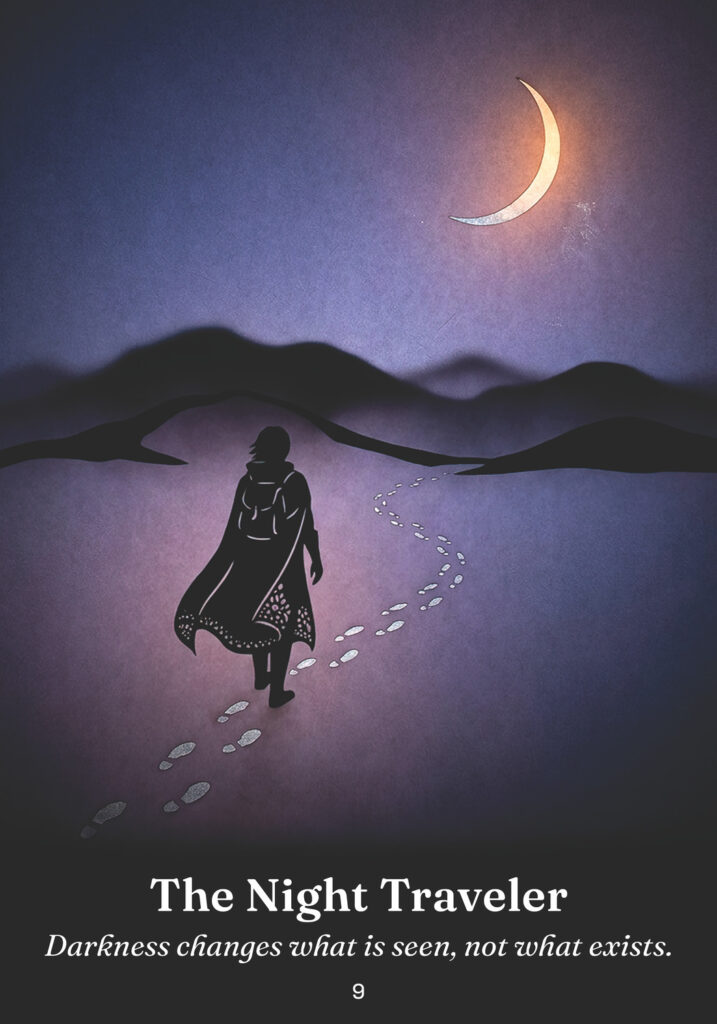
What The Night Traveler means
Many trickster tales happen after dark: cattle stolen at night, butter taken while the house sleeps, a fox crossing the border by moonlight. Night hides the traveler, but it does not change what is out there. Quiet progress suits you now. Move without announcement and gather what you learn away from the noise. Just do not confuse invisibility with safety.
The Night Traveler comes when I need cover. Some things are too new to survive an audience: the idea that would not hold up to a good question yet, the change I am making before I can defend it, the work that is still mostly nerve. The card gives me permission to go quiet, to gather what I learn away from the noise, and to let the results do the talking later.
In shadow, the card becomes secrecy for its own sake, then paranoia. Cover is a tool with a short useful life. Past that it stops protecting the work and starts protecting me from finding out how the work would land. If I have stopped telling anyone because I am afraid of what they would say, privacy has become hiding. The card knows the difference and asks me to know it too.
I move quietly and stay honest with myself.
When The Night Traveler appears in a reading
In a reading, The Night Traveler usually points at something I have been talking about more than working on. The question it asks is practical: what would this look like with the audience removed? Often the answer is that it would get done, because the talking was standing in for the doing.
What I watch for is the point where privacy turned into hiding, and it usually has a date. I can name the week I stopped mentioning the thing, and what happened that week is the reading.
One test I use: could I explain the silence to someone I respect without flinching? If yes, I am probably protecting something rather than hiding it. If not, the card is pointing at the flinch.
One small sideways move
For the next 24 hours, do not explain the thing you are working on to anyone.
The Night Traveler in the Crossroads Spread
The Trickster Oracle guidebook’s three-card Crossroads Spread does not find the correct road. It exposes the structure of the choice: the threshold that is actually present, the route you overlooked, and the cost you have not counted. In each position this card tends to say:
- The Threshold. The threshold is a passage best crossed without announcement. Quiet suits it.
- The Unexpected Route. The route is unwatched progress. Move, learn, and let the results speak later.
- The Hidden Cost. The cost is invisibility mistaken for safety. Secrecy has a way of turning into paranoia.
Journal prompts
- What would go better if I stopped announcing it?
- Where has privacy tipped into hiding?