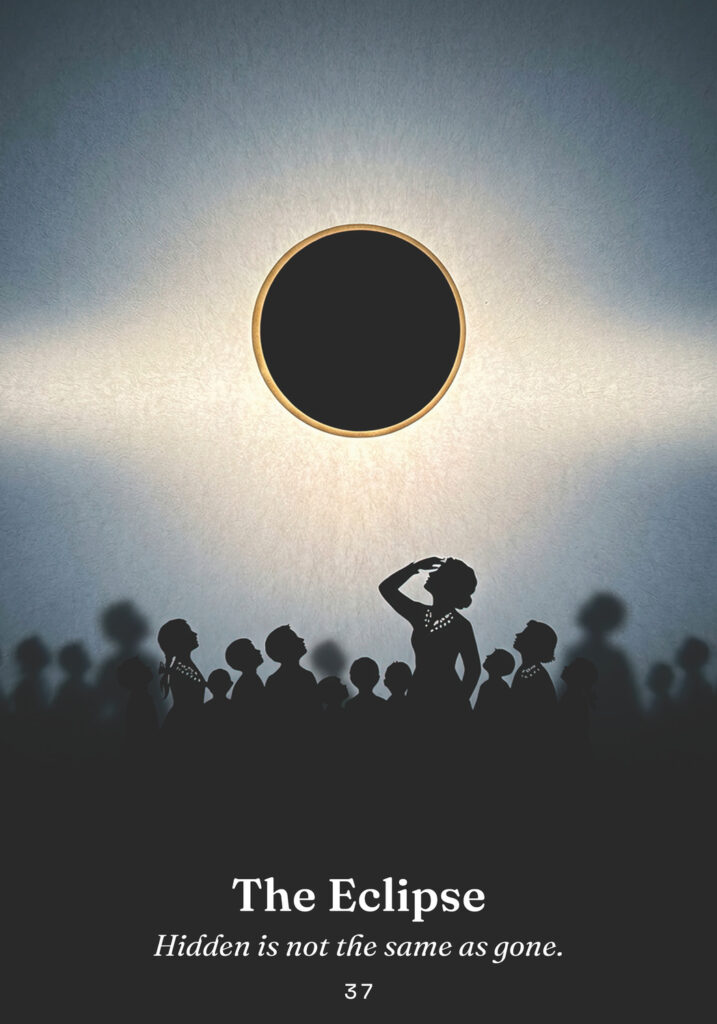
What The Eclipse means
Cultures across the world told stories about what swallows the sun, and nearly all of them noticed the same thing: it comes back. Something bright in your life has gone dark for a while. Do not act as if the light were destroyed. Use the pause to see what the glare was hiding, and watch the thin corona of what remains. Hidden is not the same as gone.
The Eclipse is a card for the weeks after a light goes out. A friendship, a confidence, a source of energy I relied on. The instinct is to treat the absence as a verdict and start rearranging everything around it. The card asks for the opposite: sit in the odd half-light, and notice what is visible now that could not be seen while the thing was blazing.
In shadow, the card is panic, acting blindly as if the darkness were permanent. Panic makes decisions the light would never have made, and some of them cannot be undone when the sun returns. The corona is still there, a thin ring of what remains. The card asks me to study that, take one small action, and wait long enough to see what changes before I call the darkness permanent.
I wait through the shadow without mistaking it for the end.
When The Eclipse appears in a reading
The Eclipse turns up when I am about to make permanent arrangements around a temporary dark. In a reading I ask how long it has actually been, in weeks, not in how it feels. The number is usually smaller than the feeling, and the gap between the two is the reading.
I read The Eclipse as shadow work in the literal sense. What the dark exposes is which parts of my life were being lit by that one source, and how much I had quietly let it carry. That is uncomfortable information and it is only available now, which is the card's argument for not rushing through the pause.
The Eclipse is a waiting card in a deck that mostly wants me to move. That contrast is the point. Not every darkness is a problem to solve; some are a pause to use.
One small sideways move
Postpone one decision you are tempted to make only because things feel dark today.
The Eclipse in the Crossroads Spread
The Trickster Oracle guidebook’s three-card Crossroads Spread does not find the correct road. It exposes the structure of the choice: the threshold that is actually present, the route you overlooked, and the cost you have not counted. In each position this card tends to say:
- The Threshold. The threshold is a darkness that is temporary. Something bright has been covered, not destroyed.
- The Unexpected Route. The route is to use the pause: see what the glare was hiding and watch what remains.
- The Hidden Cost. The cost is panic. Acting as if the light were gone for good can make it so.
Journal prompts
- What have I assumed is gone that is only hidden?
- What can I see in the dark that the light concealed?