The Table You Dread
Four cards for Thanksgiving dinner, or any holiday table you are already bracing for.
I counted the chairs before I took my coat off. Twelve people, eleven chairs, and the seat left over when I came back from the kitchen was the one at the end: back to the doorway, wedged between the wall and the extra leaf. To get out I would have had to ask two people to stand.
That was Thanksgiving last year, at my aunt’s. I did not think about the chair again until the drive home, when I noticed my shoulders had been up around my ears for four hours.
One card would have told me to sit somewhere else. That is useful and it is not enough.
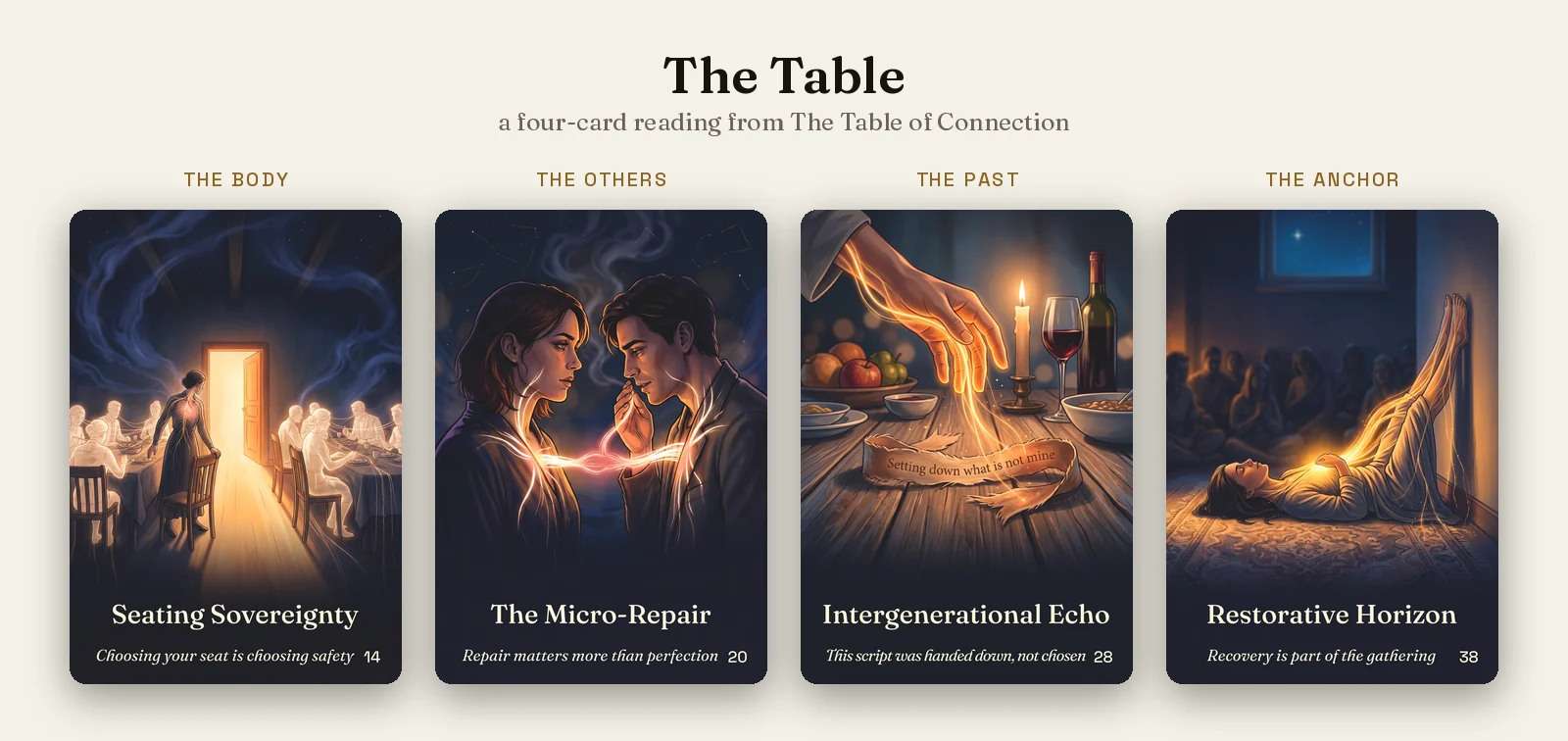
Four cards, read as one story, can show you the shape of the evening: what your body was doing, what happened between you and the room, which argument was never actually yours, and what you owed yourself the morning after.
I laid this one in September, weeks before anybody sends a Thanksgiving invitation, using the deck I built for exactly these rooms. The Table of Connection is a mirror deck. It does not predict your holiday or referee your family. It hands the body forty small things to do while the mind catches up.
The layout: The Table, a four-card spread for Thanksgiving and every table after it
This is the deck’s own spread, printed in its guidebook. Shuffle, and draw four cards, left to right. Each position asks its own question:
- The Body: What does my body need to stay regulated?
- The Others: How do I stay connected without losing myself?
- The Past: Which old script is likely to surface?
- The Anchor: What will keep me grounded and sovereign?
The order matters. The body comes first because it is often reading the room before the mind has decided there is anything to read. The anchor comes last because you cannot choose one until you know what you are anchoring against.
Position 1 · The Body
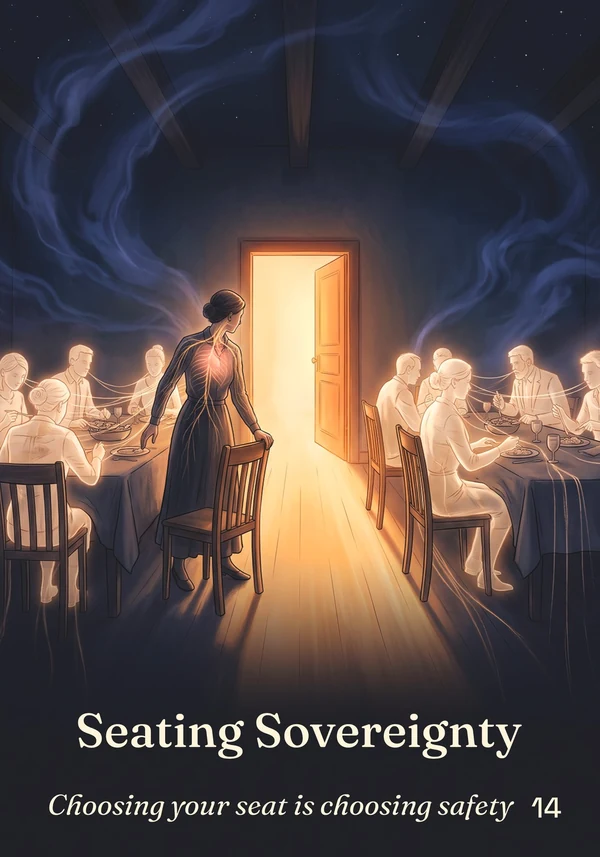
Seating Sovereignty
Suit II: The Relational Hearth · Card 14 of 40
Where you sit can quietly shape how safe you feel all evening, and feeling cornered by a difficult relative is not pettiness but your body reading a blocked exit as danger. Beneath conscious thought, your brain is always checking a space for possible exits and clear sightlines. A seat where you can see the door and do not feel boxed in lowers that background alarm before it builds.
I had filed that chair under bad manners, mine, for minding it at all. The card reads it the other way around. A blocked exit is information, and my body had the information four hours before I did.
What I remember is not fear. It is the low, steady effort of being somewhere I could not leave.
I did not need a different family. I needed a different chair.
If you draw Seating Sovereignty in this position, walk the room before the meal and take the seat with the door in view.
Its affirmation: “I place myself where I feel safe”
Position 2 · The Others

The Micro-Repair
Suit II: The Relational Hearth · Card 20 of 40
A sharp exchange does not have to define the rest of the evening, because repair matters more than avoiding every rupture, and it can be small and quick. After conflict, two nervous systems are both looking for a signal that safety has returned, and a brief, sincere reset offers exactly that. One honest sentence, free of relitigating who was right, often reopens the door that harsh words slammed shut.
Somewhere around the second course I said something clipped to my cousin and watched her face close.
I did not fix it. I told myself the moment had passed, which was not true. It had been ten minutes, and the door was still open for at least nine of them.
The card’s practice is one sentence: “Let’s pause and start over.” Five words, no verdict attached. I have thought about those five words more than about the argument they would have interrupted.
Not the argument. The ten minutes.
If you draw The Micro-Repair here, think about the rupture you have already decided is too old or too small to touch.
Its affirmation: “I can reopen a closed door”
Position 3 · The Past

Intergenerational Echo
Suit III: The Ancestral Shadow · Card 28 of 40
Some arguments at the table are older than anyone actually sitting there, and you can find yourself pulled into a fight that was handed down, not chosen. Family patterns pass through generations and settle into the body as reflexes, so a familiar trigger can fire a response you never consciously agreed to. Naming the script as inherited creates just enough space to set it down instead of repeating it.
The argument that actually ran that evening was about who takes the holiday and who gets out of it. Same words every year. It used to belong to my mother and my aunt. Last November it belonged to me and my cousin.
I was defending a position I never chose. I had simply been handed it, the way you get handed a dish to carry to the table.
The card does not ask me to forgive anybody. It asks me to notice the script is secondhand.
That is a smaller thing to do, and a more possible one.
If you draw Intergenerational Echo in this position, listen for the sentence in the fight that nobody has updated in twenty years.
Its affirmation: “I set down what is not mine”
Position 4 · The Anchor
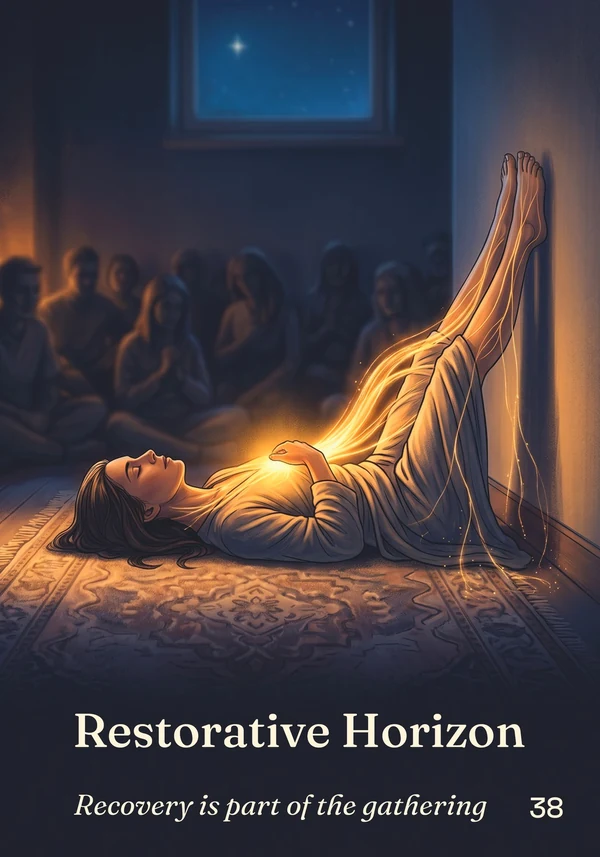
Restorative Horizon
Suit IV: The Harvest Anchor · Card 38 of 40
The day after a gathering can leave you sore and wrung out for no obvious reason, and recovery is not indulgence; a taxed nervous system genuinely needs time to refill. After sustained social effort, the body benefits from deep parasympathetic rest as it returns to calm. A gentle restorative pose, like lying with your legs up a wall, can feel supportive and give your system time to finish settling.
The next day I was flat. Not sad, not hungover, just spent, and annoyed with myself for being spent by a dinner.
This card sits in the suit the deck calls The Harvest Anchor, and it treats the morning after as part of the gathering rather than the bill for it.
That is the anchor. Not a technique for the table, a boundary around the whole day. For me that meant fifteen minutes on the floor with my legs up the wall, counted as part of the holiday instead of as proof I did the holiday badly.
If you draw Restorative Horizon here, the question is not whether you will need the recovery. It is whether you have given it a time.
Its affirmation: “I give my body time to recover”
Reading the four together
Straight across, the spread says something simpler: much of what made that table hard had begun before the actual argument.
The chair set the baseline. The ten unrepaired minutes set the tone. The inherited argument supplied the script. And the recovery I had not planned for turned one evening into two days.
The arc is seat, repair, set down, recover. Three of those four are things I can do without a single other person at that table agreeing to anything.
Lay the Thanksgiving oracle spread for yourself
Your four cards will not be mine. The point is the shape.
If Thanksgiving is the one you dread, lay it a few days out, not in the car on the way.
The spread works with any oracle deck you own; I used The Table of Connection because its language is built for this. Copy the positions into your journal, draw, and answer whatever your own cards ask. Mine asked this:
- The Body: What seat would let me breathe easier?
- The Others: What rupture is still hanging in the air?
- The Past: Whose old conflict am I repeating?
- The Anchor: How will I let myself recover?
Those four prompts come from the four cards I drew, not from the positions. Draw different cards and you get different ones, printed on their own guidebook pages. Answer in your own voice, not the deck’s.
The table may not change. You can still arrive at it differently.
Zara