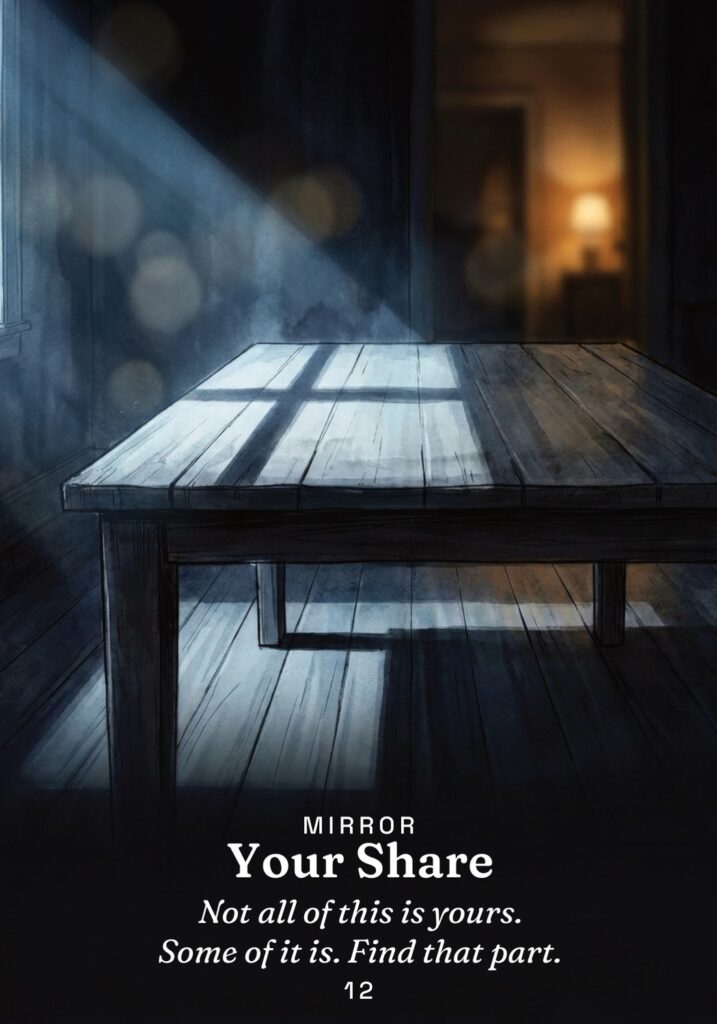
What Your Share means
This is where the work usually goes wrong. Somebody tells you that what you cannot stand in another person is secretly you, so you take the whole thing on. Now you have talked yourself out of an accurate perception of someone genuinely behaving badly. Both things are true at once. They did what they did. You are also adding something. Only the second half is yours to work.
When Your Share arrives, the reading is usually about a grudge, and the card is about proportion rather than absolution. Most grudges have been rewritten several times in memory by the time I lay a spread, and the rewriting usually goes one of two ways: everything is their fault, or everything is mine. The card holds a harder line, and the useful detail is that my addition has an age. It is older than this grudge, and that is what makes it workable.
Where it goes wrong is taking on all of it, and calling that accountability. I have met people who are proud of doing this. Every conflict becomes their fault, every true thing noticed about someone else's behavior gets talked down, and it looks like humility. It is a way of staying in control by owning everything. This is the sort most shadow work gets wrong, in both directions, and the card refuses both.
I can own my half without taking theirs.
When Your Share appears in a reading
In a reading this card is about proportion, and I read it by asking which side of the page I wanted to leave empty. Some people cannot bear to write anything in the other person's column. Some cannot bear to write anything in their own. Whichever column resists is the one the reading is about.
The practice is the three columns on one page, and the discipline is not letting the third column empty the second. If they were unkind, they were unkind. That stays. What I am adding sits beside it, not instead of it. Most people find the third column uncomfortably full, and the discomfort is the exercise doing its job.
When it lands beside The One You Can't Stand, the reading needs this card to keep the mirror from swallowing the whole conflict. Beside The Match and the Barn, the spark goes in column two and the dry barn in column three, and the fire finally has two honest authors.
One small shadow-work move
Take the argument you keep replaying and say out loud, once, the one sentence in it that is actually true about them.
Your Share in the Descent and Return spread
The Gold in the Dark guidebook’s three-card Descent and Return spread is the deck’s signature shadow work reading, for a pattern you have been circling for years rather than a fight you had on Tuesday. It names what you sent away, what keeping it buried has cost, and what is ready to come back. In each position this card tends to say:
- What Went Down. What went down was your ability to hold two facts: that they did it, and that you are adding something. One usually got dropped.
- What It Cost. The cost is every grudge you have carried whole, and every true thing you noticed about someone and then unsaw.
- What Comes Back. What comes back is the sort. Their half stays theirs. Yours is smaller than you feared and entirely workable.
Journal prompts
- What am I adding, and how old is the addition?
- What have I been calling my fault that was simply done to me?