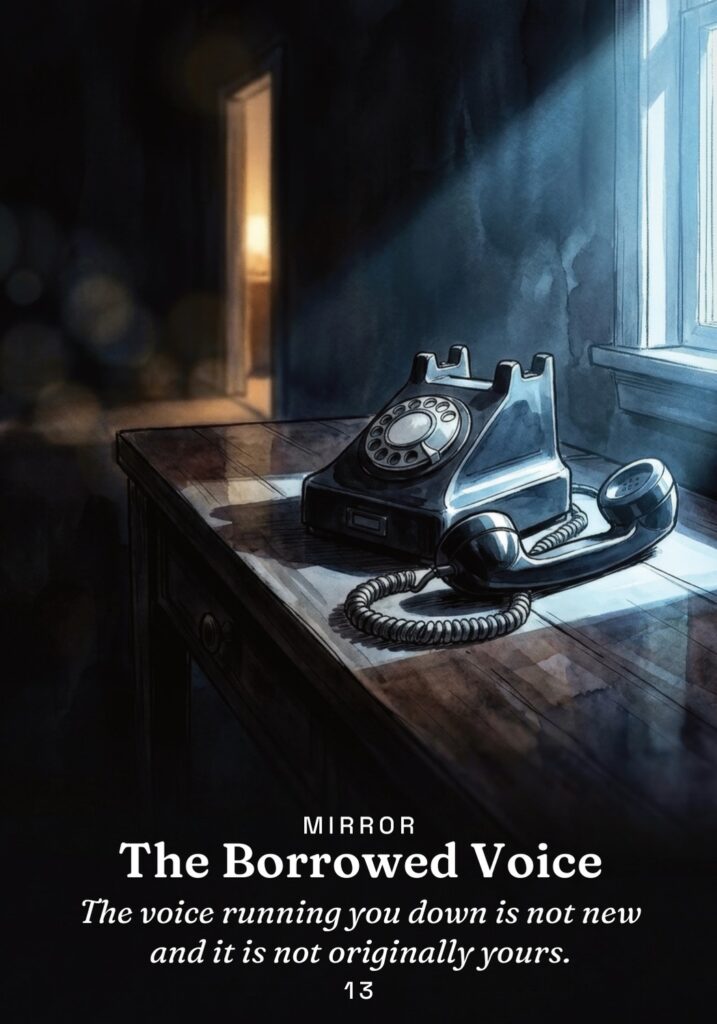
What The Borrowed Voice means
Listen to the thing that runs you down. Not the content. The delivery: the rhythm, the vocabulary, the exact register of the contempt. It has a voice, and the voice is older than you are. Somebody talked like that once, or a whole institution did. That does not make it a stranger. It has lived in you long enough to sound like your own honest opinion of yourself.
In a reading this card is about the tone of my self-criticism rather than its content. The content is usually unremarkable. The delivery is the fingerprint: a specific rhythm, a specific vocabulary of contempt, a cadence I did not invent. Once I can hear whose it is, the sentence loses some authority, because it is being read from a script written by someone with their own fears. The card is not about silencing the voice. It is about getting the attribution right.
Where it goes wrong is identifying whose voice it is, then obeying it anyway. Knowing that my inner critic sounds exactly like a particular teacher does nothing on its own. Plenty of people can name the source and still hand it the wheel every morning. The card wants the recognition to change something in the listening, so that the sentence arrives as a quotation rather than as my own honest opinion of myself.
I can hear whose voice that is.
When The Borrowed Voice appears in a reading
When The Borrowed Voice appears, I stop listening to what my inner critic says and start listening to how it says it. The cadence gives it away long before the words do. Whose is that? Naming the source is the first move, and it is usually available within a minute, because the voice has been in the house a long time.
The practice is to write the most frequent sentence word for word, unfair parts included, and then say it aloud in my own ordinary speaking voice. I have never once managed to do that without changing something. The change is the finding. My voice does not naturally deliver that line, which tells me how much of the delivery was borrowed.
Beside The First Mirror, I read the pair as the voice and the face it came from, and the reading becomes about the person rather than the sentence. Beside The Mind You Play Down, the borrowed voice is usually the one that taught me to round myself down in the first place.
One small shadow-work move
The next time the critical sentence runs, answer it once in your own voice, out loud, and notice the difference in tone.
The Borrowed Voice in the Descent and Return spread
The Gold in the Dark guidebook’s three-card Descent and Return spread is the deck’s signature shadow work reading, for a pattern you have been circling for years rather than a fight you had on Tuesday. It names what you sent away, what keeping it buried has cost, and what is ready to come back. In each position this card tends to say:
- What Went Down. What went down was some trust in your own opinion of yourself, crowded out by somebody else's cadence.
- What It Cost. The cost is a lifetime of obeying a review you did not write and could not have signed.
- What Comes Back. What comes back is your speaking voice, which is quieter, fairer, and turns out to have opinions of its own.
Journal prompts
- Whose cadence is that, and what were they afraid of?
- What is it trying to get me to avoid by saying it first?