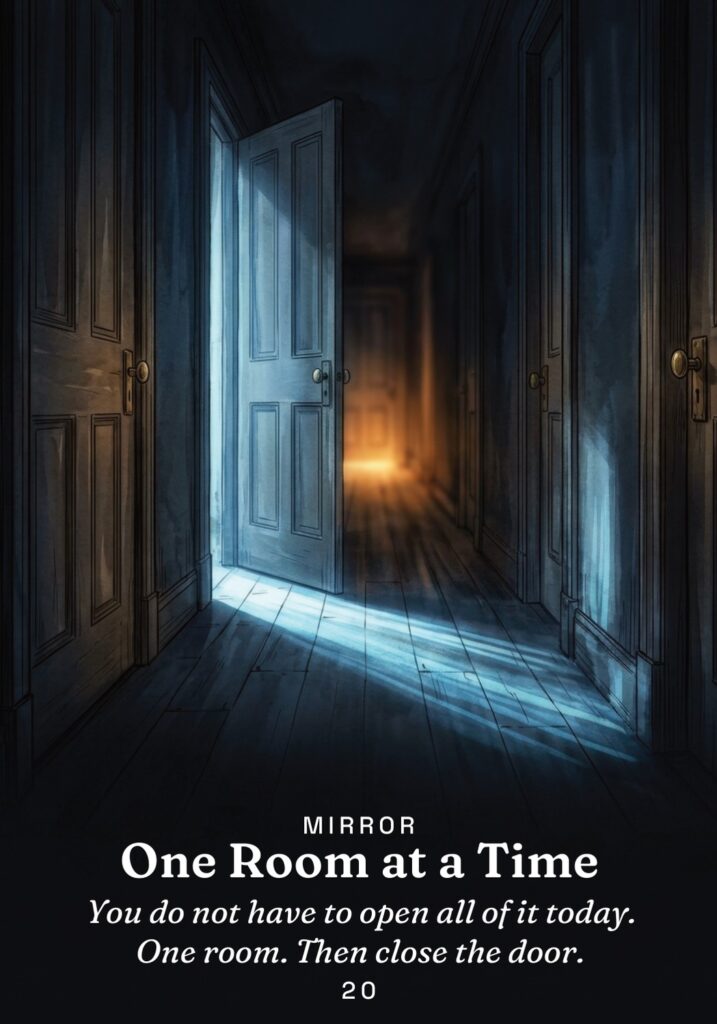
What One Room at a Time means
The impulse once you start opening doors is to open all of them tonight and get it over with. Do not. This work does not reward speed and it punishes flooding. There is nothing brave about opening more than you can sit with. One room examined honestly, then the door closed and the evening spent on something ordinary, is a better week's work than the whole house at once.
This card usually turns up when a reading has gotten large, and I read it as an instruction to stop at the right time. The impulse in this work is to open every door in one night and get it over with. The card says no. One room, honestly, then the door shut. It is a card about capacity, and it has taught me that knowing when to stop is a skill separate from knowing where to look.
Where it goes wrong is using pacing as a permanent reason never to begin. "I am going slowly" can be true, and it can also be a very tidy way of never starting. The difference is whether a door has actually been opened. Shadow work at a sensible pace is still shadow work. Pacing with no doors opened is a schedule, not a practice.
I can stop while I am still steady.
When One Room at a Time appears in a reading
In a reading this card is the one that tells me when to stop, and I have learned to obey it. If it turns up in a spread that has already opened two heavy doors, I read it as a hard limit: one more room at most, then something ordinary and physical until bedtime. It is not a soft card. Capacity is real.
The practice is a timer set before I start, twenty minutes, and a full stop when it rings, mid-sentence if I have to. Then an hour cooking or walking or washing something. I rehearse the stop when nothing is at stake, so that it is there on the day something is.
Beside The Fire Escape, I read the pair as the difference between leaving a feeling and finishing with it, and the card gives me permission for the second. Beside The Floor of the Well, the reading is about pacing the climb so the floor stays a floor.
One small shadow-work move
Leave one question deliberately unanswered tonight and close the notebook before you feel finished.
One Room at a Time in the Descent and Return spread
The Gold in the Dark guidebook’s three-card Descent and Return spread is the deck’s signature shadow work reading, for a pattern you have been circling for years rather than a fight you had on Tuesday. It names what you sent away, what keeping it buried has cost, and what is ready to come back. In each position this card tends to say:
- What Went Down. What went down was your sense of how much you could hold at once. The card does not need a reason; it only asks you to recover the stop.
- What It Cost. The cost is either flooding, when you open too many doors, or paralysis, when you refuse to open any.
- What Comes Back. What comes back is a closing skill: one room examined, the door shut, the evening ordinary, and you still steady.
Journal prompts
- How do I know when I have gone past what I can hold?
- What is my reliable way back to ordinary, and do I use it?