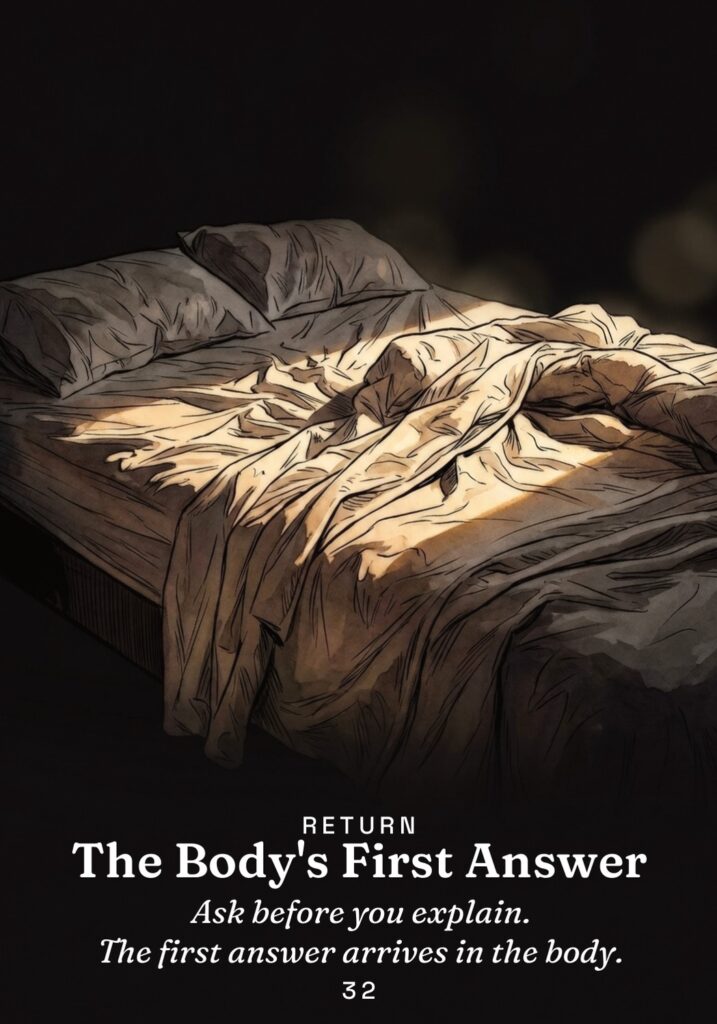
What The Body's First Answer means
Ask yourself a real question and watch what happens next. There is an answer that arrives before the sentences do: a lift, a heaviness, a small turning away. Eugene Gendlin called it the felt sense, a whole vague impression of a situation that has not become words yet. It is not wiser than thinking. It is just earlier, and by the time you finish explaining, it has been overwritten.
When this card comes up, the reading is about the half minute after a question, before the sentences start. A lift, a sinking, a small turning away. The card treats that as the reply and refuses to improve on it immediately. The point is not that the body is smarter. The point is that the body gets there first, and the explaining tends to bury what it found.
Where it goes wrong is treating a sensation as proof and skipping the thinking. A heaviness is not a verdict. A lift is not permission. The card asks me to wait for the first answer and then to think, not to wait for it instead of thinking. People who learn to listen this way sometimes stop doing the second half, and then every stomach flutter becomes a decision.
I can wait for the first answer before I improve on it.
When The Body's First Answer appears in a reading
In a reading I use this card as a pause, and the pause is timed. Half a minute of silence after the question, with no answering allowed. Whatever shifts in the middle of me during that half minute is the reading, and I keep what I say about it loose on purpose.
The practice is to wait before improving on the first answer, not to skip the improving. I catch the felt sense in one loose sentence, then I think, with the sentence in front of me. The mistake I watch for is explaining over the top of it so fast that the explanation is all that is left.
Beside The Animal That Knows, I read the pair as two early kinds of information: what noticed and what felt. Beside The Clenched Jaw, the reading listens to the body twice, once for what it is holding and once for what it already answered.
One small shadow-work move
Before answering one ordinary yes-or-no question today, notice whether you lean toward it or away from it before you speak.
The Body's First Answer in the Descent and Return spread
The Gold in the Dark guidebook’s three-card Descent and Return spread is the deck’s signature shadow work reading, for a pattern you have been circling for years rather than a fight you had on Tuesday. It names what you sent away, what keeping it buried has cost, and what is ready to come back. In each position this card tends to say:
- What Went Down. What went down was the wordless reply, overwritten so often I stopped noticing it.
- What It Cost. The cost is decisions made entirely in sentences, with the earliest information talked over.
- What Comes Back. What comes back is a pause. Thirty seconds, a loose sentence, and then the thinking, in that order.
Journal prompts
- What did the first answer feel like before I gave it words?
- Where do I habitually explain over the top of it?