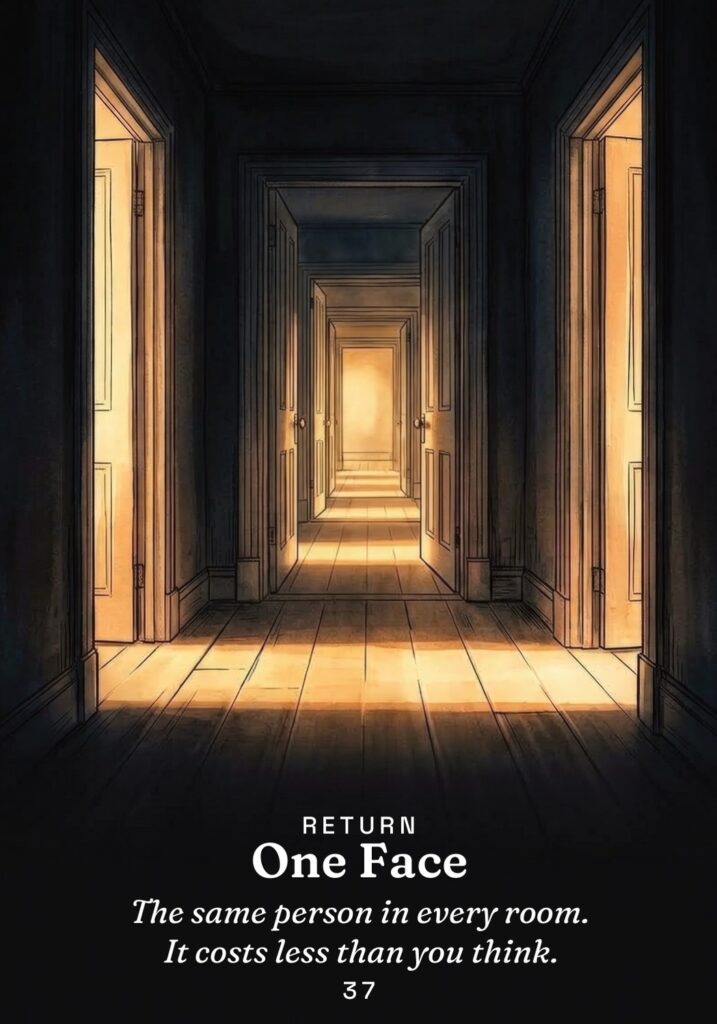
What One Face means
Count the versions of yourself you keep running: work, family, old friends, the one who answers the phone to your mother. Some variation is just manners. Past a point it becomes labor, and the labor stays invisible even to you until a weekend puts two of those groups in the same room and you spend the whole time in the corridor between them.
In a reading this card asks how many versions of myself I keep running. Work. Family. Old friends. The one who answers the phone to a parent. Some of the variation is manners and costs nothing. The card is about the point past which it becomes labor, and the labor is easiest to see on the rare occasion when two of the groups meet. The question is not whether I have versions. It is what the corridor is costing.
Where it goes wrong is calling every adjustment dishonesty, including basic manners. The card is not asking me to bring my whole self to the dentist. Some adjustment is simply how people live together, and treating it as a betrayal of authenticity is a different kind of exhaustion. One face is a direction, not a demand, and the direction is toward fewer corridors rather than none.
I can be one person in more than one room.
When One Face appears in a reading
When this card appears, I count the versions and I do it honestly. Then I find the corridor: the effort of keeping the groups apart, which stays invisible until two of them share a room. The reading is about that labor, and about what I am certain would be lost if the versions merged, which is usually less than I think.
The practice is one item carried into one room. The safest room I have, and one thing that normally stays elsewhere: an opinion, an enthusiasm, a limit. Then a note about where the energy went instead of into the corridor. I do not merge everything. One item, one room, and see what the room does with it.
Beside The Costume, I read the pair as the roles and the space between them, and the reading is about how many I am running at once. Beside The Retired Guard, the versions were often a security measure, and the card asks whether the security is still needed.
One small shadow-work move
Use the same small opinion in two different rooms today and notice which one makes you want to edit it.
One Face in the Descent and Return spread
The Gold in the Dark guidebook’s three-card Descent and Return spread is the deck’s signature shadow work reading, for a pattern you have been circling for years rather than a fight you had on Tuesday. It names what you sent away, what keeping it buried has cost, and what is ready to come back. In each position this card tends to say:
- What Went Down. What went down was ease between rooms. The versions multiplied until they stopped meeting.
- What It Cost. The cost is the corridor between them, and every weekend spent managing who sees which version.
- What Comes Back. What comes back is one face in more than one room, carried in one item at a time, which costs less than you fear.
Journal prompts
- Which two versions of me would be most uncomfortable in a room together?
- What am I certain would be lost if the versions merged?