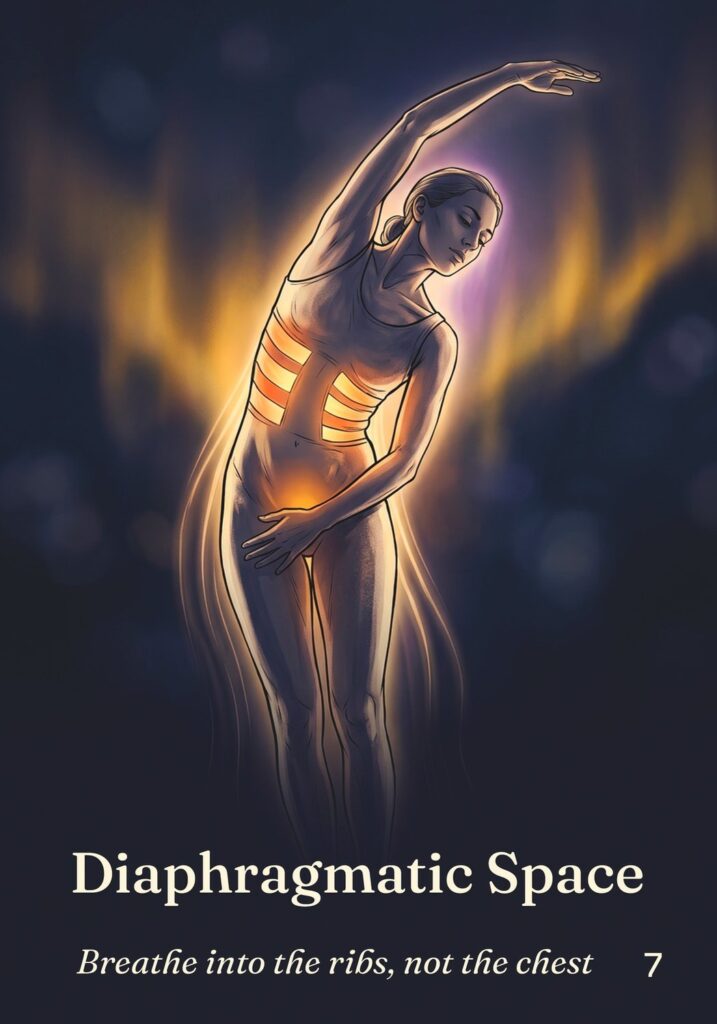
What Diaphragmatic Space means
A held, rigid posture quietly holds your breath along with it, and shallow breathing keeps the body on a low hum of alert even when nothing is actually wrong. Your diaphragm and vagus work together to steady you, so fuller movement in your breath sends a stronger signal of safety. Breathing wide into the sides of your ribs, rather than high into your chest, restores that deeper, calmer message.
Three hours in a dining chair can set a body into a shape it forgets it is holding, and Diaphragmatic Space points at that shape. Shoulders up near the ears, arms folded tight, a spine pulled stiff in a dining chair for three hours. The person may describe feeling on edge for no reason, or say they are fine while the body tells another story. I read the card as a nudge toward the body's architecture, because a posture braced for trouble keeps the whole system braced, and the breath is where that bracing is easiest to feel and easiest to change.
Where it goes wrong is fixing the posture to look relaxed while the breath underneath stays locked in place. I have watched someone uncross their arms and settle back with a pleasant face, still breathing in small sips high in the chest. That is a costume of ease. The card is not about how the body looks to the rest of the table. It is about room inside the ribs. A person can sit however they like, as long as the breath has somewhere to go.
I make room for a fuller breath
When Diaphragmatic Space appears in a reading
When this card leads a reading, I ask the person to put a hand on their chest and one on their side ribs and simply breathe for a moment. Which hand moves more? Most find that the top hand does all the work. That small discovery tends to open the reading better than any explanation, because it shows them in their own body how much effort they spend holding still. Then I ask when in the day they last took a breath that moved their sides, and the answer is often a long time ago.
My practice with the card is to breathe into the sides of the ribs instead of the top of the chest, letting the lower ribs widen like an umbrella opening slowly. I add a small lean to each side, an easy stretch I can do while standing in a kitchen or reaching for a dish, so it looks like nothing. A few rounds of this changes how I sit. The shoulders drop on their own, and I stop gripping the edge of the table without realizing I had been.
Beside The Vagal Brake, I read the pair as a full breath: room on the way in and length on the way out. Beside Armor of Critique, the reading points to the ribs twice, once as a place to breathe and once as a boundary to feel, and I take that as the body asking to be inhabited rather than defended. Where I keep Diaphragmatic Space distinct from The Child Role is the kind of holding. Diaphragmatic Space is about tension. The Child Role is about shrinking, an old smallness that feels like posture but is really a role.
One small move for the table
Wear something to the gathering that is loose around the waist and ribs, so your clothes are not doing part of the holding for you.
Diaphragmatic Space in the Ladder Spread
The Table of Connection guidebook’s three-card spread is The Ladder, for a specific trigger or a gathering that already has you tangled. Laid left to right, it moves one situation from raw reaction toward regulated response: notice what the body is doing, name the state, then check what is true now and choose a practice. In each position this card tends to say:
- Notice. As the Notice card, Diaphragmatic Space points at shoulders near your ears and a breath that stays high and small in the chest.
- Name. In the Name position, it names a low hum of alert, a body holding still and holding on even though nothing is actually wrong.
- Check and Regulate. In Check and Regulate, it asks whether there is real danger here, then widens the breath into your sides so the message of safety gets stronger.
Journal prompts
- Where is my posture holding my breath?
- What loosens when I breathe more fully?