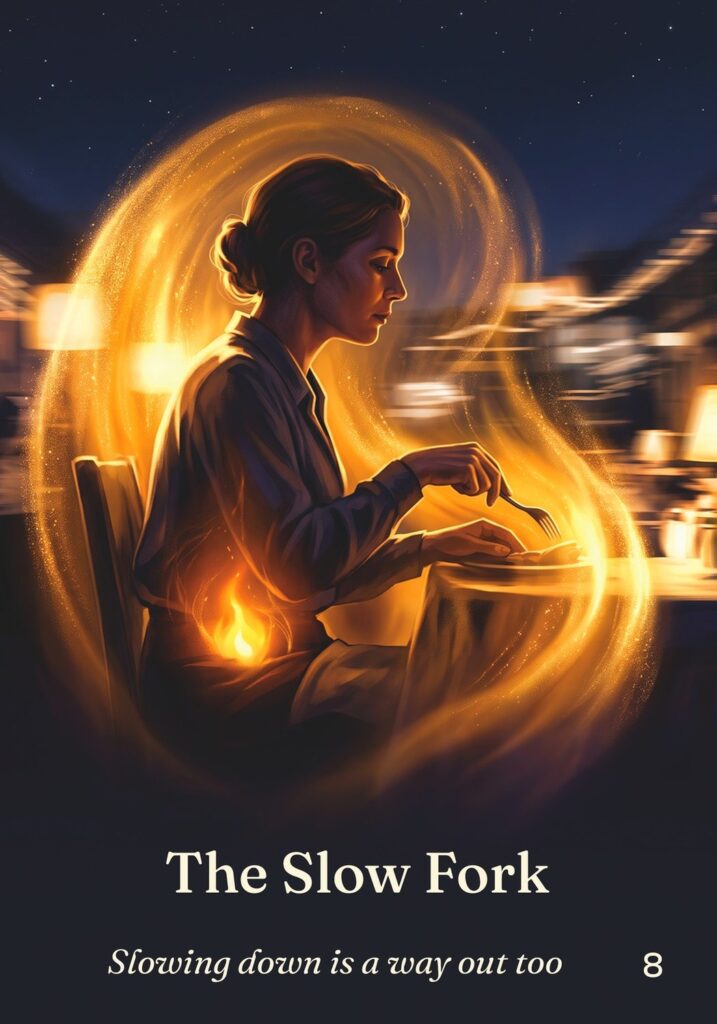
What The Slow Fork means
Speeding through the meal can feel like the fastest way out, but rushing only keeps your body in escape mode while the exit never quite arrives. When you slow your hands, you slow the physical momentum behind the urge to flee, and a deliberate pace tells the nervous system there is time and no need to rush. Eating a few bites with your non-dominant hand creates that slowdown and returns you to the present.
In a reading, The Slow Fork tends to describe an evening that feels like a sentence to be served. The person is counting down: three more courses, two more hours, one more round of pie. Everything speeds up because the goal is to be done. I read the card as a gentle question about where all that hurry is actually getting them. Rushing rarely shortens a holiday dinner, since the dessert comes out on the host's schedule, not yours. It makes the time feel longer and the body more desperate to leave.
Where it goes wrong is staying in the room while bolting inside, or leaving physically with the same rush still running. I know the version where someone finally gets out the door and drives home fast, heart pounding, replaying everything. Nothing about the escape slowed them down. The card's point is that the way out of the urge to flee runs through slowing, not speed. A deliberate pace, even for a few bites, gives the body the information it was looking for: there is time, and nobody is chasing you.
I set my own pace at the table
When The Slow Fork appears in a reading
When this card shows up, I ask the person what exactly they are trying to get away from. The answer is rarely the whole gathering. It is usually one thing: a topic that might come up, a person who has not arrived yet, a feeling of being on display. Narrowing the urge to flee down to that one thing makes it more manageable, and sometimes it reveals that the real escape route is a conversation with one person, or a seat farther from them, rather than an early exit.
In practice I take the card literally and switch hands for a few bites, using my non-dominant hand to bring food to my mouth. The awkwardness is the point. It forces a slower rhythm and pulls my attention into the present in a way that no instruction to relax ever does. I usually find myself smiling at how clumsy I am, which also helps. After three or four bites I switch back, and the pace I return to is often noticeably calmer than the one I left.
Beside The Escape Hatch, I read the pair as two answers to the same urge: slow it down at the table, or move it out of the body with a walk. I let the person choose which suits the evening. Beside The Satiety Cue, the reading is about speed at every level, the hands and the hunger alike. Where I keep The Slow Fork distinct from Sanctuary Pause is location. The Slow Fork works while you stay seated. Sanctuary Pause takes you out of the room for a reset before you come back.
One small move for the table
Plan one unhurried thing to do right after the gathering, such as a slow walk or a favorite show, so the evening has a calm ending to move toward.
The Slow Fork in the Ladder Spread
The Table of Connection guidebook’s three-card spread is The Ladder, for a specific trigger or a gathering that already has you tangled. Laid left to right, it moves one situation from raw reaction toward regulated response: notice what the body is doing, name the state, then check what is true now and choose a practice. In each position this card tends to say:
- Notice. As the Notice card, The Slow Fork points at your pace, which has quietly sped up as if the meal were something to get through rather than eat.
- Name. In the Name position, it names that speed as escape mode, a body trying to leave while sitting in a chair.
- Check and Regulate. In Check and Regulate, it asks whether anyone is actually chasing you, then slows your hands enough to show the body there is time.
Journal prompts
- What am I hurrying to escape here?
- What changes when I slow my hands?