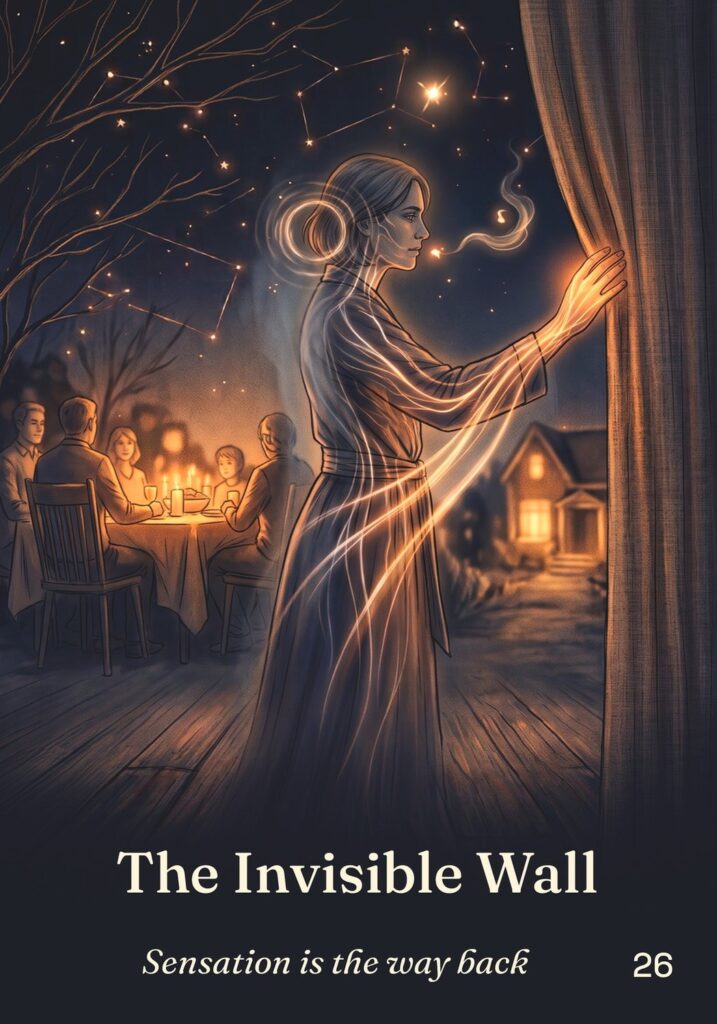
What The Invisible Wall means
When everything becomes too much, you can go blank and drift behind a pane of glass, and that fog is not failure but a deeply rooted form of protection. Extreme overwhelm can tip the nervous system into dorsal shutdown, pulling you out of the present and into numbness. Sharp, specific sensory input, especially cold or texture, gives your body a foothold to climb back into the room and the moment.
In a reading, The Invisible Wall tends to describe someone who goes blank at gatherings. They are physically there, nodding, smiling, passing dishes, but inside they feel far away, foggy, as if watching the scene through a window. Some describe it as being on autopilot. They may not remember much of the evening afterward. I read the card with gentleness. That blankness can be protective. At some point the room may have become too much, and the body found a way to step back without leaving the chair.
Where it goes wrong is pushing yourself to engage harder from behind the glass, or giving up on returning and drifting for the rest of the night. Forcing conversation while numb tends to make the fog thicker, and accepting the fog as the whole evening means missing the people you came for. The card offers a middle path. Small, specific sensations, the cold of a glass, the texture of a napkin, the taste of something sharp, give the body a handhold to climb back into the room one step at a time.
I use my senses to return
When The Invisible Wall appears in a reading
When this card shows up, I ask the person when they usually start to check out. Some can name a moment: after the second hour, during a certain conversation, when a particular person starts talking. Others realize they have been going blank at gatherings for so long they did not notice it was a pattern. Either answer is useful. The reading might suggest planning a sensory anchor in advance, something in a pocket or on the table, for the moment the fog starts rolling in.
My practice with the card is to name five things I can see, four I can hear, three I can feel, two I can smell, and one I can taste, silently, at the table. When the fog is thick, that can be too much to hold, so I start smaller: one thing I can see and one thing I can physically feel, like the edge of the table under my palm. Once those two land, the rest of the count usually comes more easily. Cold helps too, so I sometimes hold a glass of ice water or step out into cold air before starting.
Beside The Ghost Seat, I read the pair as grief and numbness, and I ask the person whether the blankness started with a loss. Beside Sensory Palette, the reading says the room may be overwhelming the senses before the fog arrives. Where I keep The Invisible Wall distinct from The Escape Hatch is direction. The Escape Hatch is about too much energy that needs to move. The Invisible Wall is about energy draining away, and the body pulling back from the present.
One small move for the table
Put something with a distinct texture in your pocket before the gathering, such as a smooth stone or a sprig of rosemary, to hold when the fog starts.
The Invisible Wall in the Ladder Spread
The Table of Connection guidebook’s three-card spread is The Ladder, for a specific trigger or a gathering that already has you tangled. Laid left to right, it moves one situation from raw reaction toward regulated response: notice what the body is doing, name the state, then check what is true now and choose a practice. In each position this card tends to say:
- Notice. As the Notice card, The Invisible Wall points at the moment you go blank, still in the room but somewhere behind a pane of glass.
- Name. In the Name position, it names that fog as a deeply rooted form of protection, not a failure to be present.
- Check and Regulate. In Check and Regulate, it asks whether you can find one sensation right now, and offers five things seen down to one tasted as the way back.
Journal prompts
- When did I start to check out?
- What sensation brings me back to now?