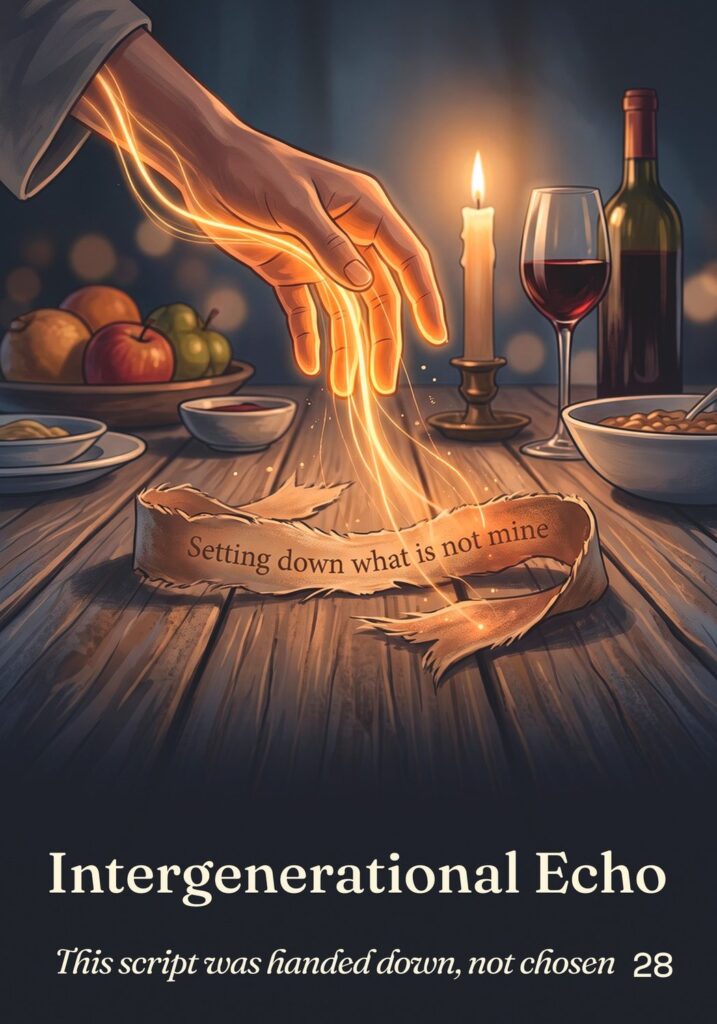
What Intergenerational Echo means
Some arguments at the table are older than anyone actually sitting there, and you can find yourself pulled into a fight that was handed down, not chosen. Family patterns pass through generations and settle into the body as reflexes, so a familiar trigger can fire a response you never consciously agreed to. Naming the script as inherited creates just enough space to set it down instead of repeating it.
A familiar fight starts at the table, and somewhere in the second sentence you realize you have seen it before. Intergenerational Echo lives in that recognition. The same accusations, the same defenses, the same people taking the same sides. Sometimes it is a fight their parents had, or their grandparents. I read the card as a step back from the argument to see its shape. The words might change from year to year, but the pattern repeats, and the person may find themselves playing a part they never chose.
Where it goes wrong is blaming the ancestors for the script and staying stuck in the blame, rather than setting the script down. Knowing that a pattern came from a grandparent can become one more argument at the table, a new way to accuse. The card does not ask anyone to put their family on trial. It asks the person to recognize the script as inherited, so they can choose not to say their lines. The pattern can end with them, quietly, without needing anyone else to agree. I find it helps to remember that whoever started the script was usually protecting something too, which makes it easier to put down without a fight.
I set down what is not mine
When Intergenerational Echo appears in a reading
When this card shows up, I ask the person which argument repeats at their family gatherings. Most can name it immediately. Then I ask who started it, or where they first heard it. The history often goes back further than expected, to a generation the person never knew. That long view changes the feeling of the argument. It becomes less personal and more like weather, something that passes through the family, and the person can choose not to stand in the rain. I also ask what the argument protects. A fight about who did the dishes in 1985 may be standing guard over a much older question about who was valued in that house, and knowing that tends to take the heat out of the dishes.
My practice with the card is to lengthen my spine, breathe, and silently tell myself, "This script belongs to the past, not to me," when I feel the familiar fight pulling me in. I say it slowly, in my own words. The sentence creates a small gap between the trigger and my response. In that gap, I can decide to change the subject, leave the room, or say nothing. I do not need to explain my choice to anyone.
Beside The Child Role, I read the pair as two kinds of inheritance, the role handed to you and the script your family repeats. Beside The Micro-Repair, the reading asks whether a small reset could interrupt the pattern this year. Intergenerational Echo and The Political Flame both burn, but the age of the fire is different. The Political Flame is about debates that flare in the moment. Intergenerational Echo is about arguments older than anyone at the table.
One small move for the table
Ask a relative who enjoys telling family stories about holidays when they were young, without pressing for the difficult memories, and listen for the pattern without pointing it out.
Intergenerational Echo in the Ladder Spread
The Table of Connection guidebook’s three-card spread is The Ladder, for a specific trigger or a gathering that already has you tangled. Laid left to right, it moves one situation from raw reaction toward regulated response: notice what the body is doing, name the state, then check what is true now and choose a practice. In each position this card tends to say:
- Notice. As the Notice card, Intergenerational Echo points at a familiar fight starting up, one you seem to have seen many times before.
- Name. In the Name position, it names that fight as a script handed down, a pattern settled into the body as a reflex.
- Check and Regulate. In Check and Regulate, it asks whether this script is actually yours, and offers naming it as inherited as a way to set it down.
Journal prompts
- Whose old conflict am I repeating?
- What pattern can end with me?