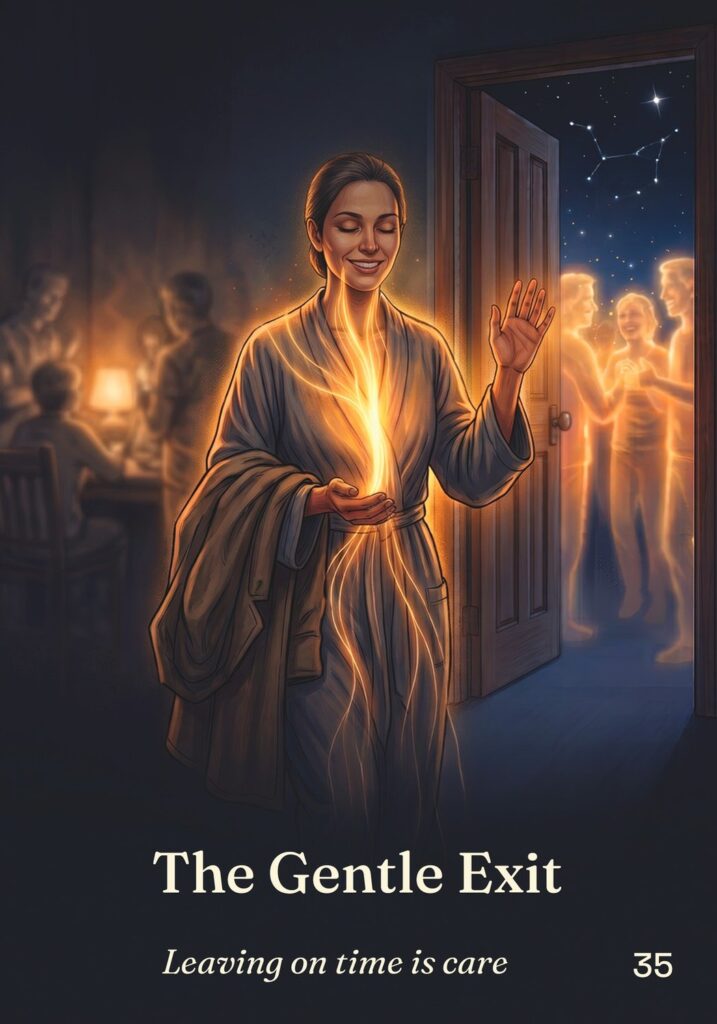
What The Gentle Exit means
Staying until you are completely wrung out serves no one, least of all the people you came to be with, and leaving on time is an act of care, not rejection. Past a certain point of depletion, an exhausted nervous system simply cannot connect anyway, no matter how long you stay. A planned, unapologetic departure protects the warmth you built before fatigue turns it into strain.
In a reading, The Gentle Exit tends to belong to the person who stays too long, year after year. They know when they are done, often hours before they leave, but they stay out of guilt, obligation, or fear of what their departure will signal. By the time they finally leave the Thanksgiving gathering, they are exhausted, irritable, and less warm than they were at the start. I read the card as permission to leave while there is still warmth to carry home. Leaving on time protects the connection rather than abandoning it.
Where it goes wrong is leaving in a way that feels like a slammed door, or overstaying out of guilt until you have nothing left. An abrupt exit after a fight can leave a wound. Staying past empty leaves the person brittle and likely to snap. The card asks for a planned, kind departure that the person decides on in advance. The time is theirs to honor or to reconsider if the evening turns out better than expected; it is a plan, not another rule to obey. A warm goodbye at a reasonable hour is a gift to everyone, including the people who stay behind.
I leave before I am depleted
When The Gentle Exit appears in a reading
When this card shows up, I ask the person what they fear their leaving will signal. That they do not care? That they are judging the family? That they are fragile? Naming the fear often reveals that it belongs to an old story more than to the people at the table. The reading then asks what time the person would leave if they were not afraid of that signal. Usually there is a clear answer, and it becomes the plan. I sometimes ask them to imagine the host's view of their goodbye. Hosts tend to remember a warm goodbye at eight more fondly than a tired, silent guest at eleven, and seeing it from that side makes the plan easier to keep.
My practice with the card is to decide my departure time before I arrive, and then honor it simply. When the time comes, I find the host, thank them warmly, say goodbye to a few people, and go. I do not over-explain or apologize my way out the door. If someone asks me to stay, I smile and say, "I need to head home." Leaving at a time I chose, rather than when I am empty, means I take the good parts of the evening with me.
Beside The Escape Hatch, I read the pair as two ways to leave: a short walk to let the urge pass, or a planned exit when the evening is done. Beside Restorative Horizon, the reading extends the care of leaving into the rest that follows. Where I keep The Gentle Exit distinct from Generous Boundary is scale. Generous Boundary is a brief moment of space during the gathering. The Gentle Exit is the decision about when the gathering ends for you.
One small move for the table
Tell one person at the gathering your departure time early in the evening, so leaving at that time feels like a promise kept rather than a surprise.
The Gentle Exit in the Ladder Spread
The Table of Connection guidebook’s three-card spread is The Ladder, for a specific trigger or a gathering that already has you tangled. Laid left to right, it moves one situation from raw reaction toward regulated response: notice what the body is doing, name the state, then check what is true now and choose a practice. In each position this card tends to say:
- Notice. As the Notice card, The Gentle Exit points at the exhaustion of staying past your limit, warmth turning into strain the longer you stay.
- Name. In the Name position, the state is depletion, the point where staying longer stops adding warmth and starts using it up.
- Check and Regulate. In Check and Regulate, it asks whether staying longer actually helps anyone, and offers a planned, unapologetic departure as an act of care.
Journal prompts
- When did I last leave before I felt empty?
- What am I afraid my leaving will signal?