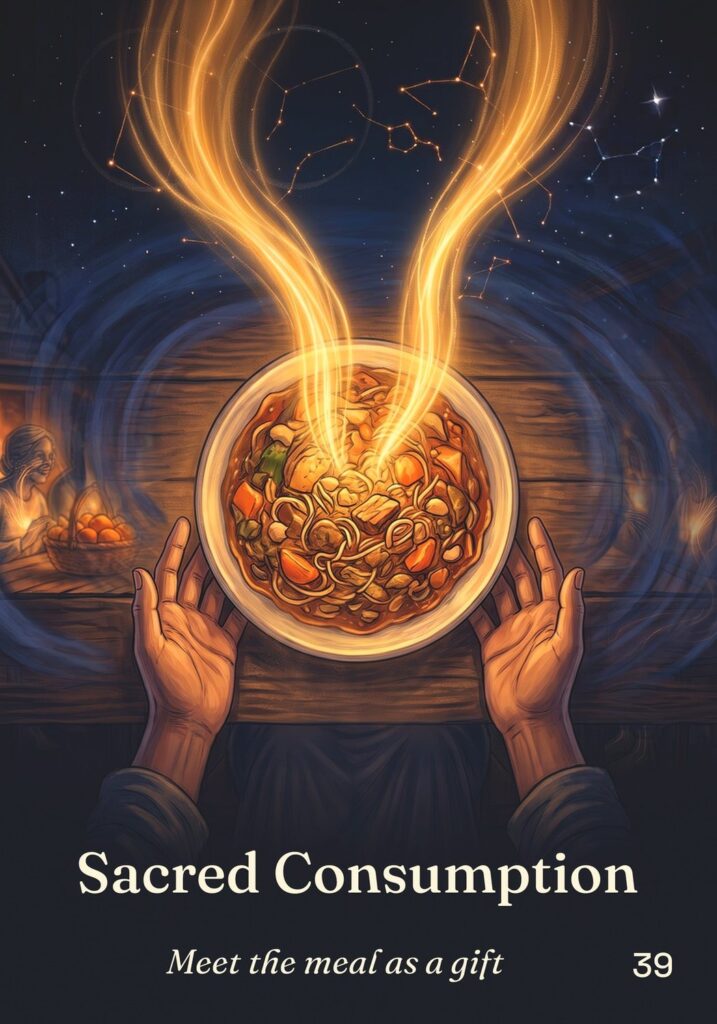
What Sacred Consumption means
When food itself has become a source of anxiety, the table quietly turns into a battleground, and meeting the meal as an enemy keeps your body braced against its own nourishment. A calm, willing pause before eating can support the parasympathetic processes involved in digestion. A brief, silent moment of respect before the first bite shifts the meal from threat to gift in your body's reading of it.
In a reading, Sacred Consumption tends to describe a person whose relationship with food has become complicated. Meals feel like negotiations, plates like threats, holidays like obstacle courses. Thanksgiving, built entirely around a big meal, can feel especially fraught. I read the card with gentleness. It does not ask the person to fix their relationship with food in one evening. It offers a small shift in how the meal is first met, one that can move the body's reading from danger toward something closer to welcome.
Where it goes wrong is making the pause before eating into a strict ritual you must perform correctly, which turns the gift into another test. A person who already feels anxious about food can easily make gratitude into one more rule to follow, one more way to fail. The card asks for something simpler. A brief, silent moment of respect. No words required, no particular form. Just a pause that lets the meal arrive as something given rather than something to defend against.
I receive this food with respect
When Sacred Consumption appears in a reading
When this card shows up, I ask the person where they first learned to see food as an enemy. Some can name a moment: a comment from a parent, a diet in their teens, a doctor's warning. Others cannot remember a time before it. The reading does not try to undo that history. It simply asks what it might feel like to meet one meal, just one, as a gift. The question opens a door the person may have forgotten was there. I keep this reading slow, and I do not push. If the honest answer is that no meal feels like a gift yet, then the reading looks for one food, one moment, one setting that feels less fraught, and starts there.
Before I eat, I take a silent pause to acknowledge where the meal came from and the hands that made it. I think of the farmers, the cooks, the people who carried it to the table. It takes a few seconds. Nobody needs to know I am doing it. The pause shifts my body from bracing to receiving, and the first bite feels different because of it.
Beside Somatic Gratitude, I read the pair as thankfulness felt toward the meal and toward the people. Beside Taste as Safety, the reading suggests that once the meal is met as a gift, its flavor might return. Where I keep Sacred Consumption distinct from The Full Circle is which end of the meal it guards. Sacred Consumption meets the food at the start. The Full Circle closes it at the end.
One small move for the table
Ask the cook about one dish on the table, where the recipe came from or who taught it to them, before you eat it.
Sacred Consumption in the Ladder Spread
The Table of Connection guidebook’s three-card spread is The Ladder, for a specific trigger or a gathering that already has you tangled. Laid left to right, it moves one situation from raw reaction toward regulated response: notice what the body is doing, name the state, then check what is true now and choose a practice. In each position this card tends to say:
- Notice. As the Notice card, Sacred Consumption points at a body braced against its own meal, the table feeling more like a battleground than a gift.
- Name. In the Name position, it names that bracing as an anxious relationship with food that keeps the body defending against nourishment.
- Check and Regulate. In Check and Regulate, it asks whether this meal is actually a threat, and offers a silent moment of respect before the first bite.
Journal prompts
- Where have I made food an enemy?
- How would it feel to receive it as a gift?