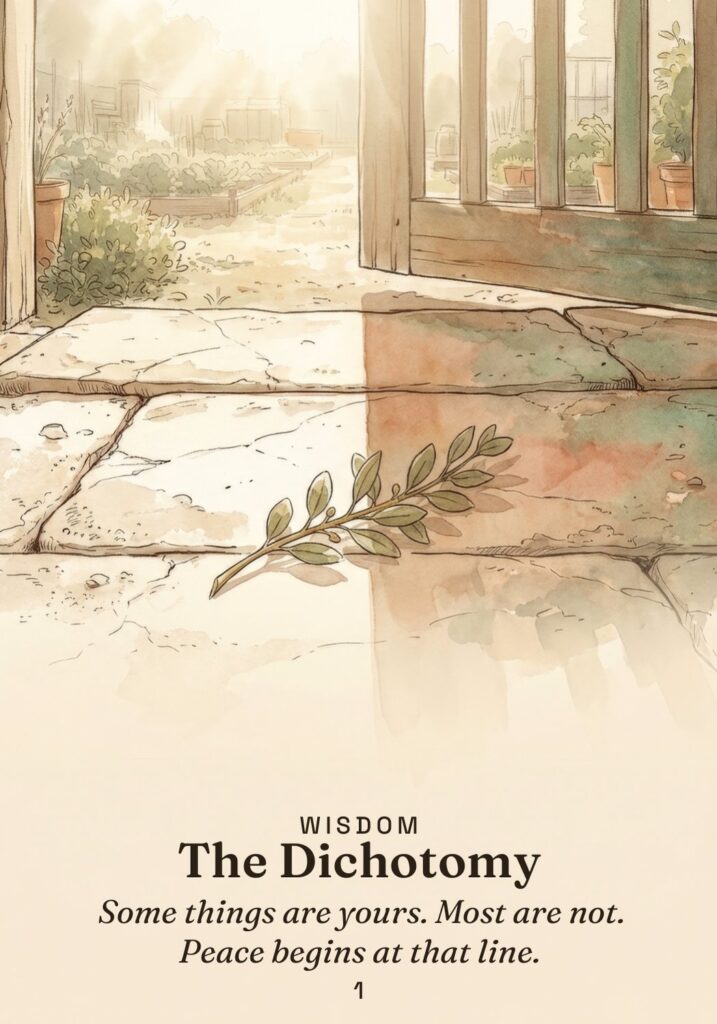
What The Dichotomy means
"Some things are in our control and others not," Epictetus begins the Enchiridion (1, tr. Carter). Our opinions, pursuits, desires, and actions are ours. Everything else, from other people to outcomes, is not. Every Stoic practice stands on this one sorting. Today, something you are straining against sits on the wrong side of the line, and the strain itself is the evidence.
In a reading, The Dichotomy tends to arrive when the person has been working hard and getting nowhere, and the hardness of the work has started to feel like virtue. They are managing a sibling's job search, a boss's temper, a verdict that has not come in yet. I read the card as a question about where the effort is landing. It is not telling them to care less. It is pointing out that a great deal of the caring has been spent on a column that does not take deposits. Promises made about outcomes tend to draw this card, whatever season they were made in.
Where it goes wrong is sorting the columns once, nodding at the result, and going straight back to pushing on the other person's side. People do the whole exercise beautifully, agree that the outcome is not theirs, and then spend the evening drafting the message that will make it theirs after all. The other failure is sorting too generously in the other direction, filing an effort that is plainly yours under not mine because it is tiring. Both are the same mistake wearing different coats. The line has to be drawn where it actually falls, not where it would be most comfortable.
I put my effort where it is mine to spend.
When The Dichotomy appears in a reading
When this card leads a reading, I ask the person to tell me the situation in one breath, and I listen for the verbs. Waiting, hoping, getting someone to, making sure that. Those verbs usually point at the other column. Then I ask for the verbs on their own side, and there is often a pause, because the person has not been thinking in those terms. The pause is the reading. Somewhere in it is a small, unglamorous action that has been sitting untouched while all the energy went to the part they cannot move.
My practice with the card is the two columns, but I keep the first pass short. Ten lines, five minutes, pen on paper, because a screen invites editing and the point is honesty, not tidiness. If the mine column comes out empty, I do not accept that. There is a response, a tone, a next phone call, a decision about how much more of the evening this gets. I circle the smallest item I can act on before the day ends and I do it before I reread the other column, because rereading the other column is how the hour disappears.
Beside The Judgment, I read the pair as a sorting problem hiding a verdict: the person cannot place the item because they have already decided what it means. Beside The Obstacle, the card says the block itself is in the not-mine column, but the response to it is firmly in mine. Where I keep The Dichotomy distinct from The Return is time. The Dichotomy is the first sort, the moment of drawing the line. The Return is what tending your own side looks like after a season of doing it. One is a decision; the other is a record.
One small move on your side of the line
Tell one person, out loud, which part of the situation you have decided to stop managing, so the decision exists somewhere other than your own head.
The Dichotomy in the Dichotomy Spread
The Stoic Oracle guidebook’s three-card spread is The Dichotomy Spread, for any situation that will not stop churning: a conflict, a waiting game, a decision that circles. Laid left to right, it sorts the situation along the one line the Stoics trusted: what is yours, what is not, and the next right act. In each position this card tends to say:
- What Is Yours. In the What Is Yours position, The Dichotomy points at the response you have not chosen yet because you have been busy choosing someone else's.
- What Is Not. In the What Is Not position, it names the outcome you keep rehearsing as if rehearsal were a lever, and asks you to set the lever down.
- The Next Right Act. As The Next Right Act, it asks for the smallest item from your own column done before anything else, so the day begins on your side of the line.
Journal prompts
- Which item did I most want to put in the wrong column?
- What would today look like if I only worked my own column?