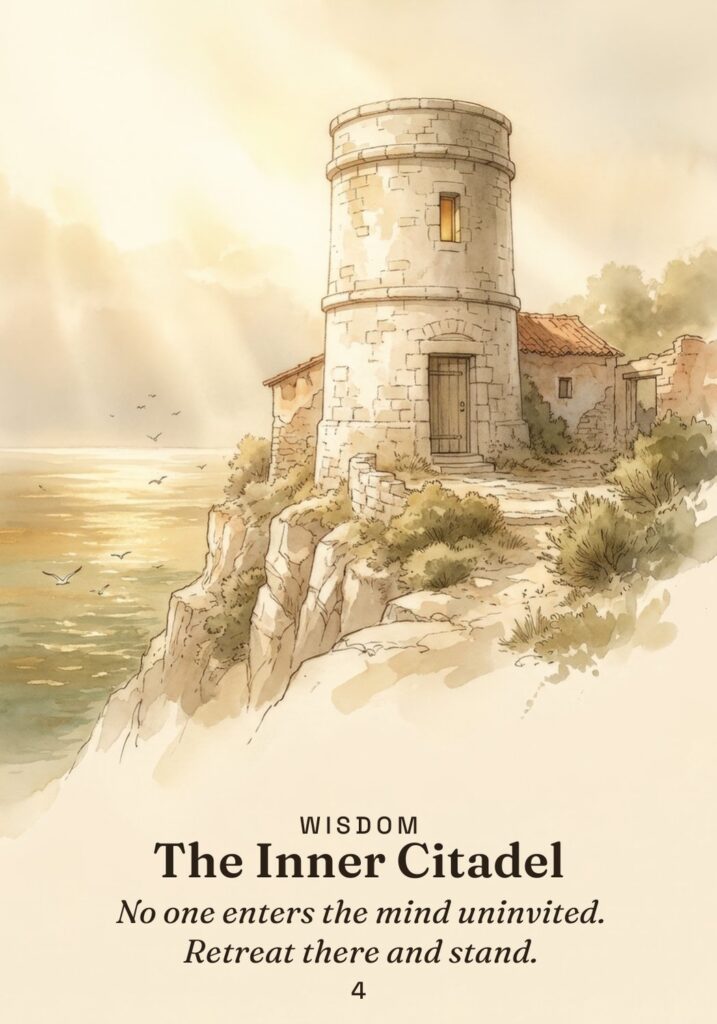
What The Inner Citadel means
"The mind which is free from passions is a citadel," Marcus writes, "for man has nothing more secure to which he can fly for refuge" (Meditations 8.48, tr. Long). He did not mean numbness. He meant that no one can make your conclusions for you. Consent is the last wall, and it holds as long as you hold it.
In a reading, The Inner Citadel comes up for someone who has been letting a particular voice finish their sentences. A parent, a feed, a colleague with opinions about their worth. The person can usually name the voice in a few seconds, and what they describe is not persuasion but trespass: the conclusion arrives already written and they find themselves living inside it. I read the card as a reminder about the last door. Opinion can walk right up to it. Agreement is the step that happens inside, and that step has never been anyone's to take but theirs.
Where it goes wrong is mistaking a locked gate for a strong one, until nothing gets in, including the people you love. The card gets taken as permission to stop listening entirely, to treat every hard remark as an assault on the walls and every ask as a siege. That is not a citadel; it is a bunker, and the person inside it gets lonely fast. The wall in the card is about conclusions, not contact. Someone can speak to you, even hurt you, and still not be the one who decides what it means. Holding that line does not require closing the door on the person.
My consent is mine. It cannot be taken, only given.
When The Inner Citadel appears in a reading
Where I start with this card is the gate, and I ask the person what has been walking through it lately. Not who; what. A tone, a comment thread, a sentence they heard years ago that still arrives on schedule. Then I ask them to say what conclusion that visitor usually leaves behind, in its own words. Hearing the verdict spoken plainly often does half the work, because the conclusions that run a life tend to sound absurd at a normal volume. The reading is about noticing the moment of consent, which is quieter than the moment of hurt.
My practice with the card is a short sentence I say inwardly when the familiar voice turns up, and I keep it polite, because the card's own line is polite: you may knock, you may not conclude for me. On a hard day I shorten it to the second half. I do not try to stop the knock. The knock is going to happen. What I practice is the half-second between hearing it and agreeing with it, and on a good day that half-second is enough to notice I have a choice. On a bad day I notice afterward, and I count that too.
Beside The Judgment, I read the pair as the gate and the verdict that slipped through it, so the work is to find where the agreement happened. Beside Hands and Eyelids, the two cards keep each other honest: the citadel stands, and the person inside it still asks for help. Where I keep The Inner Citadel distinct from The View from Above is the direction of the relief. The view goes up and out until the trouble is small. The citadel stays home and simply declines to sign. A person who cannot get any distance can often still refuse the signature.
One small move on your side of the line
Mute, unfollow, or move out of sight one source of the voice that keeps writing your conclusions, for one day, and notice what arrives in the quiet.
The Inner Citadel in the Dichotomy Spread
The Stoic Oracle guidebook’s three-card spread is The Dichotomy Spread, for any situation that will not stop churning: a conflict, a waiting game, a decision that circles. Laid left to right, it sorts the situation along the one line the Stoics trusted: what is yours, what is not, and the next right act. In each position this card tends to say:
- What Is Yours. In the What Is Yours position, The Inner Citadel names your agreement as the thing no one else can supply, however loudly they knock.
- What Is Not. In the What Is Not position, it points at the opinions, moods and commentary arriving at the gate, which were never yours to control and do not need to be.
- The Next Right Act. As The Next Right Act, it asks you to notice one knock today and leave a beat before you answer it, so the conclusion is yours when it comes.
Journal prompts
- Who or what has been walking into my citadel unchallenged?
- What conclusion have I been letting someone else write?