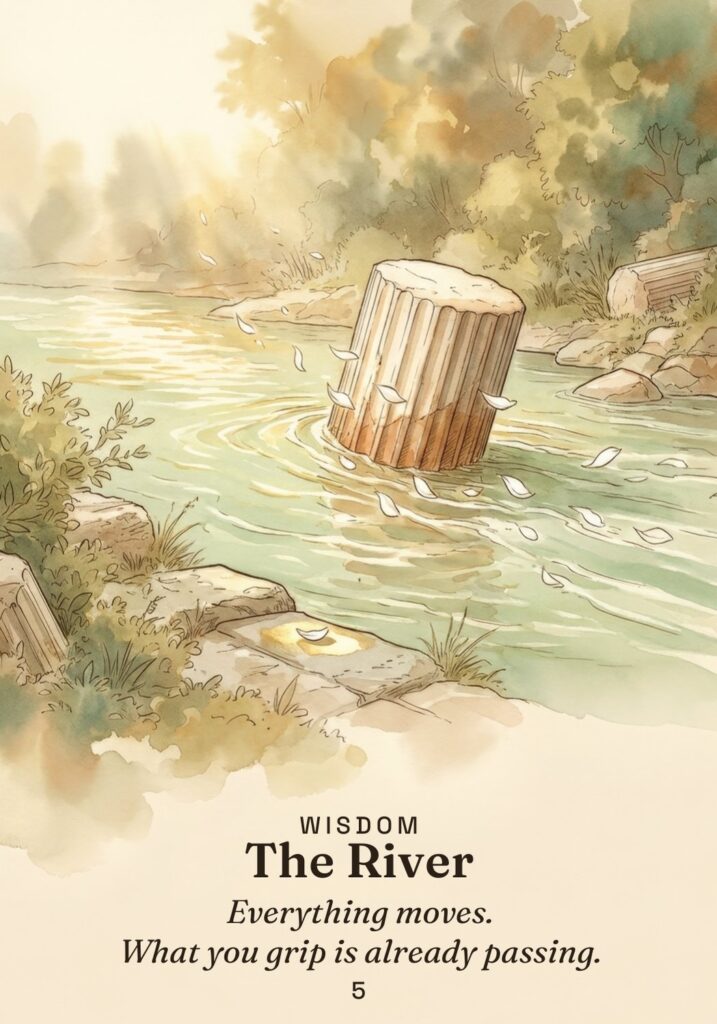
What The River means
"Time is like a river made up of the events which happen, and a violent stream," Marcus writes, "for as soon as a thing has been seen, it is carried away, and another comes in its place" (Meditations 4.43, tr. Long). He is not being gloomy. He is loosening your fingers. The moment you are gripping, good or bad, is already moving. So is the one that hurts.
The person who draws The River is usually holding something past its moment. Sometimes it is a hurt they keep diving back to retrieve, and sometimes, which surprises people, it is a good thing: a compliment, a perfect summer, a version of themselves from a year that ended. I read the card as a loosening, not a loss. The grip is the problem, and the grip feels the same whether the object is painful or sweet. The water is doing what water does. The card asks what the hands are doing.
Where it goes wrong is using the river as a reason not to care, so that nothing is held long enough to matter. The card gets quoted to end a conversation about something that deserved more than a shrug: everything passes, so why bother. That is a cold reading of a warm idea. The moving water does not cancel love; it is the condition love happens in. Loosening the fingers is not the same as opening the hand and walking away. The person who gets this card is being asked to hold more lightly, which is harder and more tender than letting go.
I can love what passes without stopping the river.
When The River appears in a reading
When this card shows up, I ask the person what they would grab if the whole situation were floating past them right now. The answer is fast and usually specific, and it is rarely the thing they came in talking about. Someone who arrived describing a job loss names a single conversation from the last week there. That is the thing the hands are around. Once it is named, I ask whether it is in the water or on the bank, and most people already know. The reading is in how long it takes them to say it.
My practice with the card is the spoken sentence and the small addition, and I do it near moving water when I can because the sound makes the point for me. I say the thing I am clenching, then: and it is moving. I keep saying it until something in my shoulders agrees, which can take longer than ten minutes on a stubborn day. When I have no river, a running tap will do. What I watch for is the moment the sentence stops being an argument I am making to myself and becomes something I am simply watching happen.
Beside The Borrowed Things, I read the pair as the same lesson from two angles, the river moving and the loan coming due, and the person usually needs the gentler of the two first. Beside This Hour Only, the card narrows: the water is moving, and the one place to stand is this hour. Where I keep The River distinct from Amor Fati is tense. Amor Fati is about the day that already arrived and the decision to work with it. The River is about the fact that even this day is already on its way out, and that the leaving is not a betrayal.
One small move on your side of the line
Put one object you have been keeping as a way of keeping a moment into a drawer or a box for a month, and notice whether the moment survives out of sight.
The River in the Dichotomy Spread
The Stoic Oracle guidebook’s three-card spread is The Dichotomy Spread, for any situation that will not stop churning: a conflict, a waiting game, a decision that circles. Laid left to right, it sorts the situation along the one line the Stoics trusted: what is yours, what is not, and the next right act. In each position this card tends to say:
- What Is Yours. In the What Is Yours position, The River points at the grip, which is the one part of the scene your hands are actually in charge of.
- What Is Not. In the What Is Not position, it names the current itself: the passing of the thing you are holding, which was moving before you noticed and will not stop for the clench.
- The Next Right Act. As The Next Right Act, it asks for a visible loosening, a conversation finished or an object set out of sight for a while, so the hands learn what the mind has been told.
Journal prompts
- What am I trying to hold still that was never still?
- What has the river already carried off that I keep diving after?