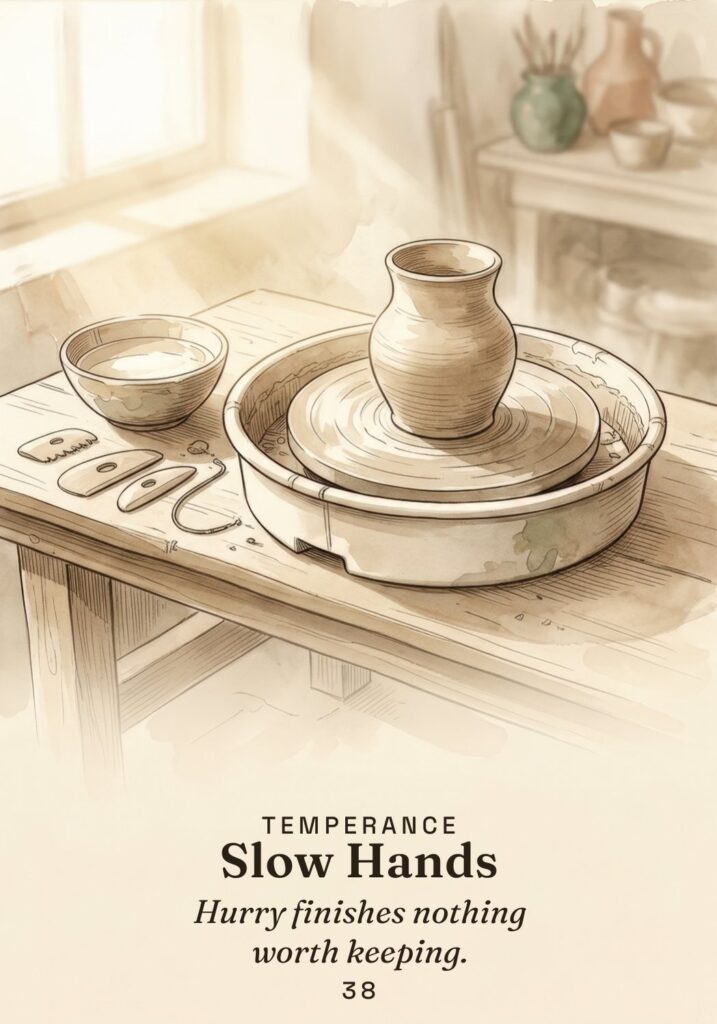
What Slow Hands means
The Stoics distrusted hurry because hurry is a judgment: that the next moment matters more than this one, that speed will outrun fear, that busyness is proof of worth. None of it survives the Check. Work done with slow hands, one thing at a time and finished before the next is touched, can be faster by the only clock that counts: it does not have to be done twice.
Slow Hands tends to come for someone who is proud of how fast they are. The person finishes early, replies instantly, does three things at once, and has a growing pile of work that had to be redone. I read the card as a question about what the hurry is paying for. Speed feels like competence from the inside, and the card is skeptical. It suggests the rush is a belief in disguise, that the next moment is worth more than this one, and that belief shows up in the quality of what the hands produce. The card asks for one task done at the speed of doing it once, as an experiment, not a sentence.
Where it goes wrong is mistaking the slower pace for laziness and hurrying anyway. The person tries the slower pace, feels the itch within two minutes, labels the itch as conscience, and speeds back up with a clear one. The itch is the subject of the card, not a verdict on it. The other failure is confusing slow with precious, turning a simple task into a ceremony, which is hurry wearing a different costume: it still cannot stand to do the plain thing plainly. Slow Hands is unhurried, not elaborate. The task gets the attention it needs and not a minute of theater more.
I move at the speed of doing it once.
When Slow Hands appears in a reading
The person who draws Slow Hands usually brings me a story about something that went wrong twice. The email sent to the wrong person and the apology that followed. The shelf hung crooked and rehung. I ask them to find the moment of hurry in the first attempt and to say what the hurry was promising. The answer is nearly every time some version of "I would get to the next thing sooner," and I ask what the next thing was. Half the time they cannot remember. That gap is the reading. The speed was buying a future that did not exist.
My practice with the card is one task, chosen in the morning, done start to finish without switching. I pick something with a clear end, like answering one long email or washing the dishes from one meal, and I go at three-quarter speed on purpose, which feels absurd for the first minute and ordinary by the third. When the itch to check something else arrives, I note where in the body it shows up and keep going. If a whole task is too much, I take the first five minutes of it slowly and let the rest be normal. The quality difference is usually visible in the first five minutes anyway.
Beside Little by Little, I read the pair as attention at two scales, one task done well and one habit built by reps. Beside This Hour Only, the reading becomes about spending the hour rather than racing through it toward the next. Where I keep Slow Hands distinct from Stillness Within is that something is being made. Stillness Within does nothing on purpose. Slow Hands does one thing at a pace where it does not have to be done again.
One small move on your side of the line
Turn off every notification on your computer for the length of one task today, then turn them back on when the task is finished and not before.
Slow Hands in the Dichotomy Spread
The Stoic Oracle guidebook’s three-card spread is The Dichotomy Spread, for any situation that will not stop churning: a conflict, a waiting game, a decision that circles. Laid left to right, it sorts the situation along the one line the Stoics trusted: what is yours, what is not, and the next right act. In each position this card tends to say:
- What Is Yours. In the What Is Yours position, Slow Hands points at the attention you bring to the work in front of you, which stays yours even on the days the clock, the inbox, and the boss set the deadline.
- What Is Not. In the What Is Not position, it names what hurry keeps promising, the approval for being first, the imagined relief of the next thing, the sense that busy means worth.
- The Next Right Act. As The Next Right Act, it asks for a single piece of work taken deliberately slowly from start to finish, with the itch to hurry noticed and left unobeyed.
Journal prompts
- What is my hurry actually promising me, and does it ever deliver?
- What have I redone this month that slow hands would have finished once?