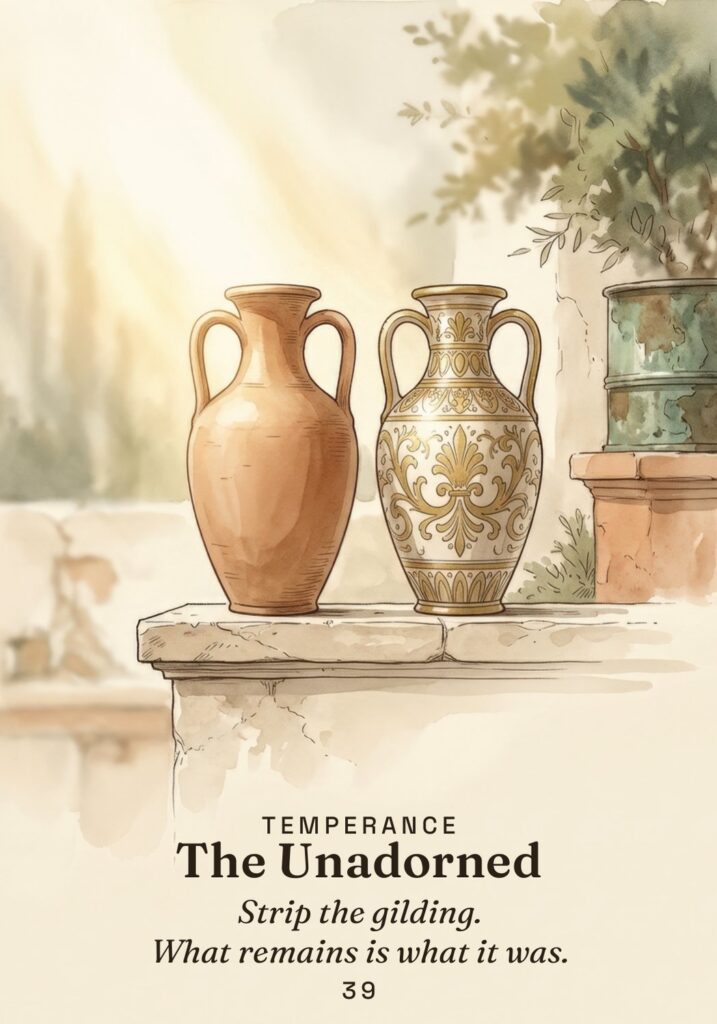
What The Unadorned means
Marcus practiced seeing things stripped: the feast is "the dead body of a fish, and this is the dead body of a bird or of a pig," the great vintage only "a little grape juice," the purple robe "some sheep's wool dyed with the blood of a shell-fish" (Meditations 6.13, tr. Long). Rude to the banquet, kind to you: strip the gilding from what owns you, and it lets go first.
In a reading, The Unadorned points at something that currently has a glow around it, and the glow is doing the deciding. The person wants the title, the device, the invitation to the thing, and when I ask why, the answer is a feeling rather than a fact. I read the card as a request for a plain description. What is the object, physically, when the lighting is turned off? A title is a line on a page and a different set of meetings. A gadget is glass and a battery. The card does not say the thing is worthless. It says the gilding was doing more of the wanting than the thing underneath it.
Where it goes wrong is stripping the shine so thoroughly that nothing is allowed to be loved. The person takes the practice and turns it on everything, the friendship, the garden, the music, until the world is nothing but dead fish and dyed wool and they are proud of seeing through it all. That is not clear sight, it is contempt wearing a plain robe. The card is aimed at what owns you, not at what you enjoy. The other failure is the reverse, doing the description once, nodding, and letting the glow back in before the sentence has ended, so the buying happens by reflex. Buying the thing after an honest look is not the failure. Buying it without one is.
I can see through a shine without despising the thing.
When The Unadorned appears in a reading
If you draw this card, describe the shining thing as if to someone who has never seen one and has no idea why anyone would want it. The exercise is harder than it sounds and often funny. Halfway through the plain description most people start laughing, or go quiet, and either response means the gilding has lifted a little. Then comes the real question: how much of your life does this still deserve? Not whether to want it. How much. The card is a measuring tool, not a prohibition, and the reading stays on the measurement.
My practice with the card is a single plain sentence written on paper, no adjectives allowed. The follower count becomes a number on a screen that changes. The invitation becomes an evening in a room with people. I read the sentence back and notice whether the pull is the same size. If writing the whole description feels like overkill, the smaller step is to say the plain name of the thing out loud once, without the brand or the title attached, and see what happens to the wanting. Often that is enough to put the thing back at its real size.
Beside The Leash, I read the pair as the two halves of training a want: see what it is, then make it wait. Beside First Impressions, the reading becomes about the story added to the fact, since gilding is a story a thing tells about itself. Where I keep The Unadorned distinct from Enough is the object. Enough looks at the whole inventory and asks if the count is complete. The Unadorned takes one glittering item and asks what it would be in a plain brown bag.
One small move on your side of the line
Find one thing you are about to buy or chase and write its plain description on the back of a receipt, then carry the receipt for a day before deciding.
The Unadorned in the Dichotomy Spread
The Stoic Oracle guidebook’s three-card spread is The Dichotomy Spread, for any situation that will not stop churning: a conflict, a waiting game, a decision that circles. Laid left to right, it sorts the situation along the one line the Stoics trusted: what is yours, what is not, and the next right act. In each position this card tends to say:
- What Is Yours. In the What Is Yours position, The Unadorned points at your own seeing, the choice to describe a thing plainly before the shine gets to vote.
- What Is Not. In the What Is Not position, it names the glow itself, the status, the packaging, the way other people look at the thing, none of which the object carries once the lights are off.
- The Next Right Act. As The Next Right Act, it asks for one plain-language description of whatever is glittering at you, and an honest answer to how much of your life it still deserves.
Journal prompts
- What in my life is mostly gilding, and what is under it?
- Which plain, ungilded thing do I love that needs no stripping?