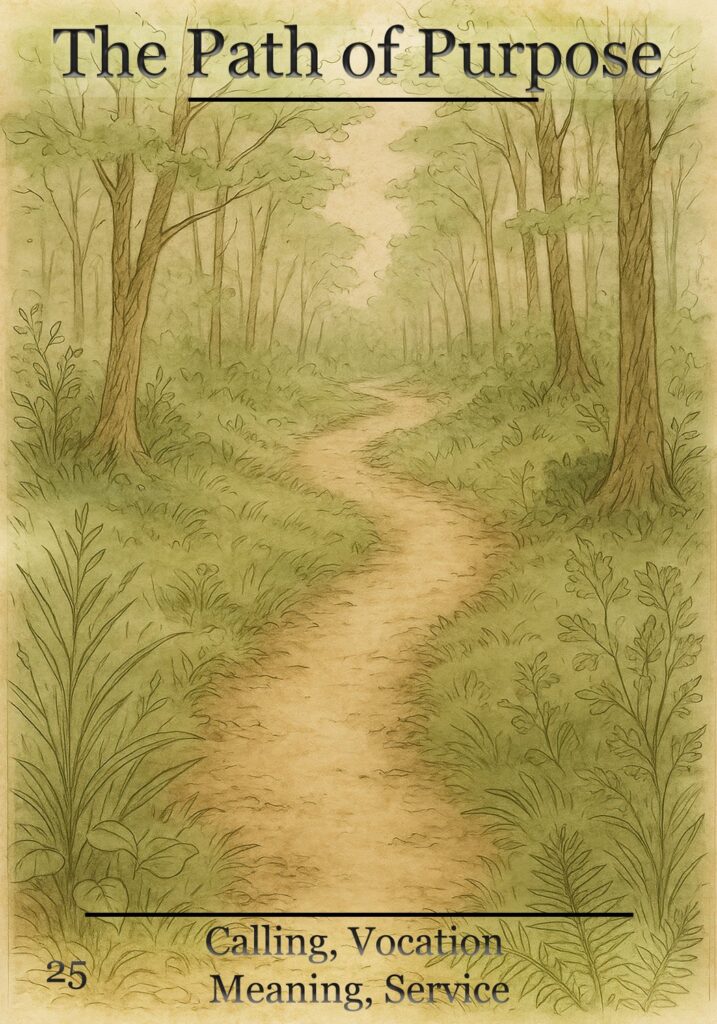
What The Path of Purpose means
This card represents finding your true work in the world; not just a job, but a vocation that aligns with your soul's calling. It encourages you to seek out and commit to work that nourishes your spirit and contributes to the greater good. It is a reminder that a life of purpose is its own reward.
The Path of Purpose tends to come up for people standing at a fork between work that pays and work that matters, or more often, people who suspect those two have drifted far apart. They may be good at their job and quietly miserable in it. They may be doing meaningful unpaid work in the margins and wondering whether it could take more room. I read the card as a direction, not a resignation letter, and a path is walked a step at a time. Thoreau wrote, "The mass of men lead lives of quiet desperation." On this card I hear that line as a description rather than an accusation: it is what happens when the path and the person stop facing the same way.
Where it goes wrong is believing a vocation has to be one dramatic leap, all or nothing, so the person waits years for the perfect moment to quit and never takes a smaller step. The opposite failure is turning purpose into a demand on everyone else: the job, the partner, the family are expected to rearrange themselves around the calling. Purpose also curdles when it becomes the person's whole identity, so a hard stretch at the work becomes a referendum on their worth. The card points toward meaningful work. It does not promise the path will be paid, easy, or visible to anyone else.
I am walking a path of purpose, and my work is a form of service and self-expression.
When The Path of Purpose appears in a reading
If you draw this card, begin by separating three things that tend to blur: the job, the work, and the calling. The job is what pays. The work is what you are actually good at doing. The calling is what you would keep doing if nobody noticed. In a reading I ask people to name all three out loud, and I listen for where they overlap. There is usually more overlap than they feared, and the card is pointing at widening it, not at burning the job down.
My practice with the card is a small, steady experiment rather than a leap. I pick one hour a week to do the calling directly: the writing, the teaching, the building, the volunteering, whatever it is. I treat that hour as an appointment and keep a short log of how it felt and what it produced. After two or three months the log tells me more than any amount of thinking: whether the calling still pulls, whether people respond to it, whether it could grow. If an hour a week is too much right now, I start with fifteen minutes and a library book.
Beside Marching to a New Beat, I read the pair as a calling that will not look like anyone else's career, and the card asks for the courage to let it look strange. Beside The Bean-Field, the pair says purpose grows through ordinary labor, not around it. Where I keep The Path of Purpose distinct from Where & What I Live For is that the second card asks what you value. This one asks where you will spend your working hours in service of those values.
One small deliberate act
Write down one task from your workday that already feels like real service to someone, and do a little more of it before the day ends.
The Path of Purpose in the Pond Spread
The Walden Oracle guidebook’s three-card spread is The Pond Spread, for any situation that looks one way from the outside and feels another underneath. The cards are laid in a vertical line like layers of water: the surface, the depths, and the bottom. In each layer this card tends to say:
- The Surface. The Path of Purpose shows a question about work, a role, or a commitment that looks practical but carries more weight than a paycheck.
- The Depths. It names a hunger to matter, often hidden under talk of salary, timing, and what other people expect.
- The Bottom. The card's truth is that purposeful work is walked in small steps, and the reward starts with the walking.
Journal prompts
- What does a "life of purpose" look like to me, and what is the next step I can take to get there?
- What kind of work would I do for free, and what does that tell me about my true calling?