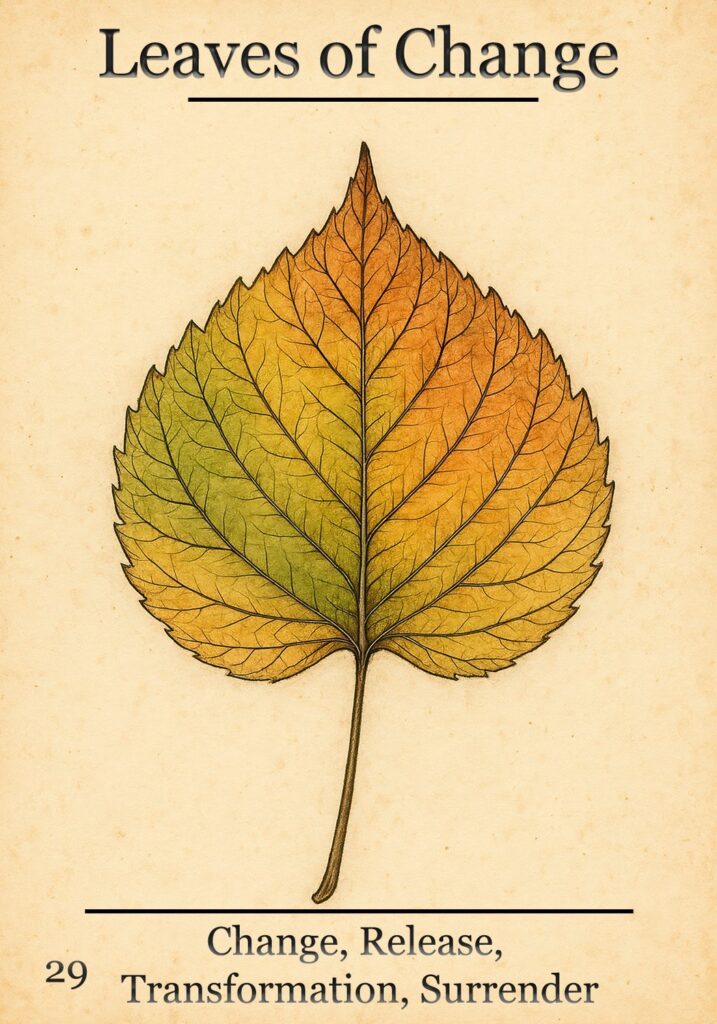
What Leaves of Change means
Like the changing colors of autumn leaves, this card represents the beauty of change and release. It is a reminder that letting go is a natural part of life's cycle. It asks you to release what no longer serves you: old beliefs, old habits, or old relationships, with grace and a trust in the natural process.
The person who draws Leaves of Change has usually already noticed that something is ending. It might be a role they have outgrown, a friendship that has turned into maintenance, a belief they keep defending out of habit more than conviction. The leaf on the card is caught halfway, green at the stem and gold at the edges, and that is often where the person is too: past the start of the change and not yet at the drop. In Walden, Thoreau wrote that "a man is rich in proportion to the number of things which he can afford to let alone," and I read this card through that kind of wealth. The question is less whether to release something than how to do it with some grace.
Where it goes wrong is dressing avoidance up as letting go. A hard conversation gets dropped and relabeled as acceptance; a commitment gets abandoned and described as surrender to the natural cycle. The other failure is the autumn purge done in one restless evening, every drawer emptied and every tie cut, followed by regret by spring. A tree does not shed in an afternoon. It lets go over weeks, one leaf at a time, and it keeps the branch. Release that leaves nothing standing is not grace, it is a mood with consequences.
I release what no longer serves me with grace, trusting in the natural cycle of transformation.
When Leaves of Change appears in a reading
When this card shows up, I ask what the person still does out of habit and how they feel the morning after doing it. Duty and desire sound different when people describe them. I listen for how often the word should comes up, and for the small pause before someone says they guess they still enjoy it. Usually one item comes up again and again across the conversation, and that repetition is where the card is pointing. I do not push for a decision in the reading itself. Naming the thing clearly is enough of a first move.
My practice with the card is to pick one thing, not a list, and release it in stages. First I stop adding to it: no new commitments, no new purchases, no fresh promises. Then I reduce it, fewer meetings, shorter visits, a smaller role. Last comes a clean ending with a sentence of thanks, said or written. With people, I often let the distance lengthen gently rather than announcing anything, unless the situation needs a clear word. With an old belief, I write it down along with the evidence it rested on, and put a date beside it, the way a leaf carries the date of its season.
Beside End of an Experiment, I read the pair as process and conclusion: Leaves of Change is the slow turning, and the other card is the morning the branch is bare. Beside The Pine Cone, the pair shows the two strategies a tree uses to get through cold months, dropping what it cannot carry and holding tight to what it needs. When both appear, I ask the person to sort their situation into those two piles before doing anything else.
One small deliberate act
Cancel, unsubscribe from, or hand back one thing you keep purely out of habit, then notice over the next few days whether anyone, including you, misses it.
Leaves of Change in the Pond Spread
The Walden Oracle guidebook’s three-card spread is The Pond Spread, for any situation that looks one way from the outside and feels another underneath. The cards are laid in a vertical line like layers of water: the surface, the depths, and the bottom. In each layer this card tends to say:
- The Surface. Leaves of Change shows a situation visibly in transition, colors turning, plans shifting, even if no one has said the word ending yet.
- The Depths. It names an attachment kept alive by habit or guilt, something the person stopped watering a while back and still carries around.
- The Bottom. The core lesson is that release can be gradual and kind, and that the branch survives the losing of its leaves.
Journal prompts
- What is one aspect of my life that is ready to be released, and how can I do so with kindness to myself?
- What can I learn from the way nature releases its leaves in the fall?