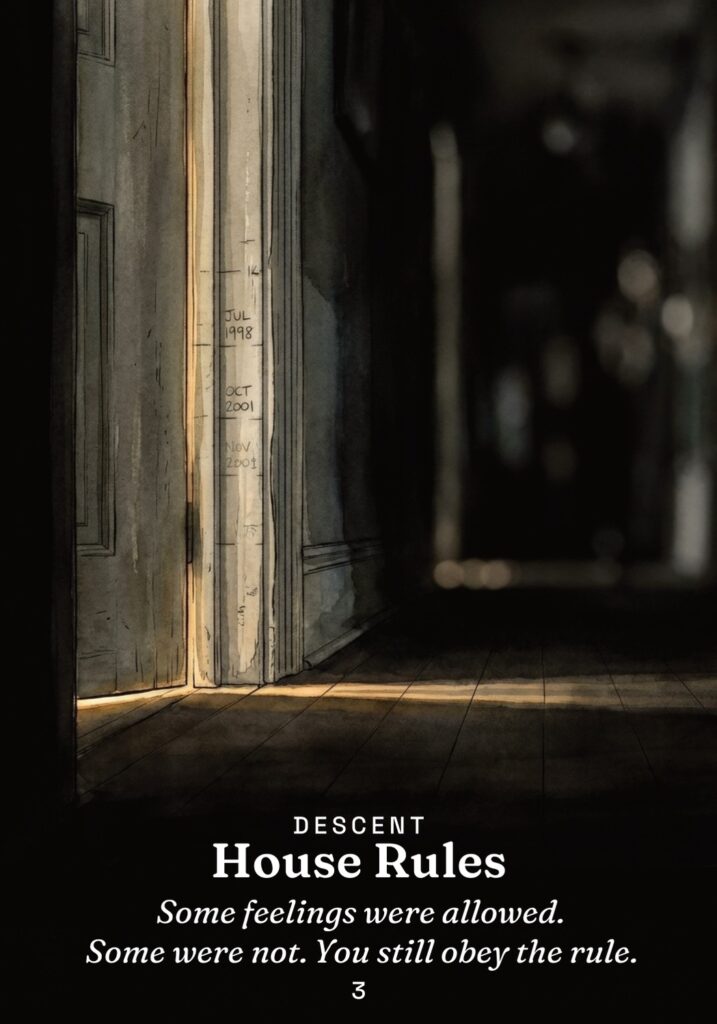
What House Rules means
Every family runs a quiet licensing system. Anger was fine at your house but tears were not. Or the reverse. Maybe ambition was welcome and need was embarrassing, or everything was permitted except being difficult. Nobody posted the rules anywhere. You learned them the way you learn a language: by being corrected. You have been out of that house for decades and you are still filing the paperwork.
This card lands in readings about a feeling I keep talking myself out of, and the tell is the phrase I use to dismiss it. "I am being dramatic." "That is not worth mentioning." "We are not like that." When I hear one of those in my own head, I know a rule is speaking, and the reading turns from the feeling to the rule. Whose was it? What did it cost to break, in the house where I learned it? The rule is rarely mine, and knowing that changes what obeying it feels like.
Where it goes wrong is blaming the household instead of retiring the rule. It is easy to spend a year cataloging what my family got wrong and never once ask whether I am still running their system. The card has no interest in the trial. It wants the rule found and then quietly taken off the books, and the people who wrote it may never know. A rule does not need its authors' consent to be retired.
I can notice a rule I never agreed to.
When House Rules appears in a reading
In a reading I use this card to find the rule behind the feeling. If a card earlier in the spread has named an emotion I keep dismissing, House Rules asks who taught me it was dismissible, and I listen for the family's exact phrasing. "We do not make a fuss." The phrase is the rule, and the rule was never mine.
The practice is to write the sentence the household would never have said out loud, and then find one place in the present where I am still enforcing it on myself, in a house those people will never enter. That is the retirement paperwork. It takes one instance, not a manifesto.
When it lands beside The Story You Inherited, I read the pair as the same inheritance at two scales: the single rule and the whole narrative it belongs to. Beside The Swallowed Word, the rule is usually the reason the word was swallowed, and the reading names both at once.
One small shadow-work move
Catch yourself apologizing for a feeling once today and finish the sentence without the apology.
House Rules in the Descent and Return spread
The Gold in the Dark guidebook’s three-card Descent and Return spread is the deck’s signature shadow work reading, for a pattern you have been circling for years rather than a fight you had on Tuesday. It names what you sent away, what keeping it buried has cost, and what is ready to come back. In each position this card tends to say:
- What Went Down. What went down was a feeling that was expensive at home. You learned its price and stopped ordering it.
- What It Cost. The cost is a rulebook you still consult, written by people who no longer get a vote.
- What Comes Back. What comes back is the feeling itself, licensed by you this time, in one room where nobody will fine you for it.
Journal prompts
- Which feeling was expensive in my family, and who paid for it?
- Where do I enforce a rule now that nobody would enforce on me?