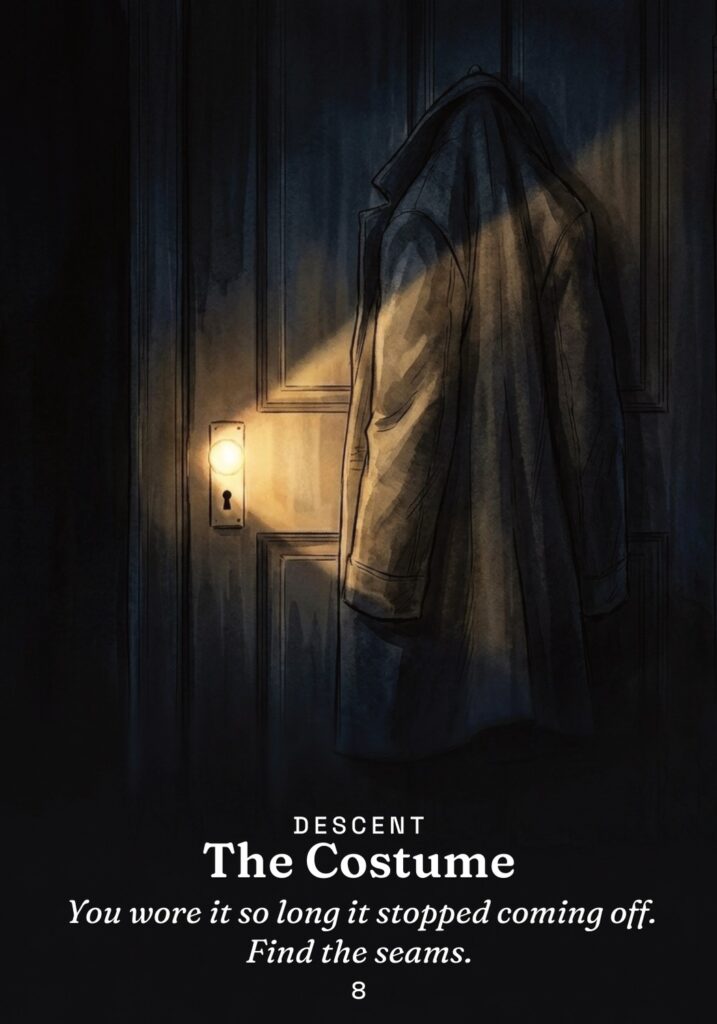
What The Costume means
The role worked. The capable one, the easy one, the funny one, the one who never needs anything. It got you liked, or left alone, or promoted, and there is no shame in that. Everyone wears something. The trouble starts when it stops coming off at night, when you cannot locate the difference between the part you play well and the person playing it.
In a reading this card is about a role that has stopped being optional. The capable one cannot ask for help. The easy one cannot object. The funny one cannot be sad in public. The reading is not against the role. It is against the seam disappearing, the point where I can no longer tell what I would do if nobody expected anything of me. The useful question is who first found this version of me convenient.
Where it goes wrong is tearing the role off in public and calling it honesty. The dramatic reveal, the sudden refusal, the speech at the dinner table about how nobody knows the real me. That is a second performance, louder than the first. Finding the seam is slow work, and it is done quietly, in rooms where the stakes are low enough that the costume can come off an inch without anyone needing to applaud.
I am not only the part I play well.
When The Costume appears in a reading
In a reading I list the things my reputation forbids, and that list is the reading. A person known for competence cannot be seen not knowing. A person known for ease cannot be seen objecting. The costume itself is not the problem. The problem is that its rules have quietly become mine.
The practice is one low-stakes room and one out-of-character move: say I do not know, decline something easy, admit I am tired. Then two observations, written separately. What I braced for. What actually happened. The gap between those two is usually the most reassuring thing on the page.
Beside One Face, I read the pair as a costume and the corridor between costumes, and the reading is about how many I am running. Beside The Understudy, the costume is the part I play well and the understudy is who has been waiting behind it.
One small shadow-work move
Ask one low-stakes question you could have figured out yourself, and let the answer arrive without proving you already knew it.
The Costume in the Descent and Return spread
The Gold in the Dark guidebook’s three-card Descent and Return spread is the deck’s signature shadow work reading, for a pattern you have been circling for years rather than a fight you had on Tuesday. It names what you sent away, what keeping it buried has cost, and what is ready to come back. In each position this card tends to say:
- What Went Down. What went down was whoever you were before the role got applause. Ask who first found the role useful.
- What It Cost. The cost is a set of things the role cannot ask for, and you have stopped asking for them too.
- What Comes Back. What comes back is the seam: the felt difference between the part and the person, which is where a costume comes off.
Journal prompts
- What does this role make impossible for me to ask for?
- Who first found this version of me useful?