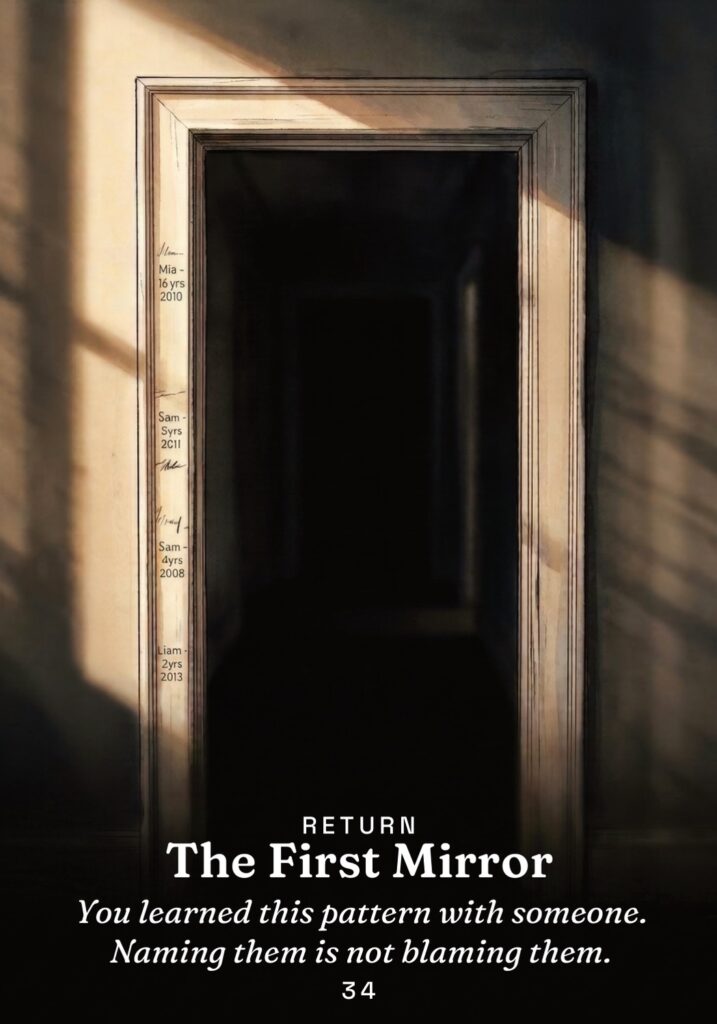
What The First Mirror means
You did not learn this pattern in the abstract. You learned it with a specific person, in a specific house, and their face is probably in the room every time it fires. Naming them is not the same as blaming them, and the distinction matters, because blame closes the inquiry and naming keeps it open. Most of them were running their own version of this, badly, with nobody there to name it for them.
This card arrives when a reading has found a pattern and wants to know where it started. The answer is a person, not a principle. Naming is not blaming, and the distinction is what lets me see the wider frame: what that person was probably managing at the time, badly, with nobody there to name it for them. The name stands, and no charge is attached to it. Shadow work that ends in a list of defendants has stopped early.
Where it goes wrong is turning the name into a permanent address for the blame. Once I know where the pattern came from, there is a temptation to send every future instance of it back to that address, and to stop looking at my own hands. The card resists this. The wider frame is not forgiveness and it is not required to be generous. It is what keeps the name from hardening into a verdict, because the pattern is mine now, wherever it began.
I can name where this began without filing charges.
When The First Mirror appears in a reading
In a reading this card asks for a name, and I give it. I learned to do this with a specific person in a specific house. The reading holds the name without a charge attached, and I watch for the moment the sentence tries to turn into an accusation, because that is where it stops being useful.
The practice is two paragraphs. The sentence with the name in it, and then, separately, what that person was probably managing at the time. Nobody is being excused in that second paragraph. It exists so that the name stays a starting point rather than a destination for every future complaint.
Beside Never Like Them, I read the pair as the person I learned the pattern from and the person I swore not to become, who are often the same person. Beside Both Things Are True, the harm and the context sit on one line without a verdict.
One small shadow-work move
Say the name of the person you learned this with, once, in a sentence that does not contain the word fault.
The First Mirror in the Descent and Return spread
The Gold in the Dark guidebook’s three-card Descent and Return spread is the deck’s signature shadow work reading, for a pattern you have been circling for years rather than a fight you had on Tuesday. It names what you sent away, what keeping it buried has cost, and what is ready to come back. In each position this card tends to say:
- What Went Down. What went down was learned with someone, in a house, at an age when you had no other model.
- What It Cost. The cost is their face in the room every time the pattern fires, and a charge you keep filing or keep withdrawing.
- What Comes Back. What comes back is the pattern as yours: named, framed, and finally available to work without a defendant.
Journal prompts
- Where did this begin, and what was happening in that house?
- What am I still doing to protect someone who is not here?