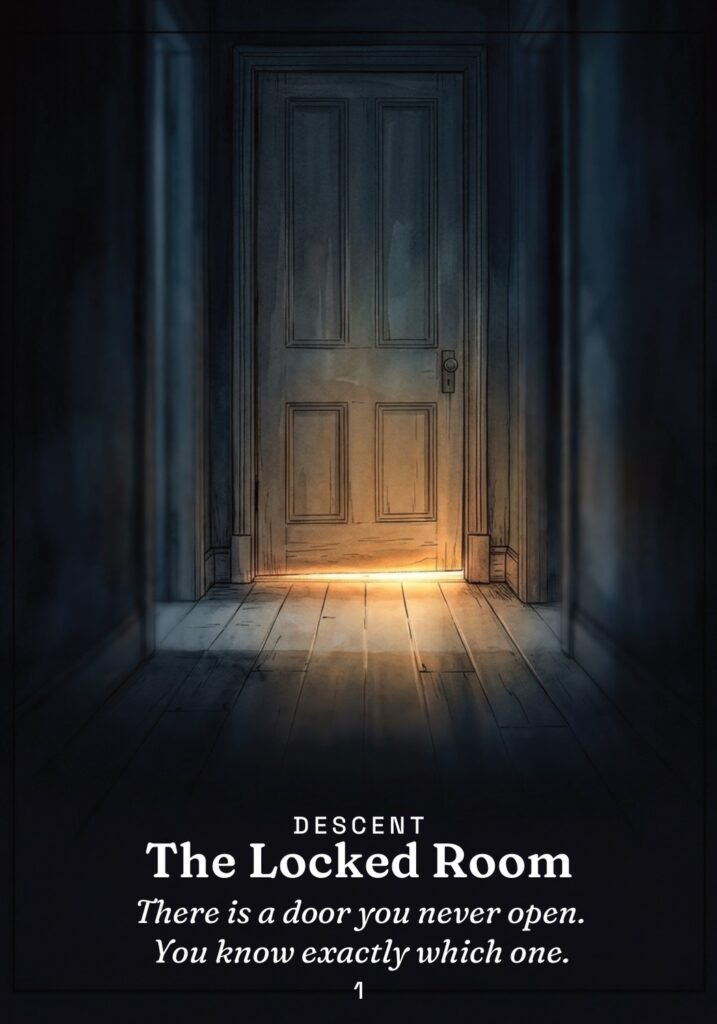
What The Locked Room means
Every house has one. You do not think about it, which is the point, and if someone asked what was in there you would answer too fast and change the subject. The door is not locked from outside. You put the lock on at an age when that was sensible, and you have maintained it ever since without once checking whether it is still needed.
In a reading this card is a location, not an accusation. It tends to arrive when I have been busy in a way that looks productive, and the busyness has a shape: it routes carefully around one subject. I do not need to know what is behind the door to read the card well. I only need to admit that my attention refuses to go somewhere, and that the refusal is old and practiced rather than random. I can usually name the door within a minute once I stop circling it.
Where it goes wrong is naming the door every year and never touching the handle. I know that move because it looks like self-awareness. Saying "I have a thing about my father" at dinner parties for a decade is not the same as standing in the hallway, and a lot of what passes for shadow work is exactly this: the announcement of the lock, repeated, in place of the work. The card is patient. It does not ask me to open anything today. It asks me to stop treating the announcement as the whole assignment.
I can stand outside the door without opening it yet.
When The Locked Room appears in a reading
When this card leads a reading, I do not go looking for the contents of the room. I go looking for the avoidance: which subject makes me change the topic fastest, and how practiced the change is. That practiced quality is the whole first read. It was built to end a conversation, and it has been doing its job for years.
The practice I use with it is to write the closing sentence down and then write what it is protecting, without opening the door at all. Locating the room is the assignment. People rush this card because it seems like a beginning, and it is, but a beginning that goes too fast produces a slammed door, not an opened one.
When it lands beside The Guard Dog, I read the pair as a door and the thing patrolling in front of it, and I address the patrol first. When it lands beside The Inventory, the reading is gentler: look at the hallway, not the room. Neither pairing is a command to go in.
One small shadow-work move
Say the name of the room out loud, once, to nobody, and then go make lunch.
The Locked Room in the Descent and Return spread
The Gold in the Dark guidebook’s three-card Descent and Return spread is the deck’s signature shadow work reading, for a pattern you have been circling for years rather than a fight you had on Tuesday. It names what you sent away, what keeping it buried has cost, and what is ready to come back. In each position this card tends to say:
- What Went Down. You sent away a whole subject, not just a feeling. Name the subject before you try to date it.
- What It Cost. The upkeep on a locked door is invisible and constant. Count what the avoidance has cost you in conversations you cut short.
- What Comes Back. What comes back is not the contents of the room. It is your ability to stand in the hallway without leaving.
Journal prompts
- What answer arrived before I finished reading the question?
- Roughly how old was I when the lock went on, and what was happening then?