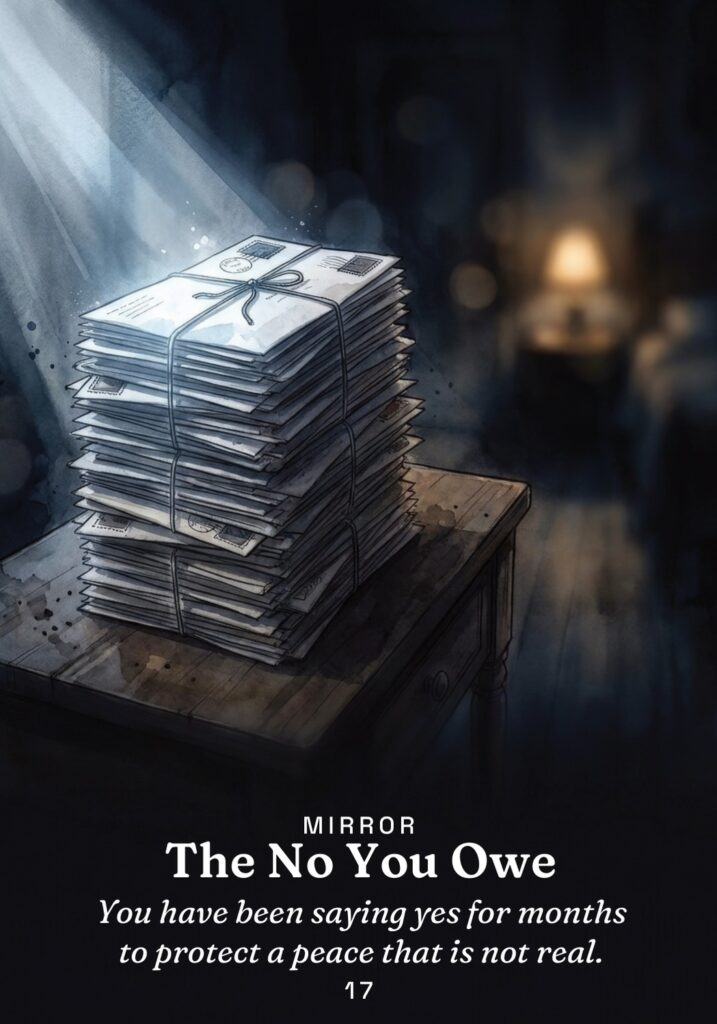
What The No You Owe means
You said yes months ago and you have been paying it off ever since. Not because you wanted to, but because the no felt more expensive than the yes, and because keeping the peace has become something you do reflexively, without checking the price. The peace you are protecting is not real peace. It is a debt you are servicing, and most of the people around you can feel it.
This card lands in readings about a commitment I resent, and it usually names one I have been calling loyalty. The reading is not about whether the other person deserves my yes. It is about the cost of the yes to me, paid in small daily installments without ever seeing the total. What I have been calling peace is a debt with a monthly payment, and the resentment leaks, whatever I think I am hiding.
Where it goes wrong is delivering it with six months of interest attached. A no that has been deferred for half a year does not arrive as a no. It arrives as an indictment, with a history lesson and a list of everything the other person should have noticed. The card wants the plain version, early, before the interest compounds. The explanations are where the no goes to die, and the interest is where the friendship does.
A no I mean is worth more than a yes I resent.
When The No You Owe appears in a reading
When this card appears in a reading, I go looking for the yes I am servicing. It is usually dressed as a virtue, loyalty or reliability or being the one who shows up. Then I ask what the peace it protects is actually made of. If the answer is my silence and somebody else's convenience, the card has found its subject.
The practice is the no written in one sentence with nothing attached, no because, no history, no apology. Even if I cannot say it yet. Having the exact sentence changes how the yes sits. I know what I am choosing when I choose it, and choosing is different from being owed.
Beside The Plain Sentence, I read the pair as the no and the way to say it without padding, and the reading becomes a rehearsal. Beside The Costume, the yes is usually part of a role, the easy one or the reliable one, and the no is out of character in a useful way.
One small shadow-work move
Decline one small thing today that you would normally absorb, with a single sentence and no reason given.
The No You Owe in the Descent and Return spread
The Gold in the Dark guidebook’s three-card Descent and Return spread is the deck’s signature shadow work reading, for a pattern you have been circling for years rather than a fight you had on Tuesday. It names what you sent away, what keeping it buried has cost, and what is ready to come back. In each position this card tends to say:
- What Went Down. What went down was your no. It felt more expensive than the yes at the time, so you paid the yes instead.
- What It Cost. The cost is a debt serviced monthly, in resentment, that the people around you can feel and cannot name.
- What Comes Back. What comes back is a no you mean, said early and plain, which is worth more to everyone than a yes you resent.
Journal prompts
- What am I afraid happens in the silence after a plain no?
- Where has my resentment already been leaking out instead?