8 Samhain Traditions for a Modern Hearth
These eight Samhain traditions bring old seasonal practices into one modern evening and one ordinary kitchen. None of them require a field, a bonfire, or anyone else’s permission.
The first year I marked Samhain on purpose, I did it badly. I had read too much, bought candles in three colors I did not need, and by nine o’clock I was standing in my kitchen feeling like I had thrown a party nobody came to.
What I remember is not the ritual. It is what happened after I gave up on it. I turned off the overhead light, put apple peels and cloves on the stove, and sat at the table while the house slowly began to smell like October.
That was the part that worked. It has been the part that works every year since.
What Is Samhain?
Samhain is a Gaelic festival marking the end of the harvest and the beginning of winter, traditionally observed around October 31 and November 1. It is the hinge of the year. The growing season is finished, the stores are in, and the dark half begins.
Samhain is not primarily a spooky festival. It is an agricultural one, centered on endings, preparation, remembrance, and the long winter ahead.
Some Samhain customs are well documented in Irish and Scottish folklore. Others are modern practices that feel older than they are. I have tried to distinguish between the two because I would rather offer something honest than something tidy.
1. Let the Hearth Go Cold, Then Light It Again
In Irish and Scottish folklore, Samhain is associated with fire. Communal bonfires were lit, and some accounts describe households allowing their hearth fires to die before carrying home a new flame for winter.
You almost certainly do not have a working hearth. That is fine. The practice is really about the deliberate pause between darkness and light.
Turn off every light in the room. Sit in the dark for a minute longer than feels comfortable. Then light one candle and leave it as the only light for the evening.
The dark part is the tradition. Do not skip it to get to the pretty part.
2. Set a Place for Someone Who Is Not Coming
The best-known version of this Samhain tradition is the silent supper, sometimes called a dumb supper: a meal eaten without speaking, with a place set for the dead.
The formal silent supper practiced today is largely a modern revival. However, the older custom of leaving food for the dead around this time of year does appear in the folk record.
For a simpler version, place one extra plate at your table or set a glass at the end of the counter. You do not have to eat in silence or explain it to anyone else.
Say the person’s name aloud when you set it down. That is the part that does the work.
3. Put the Last of It Away
Samhain marked the final gathering. What was left in the field came in, and what came in had to last.
You may not be preserving a harvest, but everyone has a modern version of this work. Cut back the garden. Put away the summer clothes. Sort the pantry so you know what you actually have.
Choose one task and do it slowly, with the radio off. It is the least mystical practice on this list and often the one that most clearly marks the change of season.
4. Carve a Turnip Lantern
Before pumpkins, there were turnips. Carved turnip and beet lanterns are documented in Ireland and Scotland. They were hollowed out, lit with an ember, placed in windows, or carried along the road.
They are much harder to carve than pumpkins, and they look considerably stranger when finished. That is part of their appeal.
For one Samhain tradition that feels genuinely old, buy a turnip, ruin a knife, and put the finished lantern in the window.
5. Build a Small Samhain Altar
A Samhain altar does not need to be formal. Use a windowsill, a shelf, or the corner of a dresser, somewhere that can remain undisturbed for a week or two.
A simple altar might include:
- Something from the last of the garden, representing the season that has ended
- A photograph or object belonging to someone who died
- One candle, left unlit until Samhain evening
- A written note naming something you do not want to carry into winter
Four things are plenty. An altar that takes an hour to build can quickly become something you maintain rather than something you use.
For more guidance, my altar starter kit offers a longer walkthrough of the basics.
6. Make a Samhain Simmer Pot
The simmer pot is a modern Samhain practice, and I am not going to pretend otherwise. It has become popular because it works.
Place a pot of water over the lowest heat and add whatever smells like autumn to you:
- Apple peels and cores
- A cinnamon stick
- Cloves
- Orange rind
- Rosemary
- A bay leaf
Keep the water topped up so the pot does not boil dry, and let it simmer for a couple of hours.
A simmer pot changes the air in the house, which changes how the evening feels. That is much of what ritual is meant to do. Use what you already have, especially anything going soft in the fruit bowl.
7. Walk the Boundary of Your Home
Samhain is a threshold festival. It marks the boundary between the two halves of the year, so boundaries naturally sit near its center.
Walk yours. Circle the house, follow the edge of the garden, or walk once around the block. Go at dusk and move slowly.
Notice the actual edges of the place where you live, which you probably stopped seeing soon after you moved in.
You may say something at each corner, but you do not have to. The attention itself is the practice.
8. Write What the Year Took and Left
Old Samhain and Halloween customs included many forms of divination: apple peels, hazelnuts in the fire, and fortune-telling games described by Robert Burns in the eighteenth century.
I do not work that way, and the oracle decks I make are not designed to predict the future. They offer a question, pattern, or phrase, and then it is your turn to respond.
That is why the version I keep is a page, not a prophecy. Sit at the table with one candle burning and divide the page into two columns:
What this year took from me
What it left me with
Be specific, and be unkind to yourself only when it is accurate. The first column is usually easier. The second is often longer, which is the reason to write both.
For more structure, try journaling with an oracle deck. A card pulled before you begin can name the thread faster than staring at a blank page.
You Do Not Need All Eight Samhain Traditions
Pick two. Genuinely, pick two.
The easiest way to spoil an evening like this is to turn it into a checklist. One candle and one empty place setting can be a complete Samhain ritual. So can a simmer pot and a walk at dusk.
These traditions were not created for novelty. At the end of the harvest, people paused, marked the turning of the year, and acknowledged what they were carrying into the dark.
That still works. It works in a rented kitchen with the overhead light off just as well as it ever worked in a field.
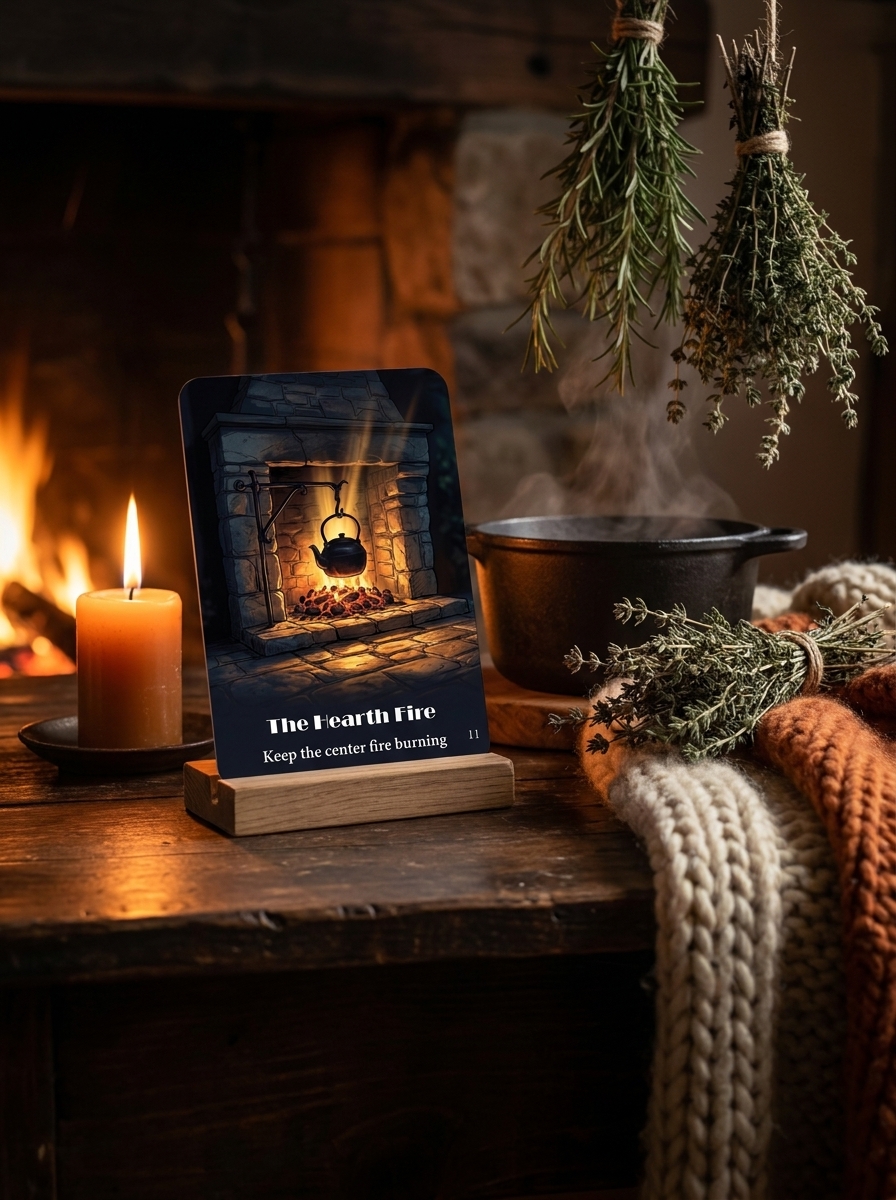
For the folk-practice side of Samhain, the deck I keep on the table throughout the dark half is the Hearth & Hedge Oracle. It is built around hearth, land, threshold, and witness, the four things this night is actually about.
Zara