Settling In as the Light Shortens: An Equinox Reading on the Evolutionary Ladder
The equinox is the one evening the light is balanced. Your nervous system is asked to find that balance every evening after it.
Last week, early September, I reached for the lamp before dinner for the first time since spring. I noticed it the way you notice a step that is not where your foot expected it.
By half past eight I was on the couch with my phone, and I would have told you I was resting. I was not resting. I was gone. The next morning my list had the word “urgent” on it four times, and none of them were true.
That is the whole reason I read three cards together instead of one. A single card tells you what state you are in. Three can show you how you got there and which way is out.
The Vagal Compass is the deck I built around the vagus nerve, that long wandering line of communication between brain and body. It works the way every deck I make works: as a mirror, not a forecast. Nothing here predicts anything. It hands you a question and a pattern, and the pattern is yours to recognize.
The layout: a three-card equinox spread
This is the guidebook’s own three-card spread, The Evolutionary Ladder. It draws on the Jacksonian idea of dissolution, used in Polyvagal Theory as a way of describing how the nervous system may move away from states of connection and toward older defensive strategies under stress.
Shuffle and draw three cards, left to right. Each position asks its own question:
- The Root (Dorsal Vagal): What ancient immobilization or shutdown energy is currently present?
- The Catalyst (Sympathetic): What is mobilizing my energy or triggering a “fight-or-flight” response?
- The Horizon (Ventral Vagal): What is the path back to social engagement, safety, and connection?
The order is the point. In this model, the ladder moves from immobilization through mobilization toward connection and calm, and you read it from the bottom rung. You cannot find the way back up until you have admitted where you are standing.
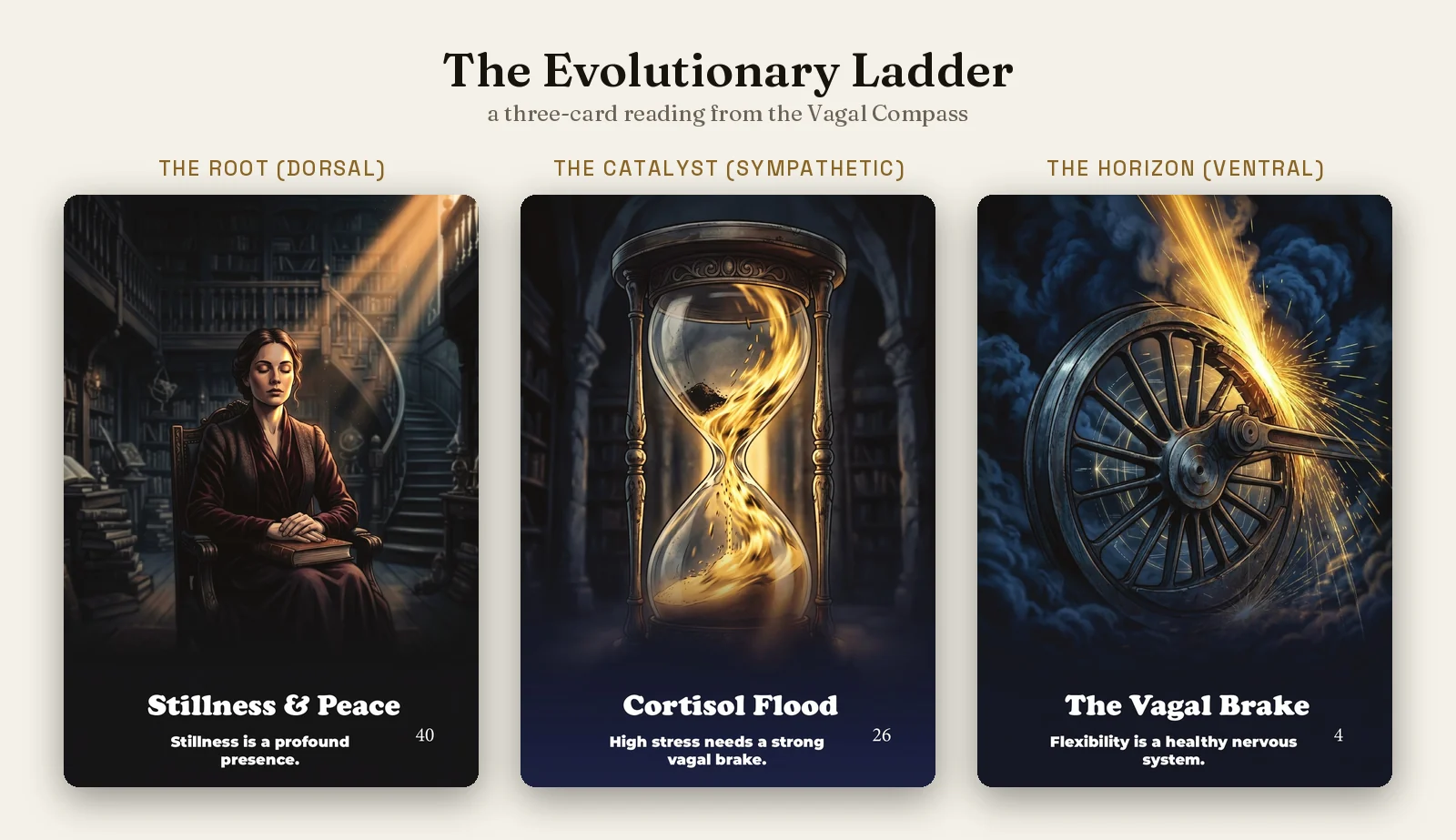
Position 1 · The Root (Dorsal Vagal)
Stillness & Peace
Stillness · Presence · Peace · Quiet · Card 40 of 44
Restorative stillness blends dorsal settling with ventral safety. It allows the body to do deep repair work without slipping into a defensive shutdown state.
I expected a harder card here. The Root asks what shutdown energy is present, and I was braced for Dorsal Collapse.
Instead, the deck handed me the gentler version of the same pull and made me look at the difference.
The couch was not wrong. The body wants more stillness as the dark comes in, and that can be repair, not failure. What was wrong was the phone in my hand. Stillness with a screen is not always rest. For me that night, it was hiding with the lights on.
If you draw Stillness & Peace at the Root, the question is not whether you are slowing down. It is whether you are resting or disappearing.
Its affirmation: “In stillness, I find my deepest strength.”
Position 2 · The Catalyst (Sympathetic)
Cortisol Flood
Stress · Cortisol · Regulation · The Vagal Brake · Card 26 of 44
The vagus nerve helps turn down the body’s HPA stress response after a challenge. When vagal tone is low, cortisol can stay elevated too long and add to inflammation and wear on the brain and body.
Here was my morning list.
Four things marked urgent. A fall restock, two emails, a page I had been meaning to fix since July. Not one of them was an emergency.
They felt like emergencies because I had spent the evening flat without ever feeling truly settled. Whatever charge was left over came with me into the morning and landed on the list.
That is what the Catalyst showed me. The rush was not really coming from the work. It was coming from a body that had never quite come down the night before.
If Cortisol Flood turns up as your Catalyst, ask which of your emergencies are events and which are habits.
Its affirmation: “I choose peace over the rush of stress.”
Position 3 · The Horizon (Ventral Vagal)
The Vagal Brake
Regulation · Flexibility · Calming · The Vagal Brake · Card 4 of 44
The myelinated ventral vagus works like a functional brake on the heart’s pacemaker. It helps your body shift quickly and smoothly between activation and calm.
Read the essence line on the middle card again: high stress needs a strong vagal brake. The deck answered its own question.
The Horizon is not a place.
I had been treating balance like the equinox, one still point I could stand on if I got the evening right. This card gave me a better image. Balance is a brake. It is the ability to go up and come back down, on purpose, without getting stranded at either end.
The practice printed on this card is one minute of vigorous movement followed by two minutes of slow, deep exhales. I did it in the kitchen that evening, feeling foolish, and then I sat down without the phone.
That is all.
I am not going to tell you I have a new evening routine, because I do not know that yet.
If The Vagal Brake is your Horizon, the way back may not be more stillness or more effort. It may be reminding your body, once, that it can move between the two.
Its affirmation: “I can move through stress and return to calm with ease.”
Reading the three together
One line runs through all three cards: I was mistaking withdrawal for rest. I was slowing down without actually settling, and the next morning that unfinished activation came out as urgency. The way out was not a better list or another hour on the couch. It was a better way to move between the two.
The sequence matters because each card changes the meaning of the next. The Root named the pull I was in. The Catalyst showed me what followed it the next morning. The Horizon offered the mechanism between them, and it was the same mechanism the middle card had already pointed toward.
The arc is settle, surge, return.
The equinox gives us one brief image of balance. After it, the dark keeps coming, a few minutes at a time. The nervous system does not get one balanced day it can keep.
It gets the practice of returning.
And that is the season ahead.
Lay the equinox oracle spread for yourself
Your three cards will not be mine, and your Root may be a far harder card than Stillness & Peace. The point is the shape.
The spread works with any oracle deck you own. I used the Vagal Compass because its language is built for this. Copy the positions into your journal and draw:
- The Root (Dorsal Vagal): What is the difference between “hiding” and “resting” for me?
- The Catalyst (Sympathetic): What “emergencies” in my life are actually just high-cortisol habits?
- The Horizon (Ventral Vagal): What helps me “hit the brakes” when I feel anxious?
Those prompts come straight from the guidebook that ships with the deck. Answer in your own voice, not the deck’s.
And lay it on the evening of the twenty-second if you can, with the lamp on.
If you want another spread to lay, there are more in the spread library, each with a worked example and a free reading tool that lays it for you.
Zara