Hearing Yourself Again: A Three-Card Spread for Too Much Noise
For the weeks when everyone has something to say to you except you.
A spread is just a set of questions laid side by side. That is its quiet power. One card hands you a meaning; three in a row hand you a story, because each card answers a different question and the answers have to live together. I built this spread after catching myself refreshing three apps before I had finished my first cup of tea, looking for something none of them had. It is for a very modern ailment: too many inputs, too little signal. It walks you from the noise you are swimming in, through the quiet you keep postponing, to the one voice you have stopped being able to hear. Yours.
I laid it with the Walden Oracle, the deck I built from Thoreau’s experiment in subtraction at the pond, and the one I reach for when my own head gets crowded. Like every deck I make, it is a mirror, not a crystal ball. The cards will not tell you what happens next. They hand you a question shaped like your own life and wait, patiently, while you answer it.
The layout: a 3-card hearing-yourself spread
Shuffle, and draw 3 cards, left to right. Each position asks its own question:
- The Noise: What is crowding me out?
- The Quiet: What would stepping back make possible?
- The Voice: What am I meant to hear?
The order is the whole method. You cannot skip to the third question; the voice only becomes audible after you have named the noise and chosen the quiet. Read left to right, the spread turns down the volume one card at a time.
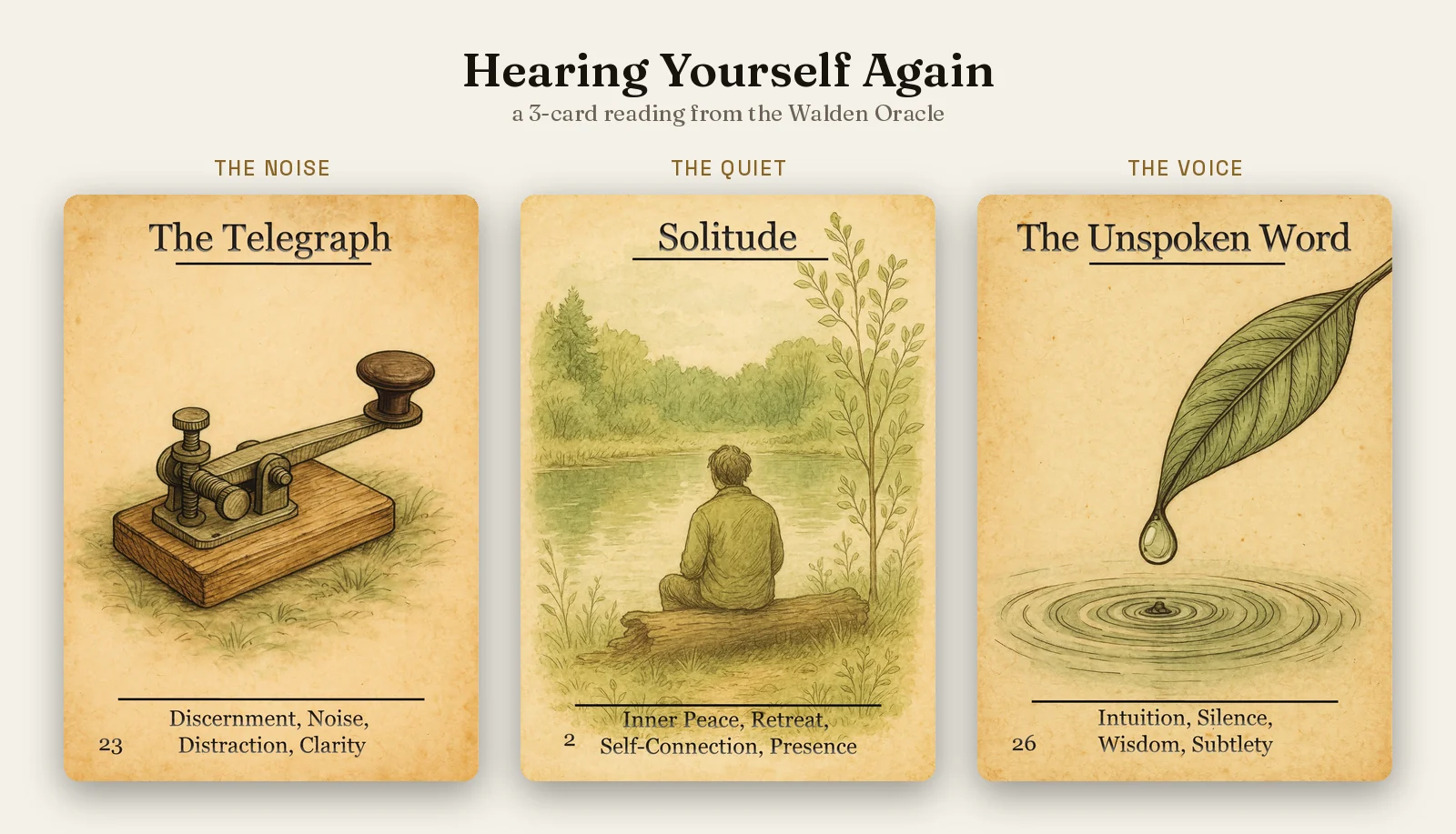
Position 1 · The Noise
The Telegraph
Discernment · Noise · Distraction · Clarity
Thoreau famously noted that the telegraph was a “hurry of letters,” a communication that often lacked true meaning. This card is a warning about the distractions in our wired world. It asks you to discern what is truly important from what is merely a “hurry” and to find moments of quiet to listen to your own inner voice.
In the first position, The Telegraph does the bravest thing a card can do: it names the problem without flattering it. The noise in your life is not urgent, it is only fast. Feeds, inboxes, other people’s opinions arriving at the speed of light and carrying almost nothing. Sitting in The Noise position, this card asks you to stop calling your distractions “staying informed” and to admit how much of what reaches you each day would not be missed. Discernment is the keyword to hold: not less input for its own sake, but a sorting of message from hurry.
Its affirmation: “I hear the message and ignore the noise.”
Position 2 · The Quiet
Solitude
Inner Peace · Retreat · Self-Connection · Presence
True solitude is not loneliness; it is an active choice to be present with oneself and the natural world. This card invites you to seek moments of quiet reflection and deep self-connection. It suggests that by stepping away from the noise of others, you can hear the wisdom of your own soul.
Here is the turn. In The Quiet position, Solitude reframes what stepping back actually is: not deprivation, not hiding, but an appointment you keep with yourself. The card is careful to separate solitude from loneliness, and that distinction matters most for people who avoid quiet precisely because they fear what it might feel like. Placed after The Telegraph, it answers the first card directly: the antidote to the hurry of letters is not a better filter, it is a room the letters cannot reach. Even a short one. Even twenty minutes.
Its affirmation: “I am never truly alone when I am with myself.”
Position 3 · The Voice
The Unspoken Word
Intuition · Silence · Wisdom · Subtlety
Thoreau believed in the power of a single, true thought. This card is a reminder that your most profound truths do not need to be shouted. It is a call to listen for the quiet, subtle messages from your intuition, which are often more powerful than the loudest, most insistent voices from the outside world.
And this is what the quiet was for. In The Voice position, The Unspoken Word tells you what you will find once the volume drops: not a revelation, not a thunderclap, but a small steady knowing that has been there the whole time, speaking at a volume the telegraph drowned out. Notice that the card does not promise a new answer. It promises the one you already have. If something surfaces in your first quiet hour that you have been half-thinking for months, that is not a coincidence. That is the signal.
Its affirmation: “I trust the quiet wisdom of my own intuition.”
Reading the 3 together
Read as one story, the line through these cards is simple: the voice you are straining to hear is not missing, it is being talked over, and quiet is the only instrument that can pick it up.
The sequence matters because each card makes the next one possible. The Telegraph gives you permission to stop listening to everything; Solitude gives the silence a shape you can actually live in; The Unspoken Word is what the silence was protecting. Three moves, one breath each: name the noise, choose the quiet, trust the voice.
Lay the inner voice spread for yourself
The spread works with any oracle deck you own; I used the Walden Oracle because its language is built for this. Copy the positions into your journal and draw:
- The Noise: What “hurry of letters” (unnecessary emails, social media feeds, or mental chatter) is distracting me from what’s important?
- The Quiet: How can I intentionally carve out time for solitude in my daily or weekly routine?
- The Voice: What is the “unspoken word” that my intuition has been trying to tell me lately?
Those prompts come straight from the guidebook that ships with the deck. Answer in your own voice, not the deck’s.
If you want another spread to lay, there are more in the spread library, each with a worked example and a free reading tool that lays it for you.
Zara