Quiet the Spiral: A Three-Card Reframe for a Racing Mind
When your thoughts start feeding themselves, three cards can turn the spin cycle back into a thought you can actually hold.
Last week I caught myself rereading the same worried email four times, and each pass added a new worst case my mind had invented in the gap. I know that loop. My thoughts had stopped giving me information and started feeding themselves. So I did the one thing that reliably breaks it: I put the phone down, shuffled a deck, and drew three cards to interrupt the story long enough to see it. A spread is not three separate fortunes lined up in a row. It is one movement read across three cards, and reading them together is exactly what turns a spin cycle back into a single thought you can hold in your hand. I want to walk you through that spread, so you can lay it for yourself the next time your own thoughts start feeding themselves.
The deck I reached for was the Cognitive Reappraisal Oracle, the one I built around a single quiet idea: the feeling changes when the framing changes. These are mirror cards, not fortune tellers. They do not predict what happens next. They hand back the pattern you are already caught in, so you can choose your next thought on purpose instead of by reflex.
The layout: a three-card reframe spread
Shuffle, and draw three cards, left to right. Each position asks its own question:
- The Pause: What lets me interrupt the momentum?
- The Balcony: What do I see when I stop standing inside it?
- The Rewrite: What truer story can I tell?
The order is the whole method. You cannot reframe a thought while you are still spinning inside it, and you cannot see it clearly until you have slowed down enough to look. Pause first, gain a little height second, and only then pick up the pen.
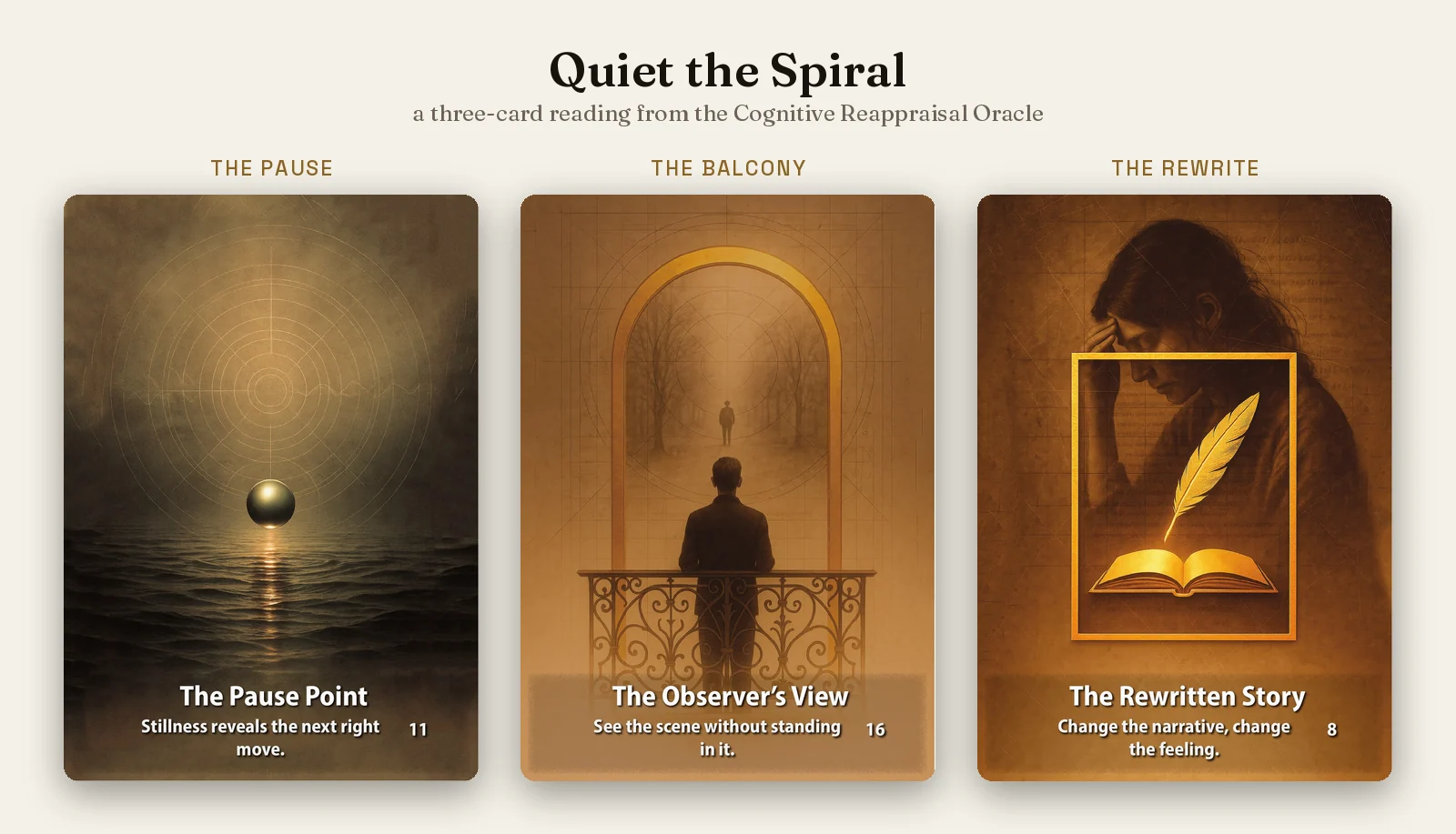
Position 1 · The Pause
The Pause Point
Pausing · Stillness · Emotional Regulation · Wise Choice
A pause interrupts emotional momentum and restores access to rational choice. The nervous system’s intensity softens when awareness replaces urgency. This stillness protects relationships and clarity, proving that waiting is an act of wisdom, not delay. Every breath becomes an anchor back to agency.
In this first position, the card is not asking you to fix anything yet. It is asking you to stop adding. A spiral runs on momentum, and every extra thought is fuel, so the single most useful move is to set one deliberate breath between the feeling and the response. That gap is small, but it is where your choices live again. You are not pausing to escape the moment, you are pausing to rejoin it.
Its affirmation: “I act from pause, not pressure.”
Position 2 · The Balcony
The Observer’s View
Detachment · Observer Stance · Clarity · Objectivity
Detachment restores clarity. Observing your experience as if from the balcony lowers emotional intensity and re-engages reasoning. This shift activates the brain’s monitoring systems that calm the threat response and steady perspective. Seeing instead of absorbing allows empathy and objectivity to coexist, revealing proportion where chaos once ruled.
Once the momentum slows, this card offers height. From inside a spiral every thought feels like fact, but described from the balcony the same scene shrinks back to what is actually happening. Notice the shift the card names: you can watch a feeling without becoming it. Say the plain facts the way a neutral narrator would, and the emotional charge starts to drain out of them. This is the position where a problem stops being your whole sky and becomes one weather system passing through it.
Its affirmation: “I observe with kindness and clarity.”
Position 3 · The Rewrite
The Rewritten Story
Rewriting the Narrative · Reframing · Self-Talk · Identity
The stories you tell yourself create emotional reality. When narrative changes, so does experience. Rewriting a self-defeating story engages the brain’s language and regulation systems, replacing helplessness with coherence. By editing the internal script, emotion transforms from burden into understanding, and identity becomes aligned with truth.
Now, with room to think, you get to choose the story. The spiral was a story too, just an old and unkind one you were telling on autopilot. This card is the turn from watching to authoring: you find the recurring line that limits your peace and revise it toward something truer, not falsely bright, just fairer. The feeling follows the framing, so a kinder script is not denial, it is a more accurate account. You end the reading holding the pen instead of the panic.
Its affirmation: “I am the author of new meaning.”
Reading the three together
Read straight across, the spread is one instruction: slow the thought down, step back from it, then say it better. The Pause Point buys you the half second the other two cards need. The Observer’s View turns that half second into distance. The Rewritten Story spends that distance on a fairer account of what is actually happening.
Nothing here erases the hard thing. The spread simply moves you from being carried by the story to writing it, and that is the whole arc in three words: pause, witness, rewrite.
Lay the overthinking spread for yourself
The spread works with any oracle deck you own; I used the Cognitive Reappraisal Oracle because its language is built for this. Copy the positions into your journal and draw:
- The Pause: What situations invite me to pause more often?
- The Balcony: What changes when I view this as an observer rather than a participant?
- The Rewrite: What truer, kinder version can I begin telling?
Those prompts come straight from the guidebook that ships with the deck. Answer in your own voice, not the deck’s.
If you want another spread to lay, there are more in the spread library, each with a worked example and a free reading tool that lays it for you.
Zara