The Stoic Evening Review: A 3-Card Spread for the Day You Keep Replaying
Seneca’s three evening questions as a 3-card oracle spread, laid on a night I could not stop rereading one text message.
At 5:40 on a Thursday, a friend texted that she could not make dinner. No reason, just “So sorry, can’t tonight.” I wrote back two words.
“Sure. Another time.”
Correctly punctuated, and cold enough to frost a window.
That night I tried the oldest end-of-day practice I know, the Stoic evening review, with three cards instead of a blank page.
By ten o’clock, I had reread that exchange more times than I want to admit. So I turned off every light but the desk lamp and laid three cards from the deck I built from Marcus Aurelius, Seneca, Epictetus, and the other Stoic voices I kept returning to.
The Stoic Oracle is a mirror, not a forecast. It does not tell you how a friendship turns out. It asks better questions than the ones you ask yourself at 10 p.m.
How to do a Stoic evening review with three cards
The Evening Review is the deck’s own spread, from its guidebook, which describes where it comes from: “Seneca ended his days this way: the lamp out, the house quiet, the day called back before him like a witness.” Seneca describes the habit himself in On Anger, Book III. Draw three cards at night, left to right, and let each one ask its question:
- What Went Well: Somewhere today you acted with more wisdom, courage, fairness, or restraint than you had to. Find it and name it.
- Where I Strayed: One moment you would take back. Name it plainly, without punishing yourself for it. Ask what it assumed, and what you will try instead.
- What I Leave Here: What does not come to bed: the replay, the grudge, the unfinished argument. Say it, set it down, sleep.
The order matters. You start with what went right, so the stray moment gets judged against a whole day instead of standing in for it. The guidebook puts it more simply: “You are the judge, not the prosecutor.”
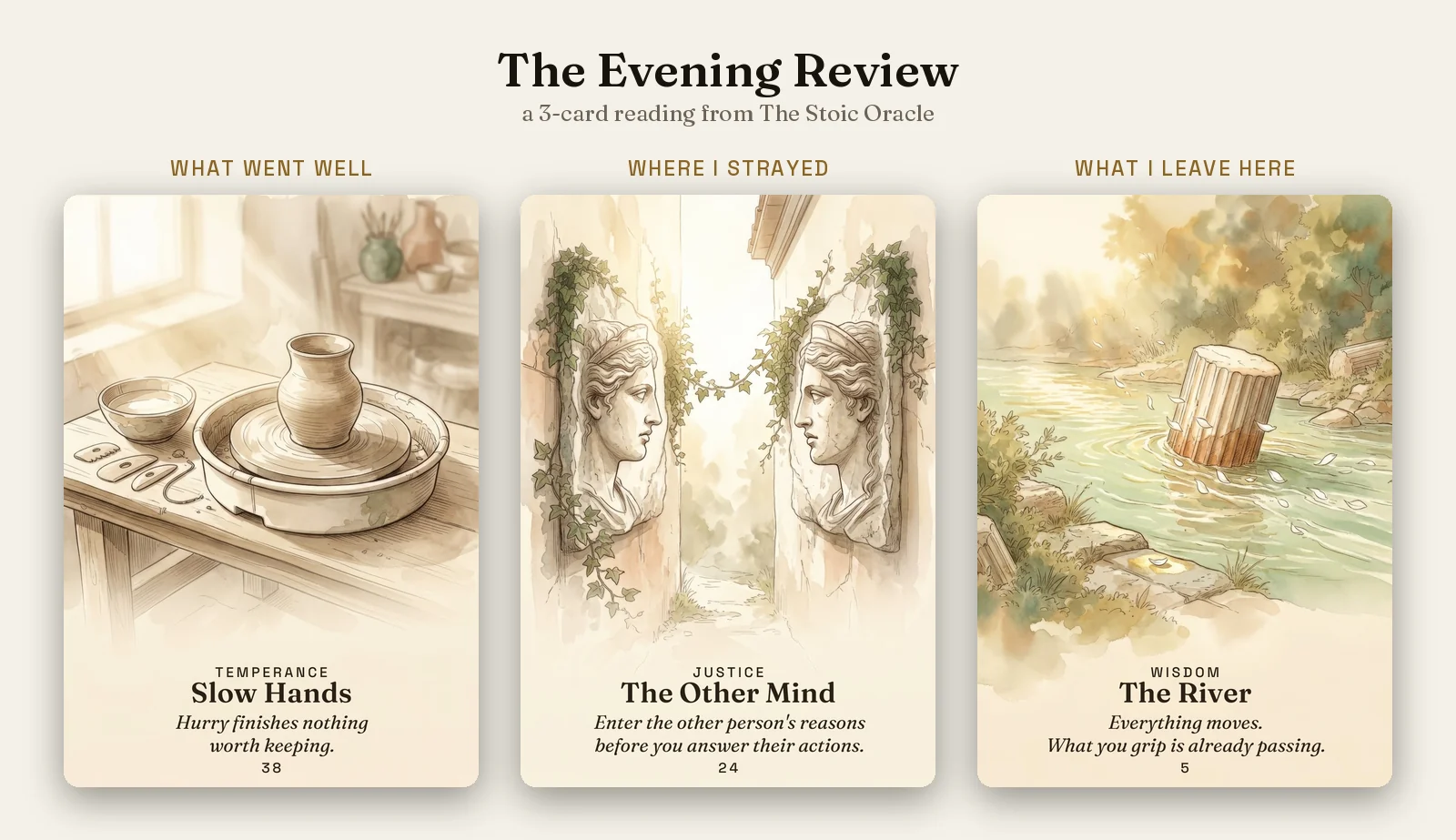
Position 1 · What Went Well
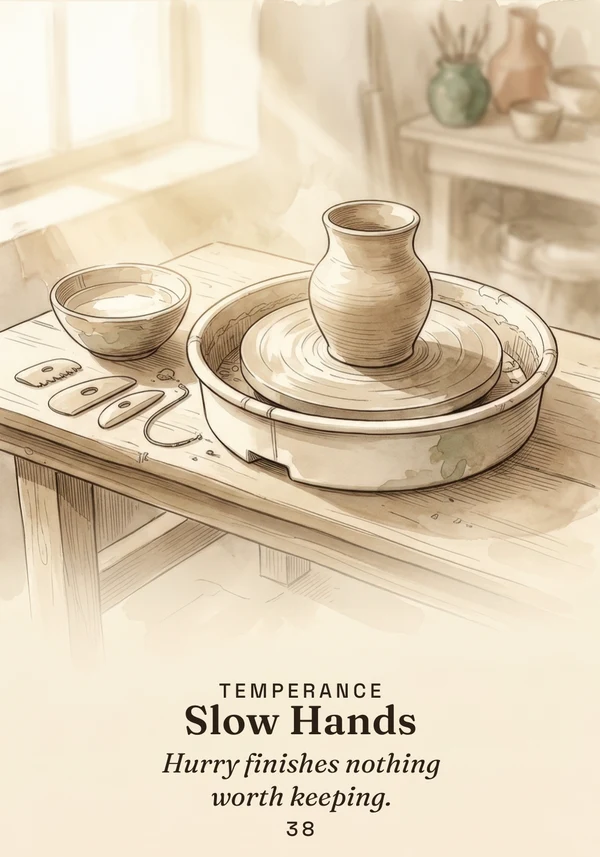
Slow Hands
Suit IV: Temperance · Card 38 of 40
The Stoics distrusted hurry because hurry is a judgment: that the next moment matters more than this one, that speed will outrun fear, that busyness is proof of worth. None of it survives the Check. Work done with slow hands, one thing at a time and finished before the next is touched, can be faster by the only clock that counts: it does not have to be done twice.
I almost skipped past this one. Nothing heroic happened that day.
But that afternoon I had spent two hours on a single guidebook page. One page, no email, no second tab. It was the only thing I made all day that I did not have to redo.
The position asks where you showed more restraint than you had to. That counted.
If you draw Slow Hands here, look for the one task today you did once, and did well.
Its affirmation: “I move at the speed of doing it once.”
Position 2 · Where I Strayed
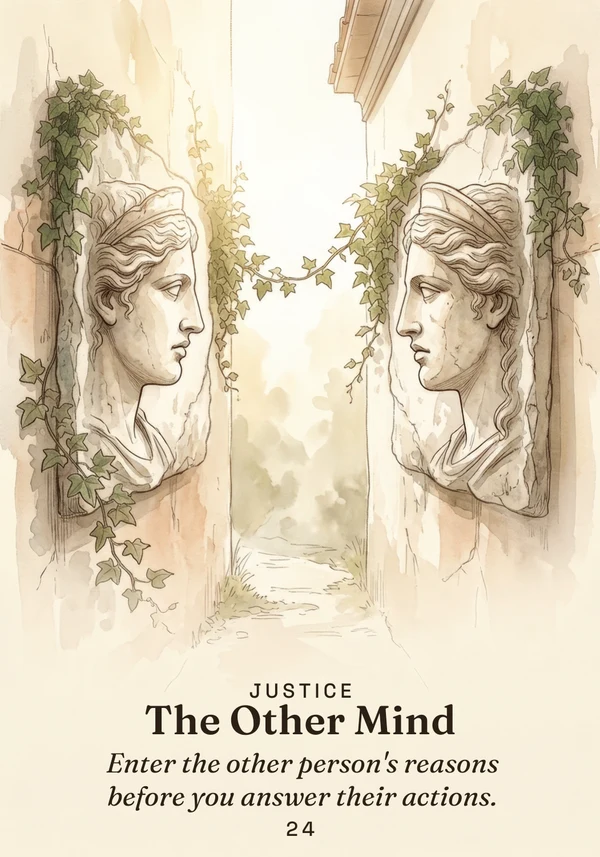
The Other Mind
Suit III: Justice · Card 24 of 40
“Enter into every man’s ruling faculty; and also let every other man enter into thine” (Meditations 8.61, tr. Long). Marcus practiced entering the other mind before answering the other behavior. People act from reasons, usually invisible, occasionally bad, almost always human. You do not have to agree with the reasons. You do have to know they exist.
There it was.
I had answered the cancellation, not the person. The position asks what the moment assumed. Mine assumed it was about me.
The card’s own Practice is to write the other person’s side in first person, three sentences, as generously as honesty allows. So I did, at the desk: “Something came up that I did not choose. I hate canceling. I kept it short because I was already late for it.”
I did not know if any of it was true. I only needed to remember that my first explanation was not a fact either.
Then I sent one more text: “Sorry I was short earlier. Hope tonight is okay.”
If you draw The Other Mind here, write the three sentences before you decide what the moment meant.
Its affirmation: “I answer people, not just their behavior.”
Position 3 · What I Leave Here
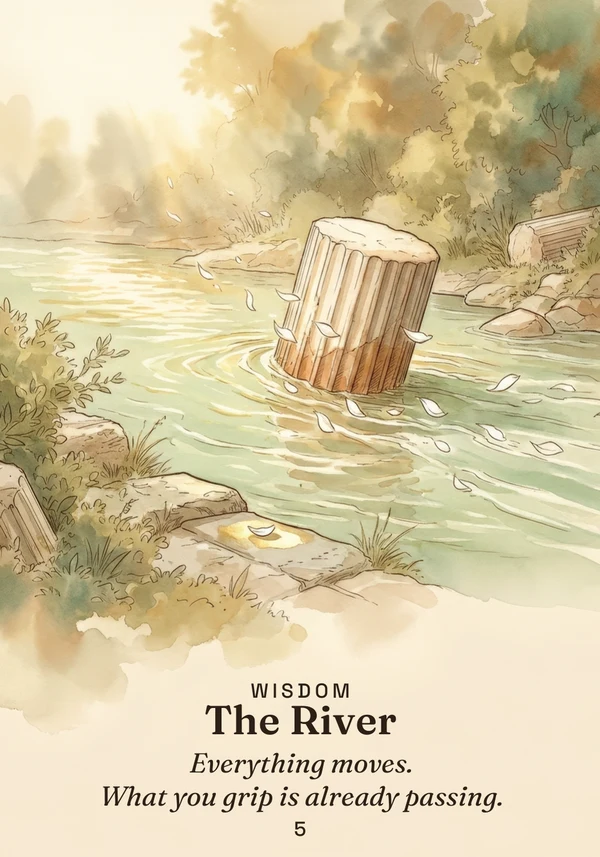
The River
Suit I: Wisdom · Card 5 of 40
“Time is like a river made up of the events which happen, and a violent stream,” Marcus writes, “for as soon as a thing has been seen, it is carried away, and another comes in its place” (Meditations 4.43, tr. Long). He is not being gloomy. He is loosening your fingers. The moment you are gripping, good or bad, is already moving. So is the one that hurts.
What was not coming to bed was the replay. Two words, sent at 5:41, reread all evening as if rereading could change them.
They were already downstream.
The apology was sent too, and there was no answer yet. The card did not ask me to fix that. It asked me to stop holding the moment still.
So I did the Practice at the desk: said it out loud, then added “and it is moving.” It took longer than I expected for my hands to loosen.
If you draw The River here, name the moment you keep diving back into, and say out loud that it is moving.
Its affirmation: “I can love what passes without stopping the river.”
Reading the three together
Straight across, the spread said something plain: most of my day went fine, one minute of it did not, and I had been letting that minute stand in for the whole thing.
Slow Hands gave the day its proper size. The Other Mind named the stray moment and handed me something to try instead. The River told me where the replay belonged.
The arc is keep, amend, release.
It was a double shift, by the way. She told me over coffee two days later. My three generous sentences had been closer than my two cold words.
That was luck. The useful part was realizing I had treated my first story as fact.
Stoic journal prompts for your own evening review
Your three cards will not be mine. The questions will be. The spread works with any oracle deck you own; I used The Stoic Oracle because it was built from the Stoic texts I was trying to practice that night. Draw at night, and journal with these prompts:
- What Went Well: What is my hurry actually promising me, and does it ever deliver?
- Where I Strayed: Whose behavior am I judging without ever visiting their reasons?
- What I Leave Here: What am I trying to hold still that was never still?
Those prompts come from the guidebook included with the deck. Write one sentence per card, not a page. If you want to try the deck first, you can draw three cards from The Stoic Oracle free on the site.
Then turn off the lamp.
Zara