What Is an Oracle Deck? (And How It Differs From Tarot)
Somewhere along the way, “oracle deck” started sounding like something you need permission to pick up. A password, a lineage, a talent for the mysterious. Let me put that to rest. An oracle deck is a set of cards designed to help you reflect. You draw a card, you sit with what it shows you, and you let it ask you a better question than the one you woke up with. That’s the whole entrance requirement. If you can pull a card and be honest with yourself for two minutes, you can read oracle cards.
The Short Answer
An oracle deck is any card deck built around its own theme, structure, and set of meanings. There is no standard number of cards, no fixed suits, no required symbols. One deck might hold thirty-six cards about grief; another, fifty about the nervous system; another, forty-four about returning to the present moment. The creator decides what the deck is for, and every card serves that intention.
Tarot, by contrast, is a standardized system: seventy-eight cards, twenty-two major arcana, four suits, centuries of layered symbolism. Every tarot deck, however wildly illustrated, is a variation on that same underlying architecture.
A useful way to hold it: tarot is a language you learn; an oracle deck is a letter written to you. Tarot rewards years of study. An oracle deck hands you its meaning the day it arrives.
Oracle vs. Tarot, Side by Side
- Structure. Tarot: seventy-eight cards, fixed system. Oracle: any size, any theme, and the deck’s creator sets the rules.
- Learning curve. Tarot asks for study; most readers keep the guidebook close for years. Oracle decks are built to be read from the very first pull.
- Tone. Tarot carries inherited weight: the Tower, the Devil, Death… cards that can feel ominous out of context. Oracle decks set their own emotional register, and most choose a gentler one.
- Purpose. Tarot is often used for divination in the traditional sense. Oracle decks lean toward reflection: journaling, a morning draw, a question to carry through the day.
- Interchangeability. A tarot reader can pick up almost any tarot deck and read it. Every oracle deck starts fresh, which is exactly what makes each one feel personal.
Neither is “better.” They’re different instruments. Plenty of readers keep both on the shelf: tarot for the long, layered spreads, an oracle deck for the daily check-in.
“But Do the Cards Tell the Future?”
Not in my house. The decks I make, and the way I’d encourage you to read any deck, treat a card as a mirror, not a forecast. When you pull a card, you’re not asking the universe for a verdict. You’re giving your own attention something to catch on: a question, a pattern, a phrase. The card that shows up doesn’t know your future. But the thought you have two seconds after seeing it? That’s real information, and it was yours all along.
This is why oracle cards pair so naturally with journaling and quiet morning practice. The card starts the sentence; you finish it.
How to Choose Your First Oracle Deck
Ignore “best deck” lists. Choose by season, the one you’re actually in. A deck works when its theme meets you where you are:
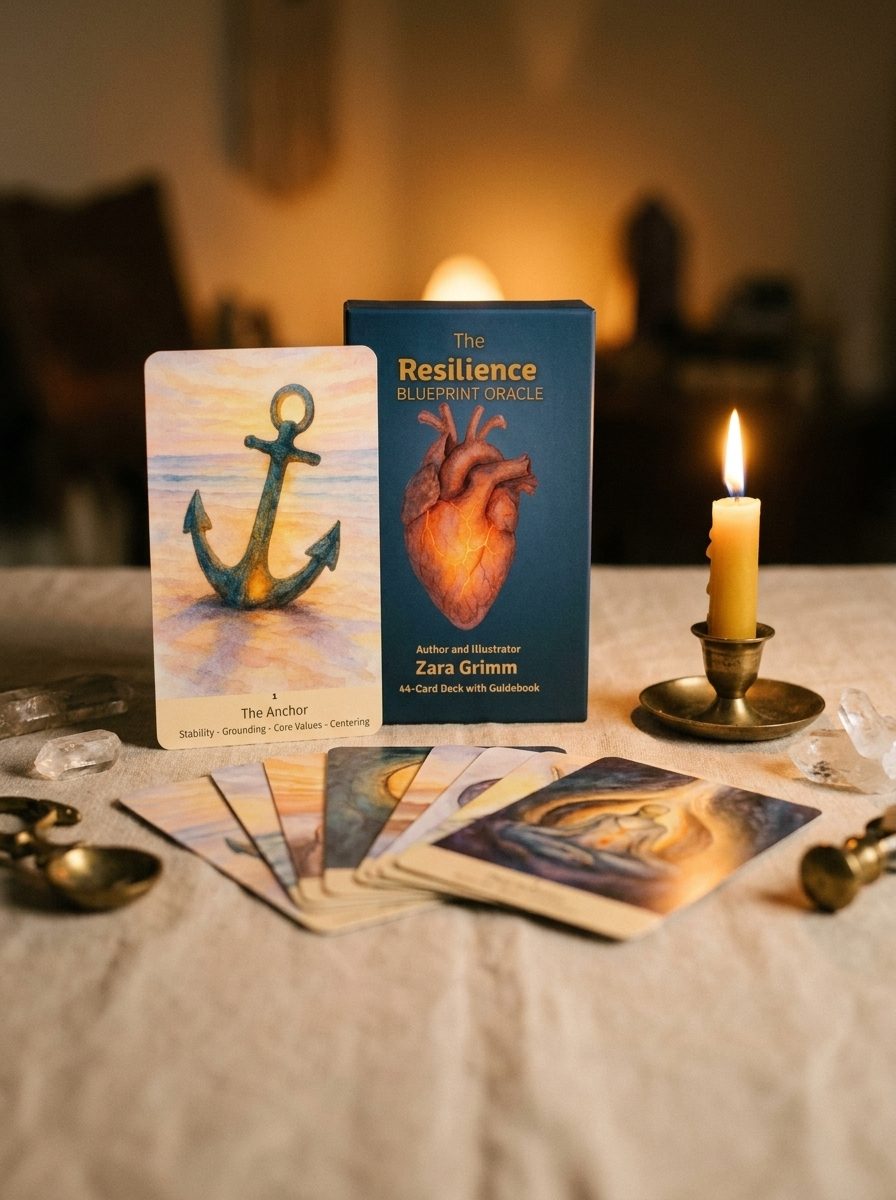
- Carrying something heavy? Look for a deck built for resilience and hard seasons, like the Resilience Blueprint Oracle.
- Anxious, and tired of arguing with your own body? A nervous-system deck like Gut-Brain Harmony speaks that dialect.
- Craving stillness? Something slower and more contemplative: Walden or Mindful Awareness.
Then hold the deck to one honest standard: does it give you language you’d actually use? Read a few sample cards before you buy. If the words make you exhale, that’s your deck.
For the full version, with every deck I make sorted by what it is for, read how to choose your first oracle deck.
Begin Here
If you’d like to see what this looks like in practice, every deck I make can be opened and read card by card (artwork on one side, meaning on the other) before you spend a cent. Start with the collections if you want a guided path by season, or go straight to the shelves and browse the decks. Pull a few cards. See which one finishes your sentence.
Zara