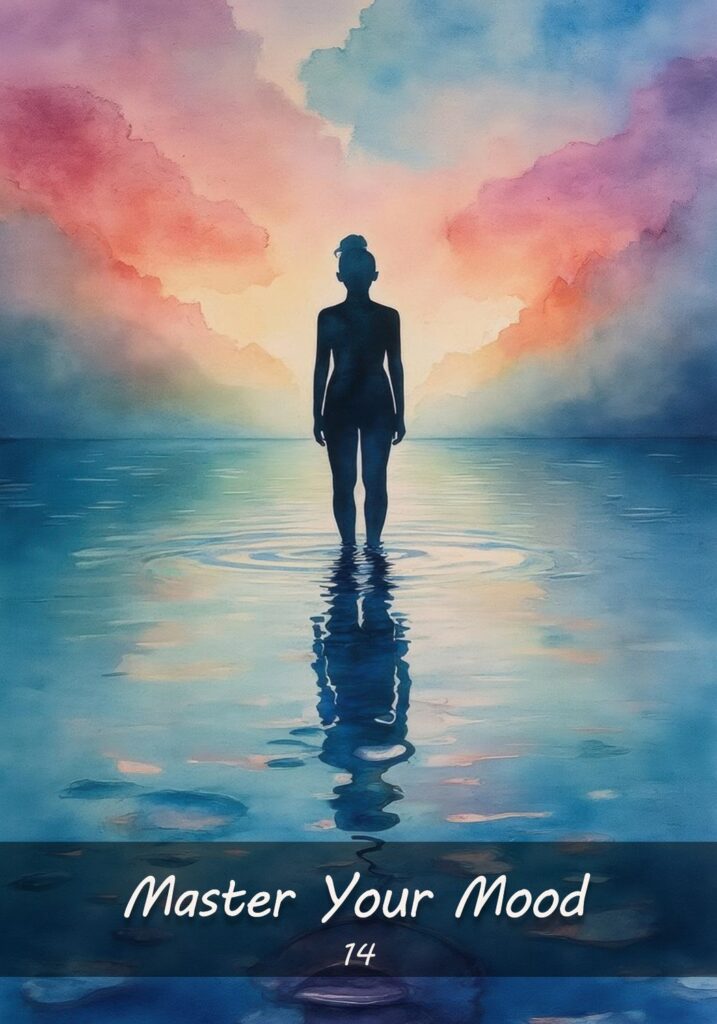
What Master Your Mood means
This card urges emotional mastery, keeping your mood steady despite others' actions. Don't let external forces control your inner state. Control of mood is mastery. Manage stress with mindful presence and equanimity. Mindful awareness grows by maintaining balance, conserving energy, thinking clearly, and responding from centered strength.
The situations around Master Your Mood tend to involve a day being set by other people's weather. A sigh at breakfast, a curt email, a driver leaning on the horn, and by ten a person can be carrying three moods that started in someone else. I read it as a card about where a mood comes from and who owns it once it arrives. The figure on the face stands on water so still it looks like glass. Nothing about that stillness says the figure feels nothing; the surface simply is not being stirred from outside. The card does not claim other people's actions are unimportant. It suggests a person can register them fully and still decide how far into the day those actions are allowed to travel.
Where it goes wrong is a quiet swap: steadiness traded for a performance of not caring. Some people take this card and go flat: nothing anyone does can reach them, and they are proud of it. But a mood that never moves can mean nothing is getting in, including good news, other people's distress and information the person actually needs. Feeling stung by an unkind remark is not a failure of mastery either. The steadiness this card describes is about coming back, not about never being moved.
I am the master of my mood. I cultivate calm and equanimity, and I do not allow external actions to dictate my inner peace.
When Master Your Mood appears in a reading
With Master Your Mood, I ask the person to walk me through a recent day when someone else's mood seemed to become theirs. Then I ask a second question: when did you notice the mood had changed? Sometimes the answer is hours later, when they snapped at someone who had nothing to do with it. If there is a lag like that, I ask what was going on in between. The card is not asking anyone to stop being affected. It is asking them to catch the shift sooner. A mood spotted at the curt email is often easier to set down than one discovered at dinner, already grown and handed on to whoever is nearby.
I tie a check-in to something I already do several times a day. Each time I go through a doorway, any doorway, I ask myself one question: what is my mood right now, and where did it come from? A word or two is enough: "tight, the phone call," "fine, nothing," "low, tired." If someone else's behavior affected me, I name what happened and ask what response is mine to choose now. I do not try to fix the mood. Naming it is often enough to loosen its hold a little. If the doorway habit is too much to remember, I start with one check-in, when I sit down for lunch or whatever passes for lunch.
The line between Master Your Mood and Self-Control & Calmness is scale. Self-Control is a single moment, the reply held back. Master Your Mood is the whole day and the climate a person carries into each room. Beside Stillness in Storm, I read the pair as steadiness under real pressure, and I ask whether the storm is outside the person or being imported from someone close. Beside Compassionate Presence, the card softens: staying level can help a person be useful to someone who is not level at all.
One small mindful act
Choose one person whose mood tends to set yours, and the next time you are with them today, notice your shoulders and jaw before and after, without trying to change anything.
Master Your Mood in the Past, Present, Future Spread
The Mindful Awareness Oracle guidebook’s three-card spread is the Past, Present, Future Spread, for seeing a situation in context. Laid left to right, the first card shows what is still shaping it, the second the central theme right now, and the third a potential outcome on the current path, which I read as a direction worth noticing rather than a verdict. In each position this card tends to say:
- The Past. In the Past position, Master Your Mood can mark an older habit, such as taking on the feelings of whoever was loudest in the room: does it still set the tone of your days?
- The Present. In the Present position, the card invites you to notice how other people's actions are affecting your mood, and where you still have a choice about your response.
- The Future. In the Future position, the current path leads toward knowing what moves your mood and choosing what to do with it, without demanding that you stay untouched, if the noticing keeps happening early in the day.
Journal prompts
- What are some common external triggers that tend to shift my mood?
- What are things I can do to think clearly in my daily life?
- What is one step I can take to feel more in control of my own emotional state today, regardless of others' actions?