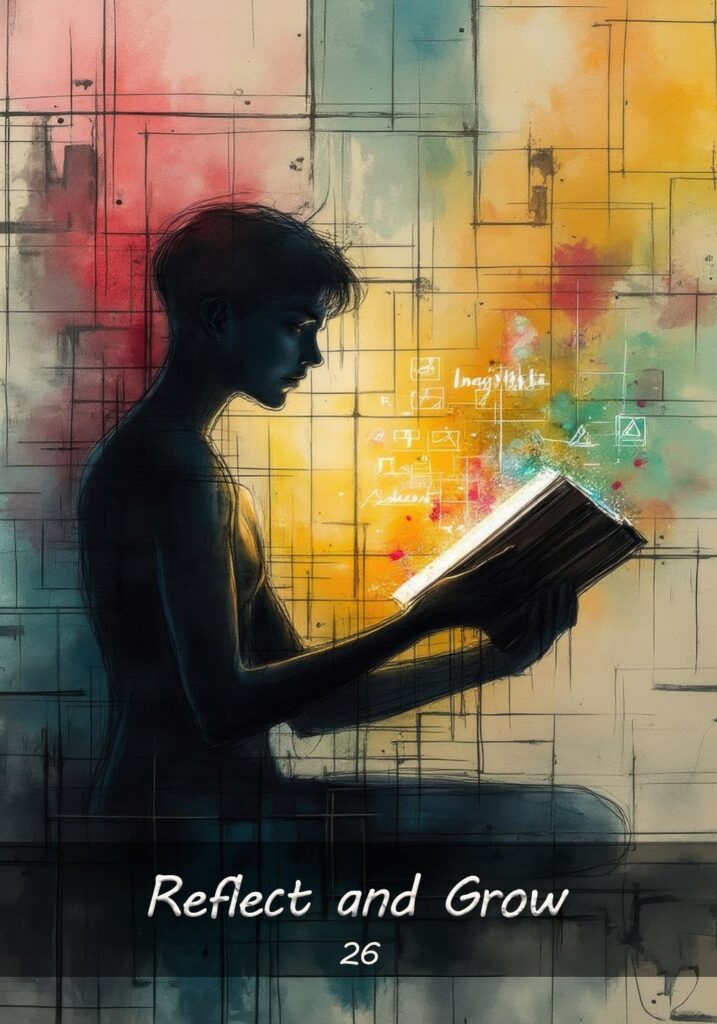
What Reflect and Grow means
To understand yourself, write; to understand the world, read. This card invites reflection: What have I learned? How can I grow? Reflection speeds learning and makes it enjoyable. Mindful awareness deepens by processing successes and failures, gaining insights to help you adapt, avoid mistakes, and build lasting awareness.
Reflect and Grow often turns up when life is moving fast enough that experiences pass straight through. A project ends and the next one starts the same afternoon. An argument happens, gets smoothed over, and is never looked at again. The result can be a person who keeps having the same month. The card is an invitation to slow the conveyor belt long enough to pick something up and look at it. The face shows a person absorbed in a glowing book, and I take the glow as interest rather than duty. The card also suggests something easy to forget: the life being lived is itself material worth reading.
Where it goes wrong is reflection stretched into an endless post-mortem. Some people draw this card and start examining everything, replaying each conversation for errors, writing pages about a mistake that needed a paragraph. The looking becomes a way of not moving, and the lessons pile up unused. Reflection can also turn into grading, with every experience marked pass or fail. Growth needs reflection to have an end point. The page gets written, the lesson gets named, and then the cover closes for a while so the person can go and live the next chapter.
I pause to reflect, learning and gaining insight. My experiences are my teachers.
When Reflect and Grow appears in a reading
If you draw this card, begin by noticing what kind of reflection you already do without calling it that. Some people think out loud on the bus, some go over the day in the shower, some send a friend a long recap. When I read Reflect and Grow for someone, I start there, because many people are already reflecting in some form without keeping anything from it. I ask which experience they would want to look at first. If it is a failure, I ask about something that went well too, because successes hold lessons people skip: what made it work, and could it happen again on purpose?
My practice with this card is a short written review at the end of the day, three lines in a cheap notebook by the kettle. What happened that I want to remember? What would I do differently? What surprised me? Keeping it to three lines keeps it from becoming a chore. Once a month I read the past few weeks back, and patterns show up that I would never have caught day to day. The reading half matters to me as much as the writing: I keep one book going that has nothing to do with my own life, a novel or a history, so my reflection has other people's experience to measure against. If three lines feel like too much, I write one word for the day and stop.
Where I keep Reflect and Grow distinct from The Overthinking Pause is direction of travel. The Overthinking Pause interrupts thought that is spinning in place. Reflect and Grow asks for thought that moves forward and lands somewhere. With Habits Shape Your Future alongside, the pair describes review feeding practice: what the reflection notices becomes the next small habit. Beside Wisdom in Stillness, the reflecting may need fewer words. The seated figure on that card suggests pausing before trying to write the answer, so I suggest the person let a question sit for a while first.
One small mindful act
Ask someone who was there for a recent event, good or bad, what they noticed about it that you might have missed, and listen without correcting them.
Reflect and Grow in the Past, Present, Future Spread
The Mindful Awareness Oracle guidebook’s three-card spread is the Past, Present, Future Spread, for seeing a situation in context. Laid left to right, the first card shows what is still shaping it, the second the central theme right now, and the third a potential outcome on the current path, which I read as a direction worth noticing rather than a verdict. In each position this card tends to say:
- The Past. In the Past position, Reflect and Grow asks the person to consider whether an experience they moved through quickly still has lessons waiting to be gathered.
- The Present. In the Present position, the central theme is making room to look back with curiosity. Something recent is worth understanding before the next decision gets made.
- The Future. In the Future position, the trend is toward brief, regular looking back, if the person uses it to choose what to carry forward and then returns to living.
Journal prompts
- What is a recent experience (positive or negative) that I haven't fully reflected on yet?
- What key lesson or insight can I take from that experience to help me grow?
- How can I make reflection a more regular and enjoyable part of my routine (e.g., journaling, quiet contemplation)?