What Release Mental Clutter means
To create space for clear decisions, release mental clutter. Clear old worries and outdated narratives. You need fewer distractions, not more time. Releasing mental baggage is liberating, allowing focus and purpose. Mindful awareness requires a focused mind. Mental clutter drains energy; releasing it enhances concentration, and decision-making.
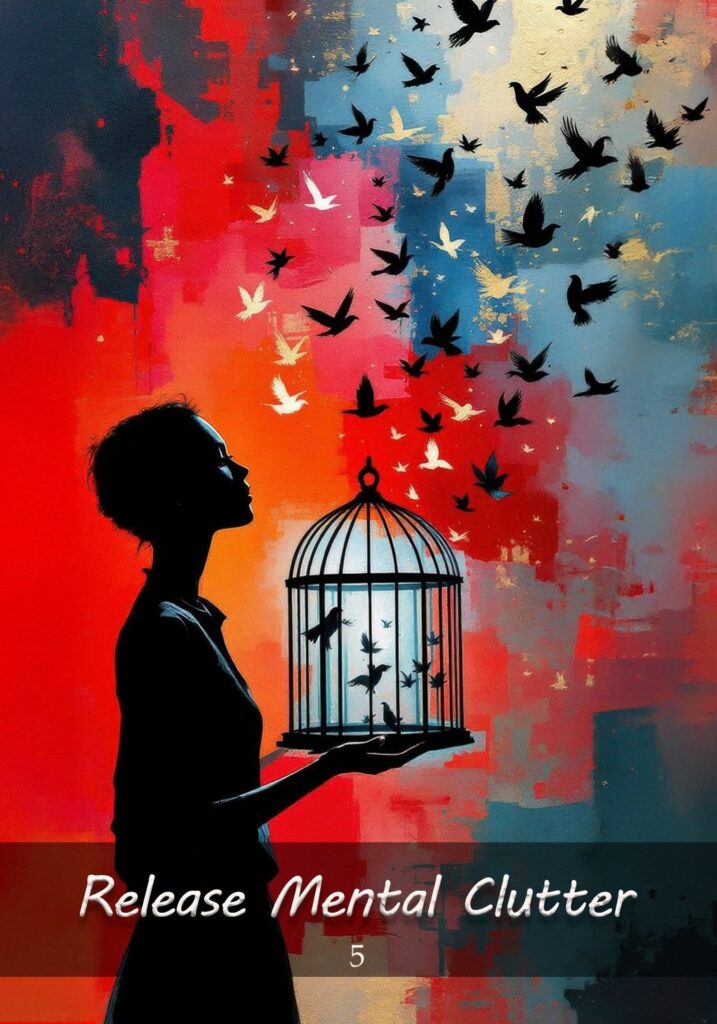
Release Mental Clutter tends to appear when someone's head has become a storage unit. Unanswered messages, a half-remembered appointment, an argument from years ago, a plan for the weekend, a fact they meant to look up, all stacked on the same shelf with no labels. Often the word people reach for is "full." The image on the face is precise about the tone of this card. The woman is not chasing the birds or throwing them out. She has opened the cage door, and they are leaving on their own. I read that as the card's emphasis: release is often less about effort and more about stopping the effort of holding on, and noticing what goes once it is allowed to.
Where it goes wrong is calling something clutter because it is uncomfortable. A deadline that keeps getting closer, a symptom that keeps coming back, a strained friendship: these are not noise to be cleared but messages that need a reply. A person can get so committed to a clear head that every unwelcome thought gets swept out with the junk, and the problem grows in the dark. The open door is for the worries that are ready to leave. The ones asking for action need an answer first.
I release mental clutter and create space for clarity, focus, and peace. My mind is becoming clear and open.
When Release Mental Clutter appears in a reading
If you draw this card, begin by naming the three thoughts that have visited you most often in the last day. Do not sort them yet. When I read Release Mental Clutter for someone, I ask which of those three they can act on, which belong to someone else, and which are stories they keep replaying out of habit. Sometimes more land in the last group than the person expected. When phrases like "I should have" or "what if they" come up, I ask whether that story is still doing anything useful for them.
My practice is a brain dump with a sorting step. I take a blank page, or the notes app if paper is not handy, and write every open loop I can think of for five minutes, without judging any of them. Then I mark each item with one of three letters: D for do, which gets a time attached; W for waiting on someone else; and L for let go, which I cross out. The crossing out matters more than I expected. On a day with no room for five minutes, I write down the one thought that keeps returning and decide its letter. I do this at the end of the day, or whenever my head feels loud, and I treat the timing as a habit I like rather than a rule.
With The Art of Letting Go in the same spread, I take it as a call to release something specific, and I ask which thought the person keeps reaching for after deciding to drop it. I tell Release Mental Clutter apart from The Overthinking Pause by scale. The Overthinking Pause interrupts one spiral in the moment. Release Mental Clutter is the slower clearing of everything that has piled up around it. Beside Focus Your Energy, clearing comes first, and the space it opens is meant to be used.
One small mindful act
Save what you need, close one unnecessary tab or app, and give the next task ten minutes of attention.
Release Mental Clutter in the Past, Present, Future Spread
The Mindful Awareness Oracle guidebook’s three-card spread is the Past, Present, Future Spread, for seeing a situation in context. Laid left to right, the first card shows what is still shaping it, the second the central theme right now, and the third a potential outcome on the current path, which I read as a direction worth noticing rather than a verdict. In each position this card tends to say:
- The Past. In the Past position, Release Mental Clutter invites the person to consider whether an old story, about what they are like or what tends to happen to them, has been retold so often that it now feels like furniture.
- The Present. In the Present position, the live issue is capacity. The decision in front of the person may be harder than it needs to be because too many other things are competing for the same room.
- The Future. In the Future position, the direction is toward sharper choices if the person decides which concerns need action, which need time, and which they are ready to stop carrying, and toward the same foggy tiredness if every thought keeps its place.
Journal prompts
- What specific worries or old narratives are contributing to my mental clutter right now?
- What is one small step I can take today to "release" some of this clutter?
- If I had fewer mental distractions, what would I focus my energy on?