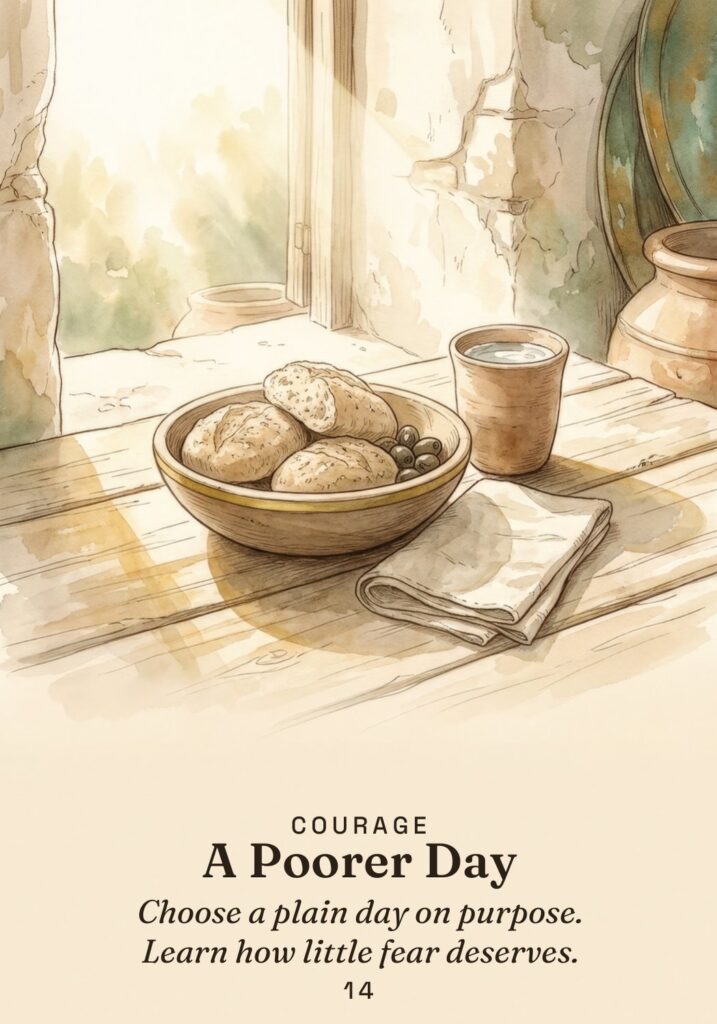
What A Poorer Day means
Musonius Rufus taught that hardship, taken in small chosen doses, trains the body and soul together: cold, hunger, plain conditions, endured on purpose so that fortune's versions find us practiced (rendered from Lecture 6, On Training). Seneca ran the same drill with days of plain fare, asking, is this the condition that I feared? Chosen scarcity shrinks the fear of the unchosen kind.
The person who draws A Poorer Day is usually afraid of losing something they have not lost: income, comfort, a certain standard of ease. The fear is detailed and the test has never been run. In a reading I frame the card as an experiment with a question attached: how much of this do I actually need, and how would I know? It is a card for the comfortable, which is worth saying plainly. When someone is already living a hard season not by choice, the card speaks to the fear underneath rather than to the circumstance, and I read it more gently. Someone already going without does not need to manufacture more lack. For them the card is about the fear, not another experiment.
Where it goes wrong is turning the plain day into a punishment or a performance. As punishment, it becomes penance: self-denial as a way of paying for something, with no question being asked and nothing being learned. As performance, it becomes an announcement, the fast described to everyone at the table, the simplicity posted. A quieter failure is making the day too dramatic. A day with no comfort at all teaches that misery is possible, which nobody doubted. The card asks for a plain day, not a cruel one, because the fear it is testing is the fear of plainness.
I can do without more than I think, and I can prove it gently.
When A Poorer Day appears in a reading
When this card turns up, I ask what the person is most afraid of losing, and then whether they have ever gone without it for even a day. The second answer is usually no. The fear has had years to grow and has never once been measured against the thing itself. That gap is where I aim the reading. I am not asking anyone to want less. I am asking them to find out, in a small controlled way, what less actually feels like, so that the fear is answering to evidence instead of to itself.
My practice with the card does not begin with a whole day. It begins with one evening: the simple dinner, nothing bought, the older coat on the walk, no screen after it. At the end I write a single line about what I missed, and most nights the honest answer is almost nothing. When one evening becomes easy, I let it grow to a day. The experiment works because it is boring. Nobody is watching, nothing is being proved to anyone, and the fear has to show up on its own and account for itself.
Beside Enough, I read the pair as a line and a visit below it: Enough asks where sufficiency sits, and A Poorer Day goes a step under that line to see what is there. Beside Imagined Suffering, the plain day becomes the test of a forecast. Where I keep A Poorer Day distinct from The Simple Table is the subject. The Simple Table is about attention at one meal. A Poorer Day is about the fear of going without, and a meal is just one place that fear can be met.
One small move on your side of the line
On one ordinary outing, wear the older coat or carry the plainer bag, and notice whether the discomfort comes from the item or from what you imagine others think.
A Poorer Day in the Dichotomy Spread
The Stoic Oracle guidebook’s three-card spread is The Dichotomy Spread, for any situation that will not stop churning: a conflict, a waiting game, a decision that circles. Laid left to right, it sorts the situation along the one line the Stoics trusted: what is yours, what is not, and the next right act. In each position this card tends to say:
- What Is Yours. In the What Is Yours position, A Poorer Day says the experiment is yours to run. You can choose the plain day, its size, and what you learn from it.
- What Is Not. In the What Is Not position, it points at fortune's version of the same day, the one nobody chooses. You do not control whether it comes, and the card asks you to stop paying it rent in advance.
- The Next Right Act. As The Next Right Act, it asks for one small chosen lack, an evening or a meal lived plainly, with one honest line written at the end.
Journal prompts
- Which comfort owns me most, and how do I know?
- What did my last involuntary hard stretch teach me that I have forgotten?