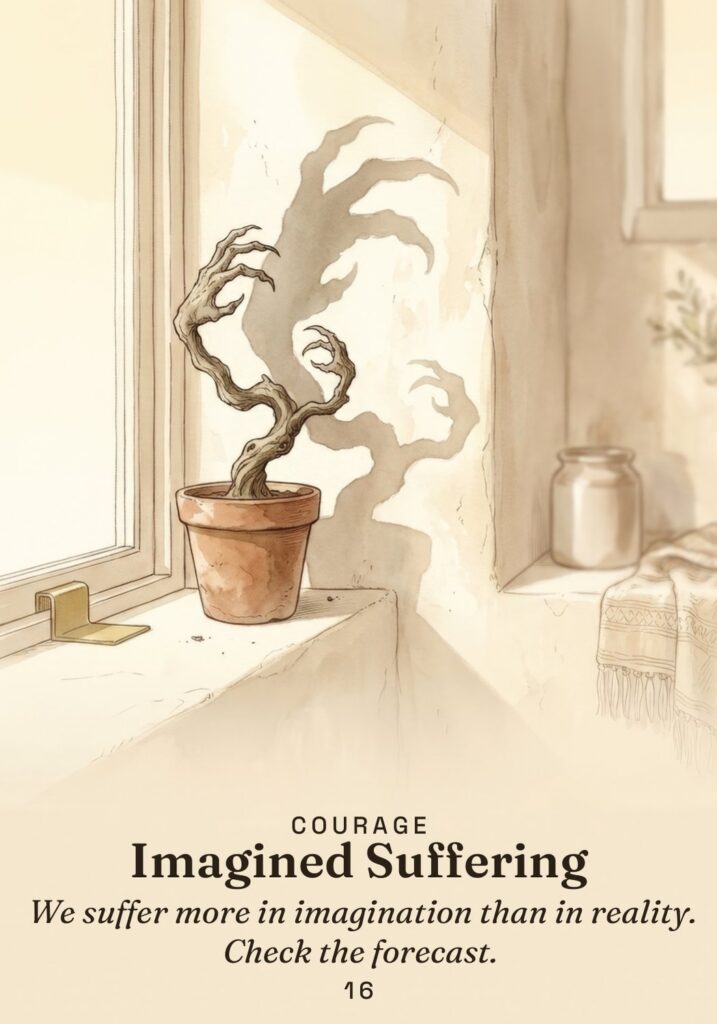
What Imagined Suffering means
"There are more things, Lucilius, likely to frighten us than there are to crush us; we suffer more often in imagination than in reality," Seneca writes (Letter 13, tr. Gummere). Most of what you have dreaded never happened, and you have the receipts. Fear inflates in the dark of maybe. Drag it into the arithmetic of likely.
Imagined Suffering tends to arrive for the chronic forecaster, the person whose dread has a detailed script and no data. They can tell me the whole disaster scene by scene. They cannot tell me how often that scene has actually played out. In a reading I am careful to say what the card does not say: it does not call the fear false. It calls the fear unverified, and asks for the ledger. The usual pushback is that this time is different, and sometimes it is. But the person who says that has often said it before, and the card wants them to notice that too.
Where it goes wrong is turning the arithmetic into a weapon. One version uses the numbers to shame yourself for having been afraid at all, as if a fear that did not come true were a character flaw. Another uses them to dismiss a fear that happens to be likely, waving a good track record at a forecast that is, this time, accurate. The count is a check, not a verdict. When the numbers come back and the feared thing really is probable, the card hands you to The Rehearsal and steps aside. A quieter failure is counting the dramatic fears and ignoring the small daily ones, which cost the most.
I answer my imagination with evidence.
When Imagined Suffering appears in a reading
If you draw this card, begin by naming the last three things you were certain would go wrong, and then what happened. Most of the time the pattern speaks for itself. Two did not happen, one happened smaller than feared, and you are a little embarrassed and a little relieved. When the answer is different, when all three came true, the reading changes and asks for a slower look. Three hits do not settle whether your forecasting is sound, but they do mean this fear has earned more than a quick count. The card serves both readers, but not with the same sentence.
My practice with the card is a running note on my phone titled Forecasts. When a dread shows up, I write one line and the date, nothing more, and I close the note. Months later, on a quiet evening, I read the list. The reading is humbling in the good direction nearly every time. It is a smaller discipline than the three-number exercise, which I save for the fears that will not let go of me. The note is for the everyday ones, and it is the everyday ones that quietly set the tone of a life.
Beside The Rehearsal, I read the pair as check the odds, then rehearse the real one. Beside The Judgment, Imagined Suffering becomes a verdict passed in advance of the trial. Where I keep it distinct from First Impressions is direction in time. First Impressions separates the event from the story in the present moment, as the email arrives. Imagined Suffering does the same work on the future, separating what might happen from the story already written about it. Same gap, different tense, and the person who is good at one is often blind to the other.
One small move on your side of the line
Ask one person who knows the situation how likely the thing you dread actually is, and set their answer beside your own for the rest of the day, noticing where the two differ.
Imagined Suffering in the Dichotomy Spread
The Stoic Oracle guidebook’s three-card spread is The Dichotomy Spread, for any situation that will not stop churning: a conflict, a waiting game, a decision that circles. Laid left to right, it sorts the situation along the one line the Stoics trusted: what is yours, what is not, and the next right act. In each position this card tends to say:
- What Is Yours. In the What Is Yours position, Imagined Suffering says the forecast is yours to check. The story about the future was written by you, and you can read it against the record.
- What Is Not. In the What Is Not position, it names the future itself. What happens tomorrow is not in your control, and dreading it in detail has never changed the weather once.
- The Next Right Act. As The Next Right Act, it asks you to put a number on the fear, how often something like it has actually come true, and to let that number into the room.
Journal prompts
- What is my imagination charging me for events that never occur?
- Which past dread looks almost funny from here?