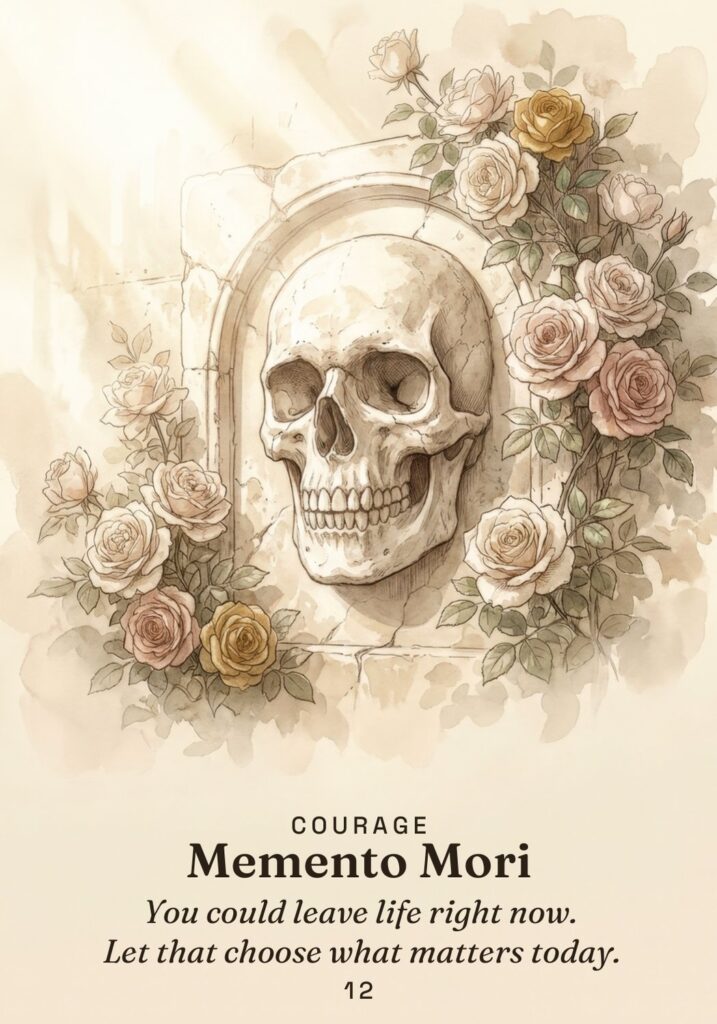
What Memento Mori means
"Since it is possible that thou mayest depart from life this very moment, regulate every act and thought accordingly," Marcus writes (Meditations 2.11, tr. Long). The Stoics kept death on the desk, not in the closet. Not morbid: clarifying. Mortality is the deadline that tells you which of today's ten urgencies was ever real.
In a reading, Memento Mori rarely comes for someone who is thinking about death. It comes for someone buried in small urgencies who has lost the ability to rank them: twelve things due, all of them shouting, none of them weighed. I read it as a sorting card, a cousin of The Dichotomy, except that it sorts by weight rather than by ownership. It turns up often when the list of intentions is long and nothing on it has been ranked against anything else. The card hands the person a lens and asks them to look at the list through it once, without flinching.
Where it goes wrong is using mortality as a mood instead of a measure. In one direction the card becomes a heaviness, a verdict that the day is being wasted, and the person spends the afternoon feeling morbid about their inbox. In the other direction it becomes a slogan, life is short, used to drop every obligation that happens to be boring. Neither is the instruction. The card does not say abandon the dull work. It says look at the dull work and see which of it was real. Some of the dullest things on a list, the dishes, the check-in call, pass the test easily. The impressive project is often the one that does not.
I let the shortness of life set the size of my worries.
When Memento Mori appears in a reading
When this card leads, I ask the person a single question: if you could keep three things on your list exactly as they are, and the rest had to go quiet for a month, which three would you keep? Not the heroic version. Exactly as they are. People surprise themselves. The dishes stay. The weekly call to a parent stays. The project they have been describing as essential goes quiet, and they notice that it went quiet without a fight. Those three survivors are the reading. Everything else on the list has been borrowing their urgency.
My practice with the card is lighter than a full rewrite of the day. I put one small mark beside the item on my list that would survive the lens, and I do that item before I open anything with a notification on it. If even that feels heavy, I use a smaller version: I send the one message I would be sorry to have left unsent. That takes two minutes and it reorders the whole morning. The point is not to think about death for long. It is to let the thought touch the list once and move on.
Beside This Hour Only, I read the pair as deadline and unit: one card sets the horizon and the other sets the size of the piece in front of you. Together they are a short answer to a long list. Where I keep Memento Mori distinct from The Borrowed Things is the direction of the loan. The Borrowed Things is about what I love being on loan to me. Memento Mori is about me being on loan to the day. One loosens the grip and the other sets the order of work, and a person who is overwhelmed usually needs the order first.
One small move on your side of the line
Send the message you would be sorry to have left unsent, before you touch anything else that merely feels urgent.
Memento Mori in the Dichotomy Spread
The Stoic Oracle guidebook’s three-card spread is The Dichotomy Spread, for any situation that will not stop churning: a conflict, a waiting game, a decision that circles. Laid left to right, it sorts the situation along the one line the Stoics trusted: what is yours, what is not, and the next right act. In each position this card tends to say:
- What Is Yours. In the What Is Yours position, Memento Mori says the order of today's attention is yours to set. What gets the first good hour is a decision, not an accident.
- What Is Not. In the What Is Not position, it names the number of days. That was never yours to extend, and the card asks you to stop spending the ones you have as if the supply were endless.
- The Next Right Act. As The Next Right Act, it asks you to retire one urgency that would not survive the question, and to give its hour to something that would.
Journal prompts
- What would I stop doing tomorrow if I took my own mortality seriously?
- What have I been postponing to a someday I am not promised?