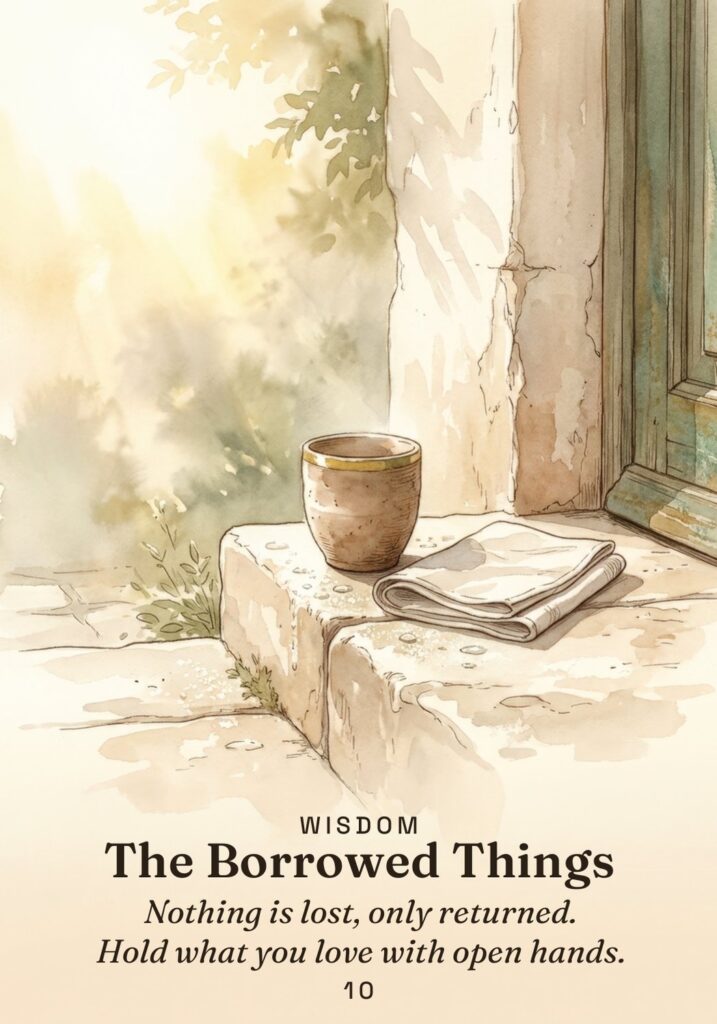
What The Borrowed Things means
"Never say of anything, 'I have lost it'; but, 'I have returned it'" (Enchiridion 11, tr. Carter). Epictetus said it of a cup, a job, and, unbearably, a child, because he meant it all the way down. Everything you love is on loan, and no one told you the term. Gratitude, not grip, is the right way to hold a borrowed thing.
In a reading, The Borrowed Things comes up for someone who has started guarding what they love instead of enjoying it. The child is watched for signs of leaving, the friendship is checked for cracks, the good job is held so tightly that the work itself stops being pleasant. I read the card as a change in posture, from fist to open palm. Nothing in it says the loss is near. It says the thing was on loan from the first day, that the term was never disclosed, and that the right response to an undisclosed term is not vigilance. It is attention, while the thing is here.
Where it goes wrong is loving the thing less in advance, as if grief could be prepaid. The card can be read as a reason to hold back: if everything is borrowed, why get attached. That is a misreading in the opposite direction from the grip, and it costs just as much. The borrower the card describes is not detached; the line about the child makes that plain. The card asks for full use, full love, with the hands open. The open hands are not about caring less. They are about not spending the loan period bracing for the return.
I hold what I love with gratitude, not grip.
When The Borrowed Things appears in a reading
The person who draws The Borrowed Things can usually name the thing within a breath, and the naming often comes with a flinch, as if saying it aloud might speed up the clock. I ask when they last enjoyed it without also checking on it. The answer is frequently a while ago. The guarding has replaced the having, and the person has been experiencing the loss in advance, daily, without the thing having gone anywhere. The reading is about getting the having back while the having is still available.
My own practice with the card is ten minutes of loving the thing on purpose, and the on-purpose part is the practice. A call where I do not multitask. A note written by hand. An hour in the same room as someone you love, with the phone somewhere else, which they tend to notice. I set a timer because without one I will drift back into managing. At the end I do not add a line about how it could all be gone tomorrow. The card does not ask for that and it undoes the exercise. The ten minutes are the whole point, not a rehearsal for their absence.
Beside The River, I read the pair as the same teaching twice, once as motion and once as loan, and I usually lead with the river because it is less personal. Beside Memento Mori, the cards sharpen each other, and I slow down, because a person holding both is often being asked to look at something tender. Where I keep The Borrowed Things distinct from Enough is the direction of the wanting. Enough is about wanting less of what you do not have. The Borrowed Things is about wanting fully what you do, for as long as it is here, without the wanting becoming a watch.
One small move on your side of the line
Spend the money, use the good dishes, or wear the thing you have been saving, today, for no occasion, because saved is just another word for unused.
The Borrowed Things in the Dichotomy Spread
The Stoic Oracle guidebook’s three-card spread is The Dichotomy Spread, for any situation that will not stop churning: a conflict, a waiting game, a decision that circles. Laid left to right, it sorts the situation along the one line the Stoics trusted: what is yours, what is not, and the next right act. In each position this card tends to say:
- What Is Yours. In the What Is Yours position, The Borrowed Things names the attention you give while the loan is open, which is the one part of the arrangement you set the terms of.
- What Is Not. In the What Is Not position, it points at the term of the loan, undisclosed from the start, and asks you to stop reading the calendar for a date it does not contain.
- The Next Right Act. As The Next Right Act, it asks for ten minutes of full use today, a call made or a room sat in, given to the thing you have been guarding instead of having.
Journal prompts
- What am I guarding so hard I have stopped enjoying it?
- If everything I have is borrowed, what does being a good borrower look like?