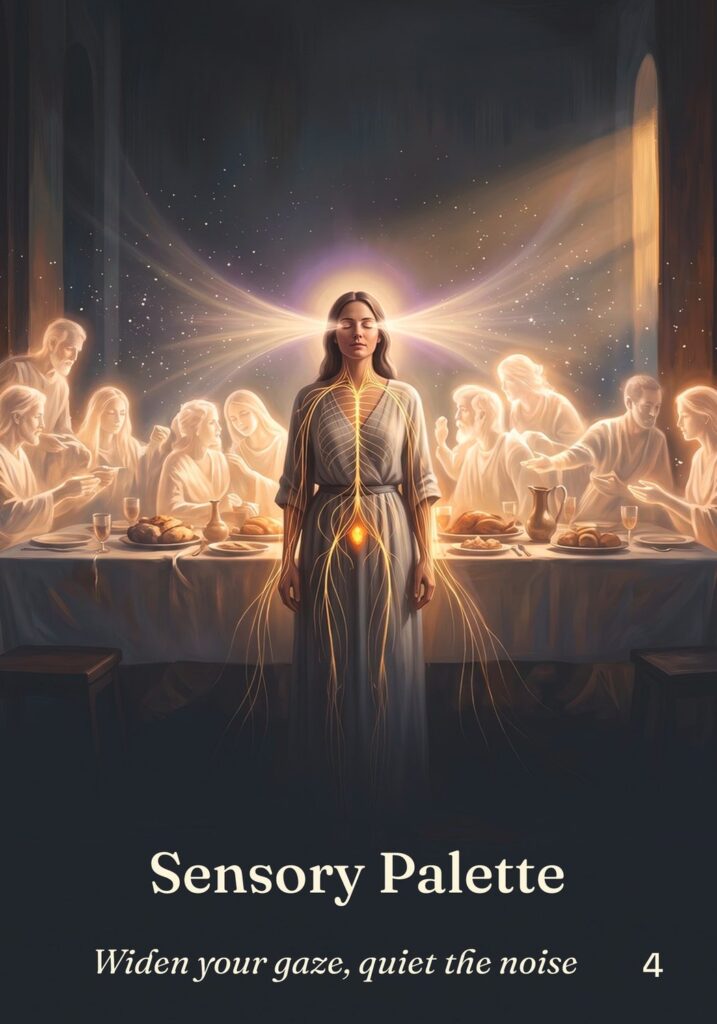
What Sensory Palette means
A crowded table can flood you with overlapping voices and bright light until your focus frays, and that overwhelm reflects a system taking in more than it can sort. When you feel safe, the nerves of your face and inner ear naturally tune toward human voices and filter the rest, but under strain that filter drops. Softening and widening your gaze can lower the alarm, letting those nerves retune and the din fall back.
Overload rarely announces itself as overload, and Sensory Palette is the card for when it arrives disguised as a bad mood. The person says they feel irritable, scattered, or oddly tired by seven in the evening, and they blame themselves for it. The card points at the room instead: the television on in the next room, three conversations crossing the table, the overhead light no one dims, the dog, the kids, the kitchen timer. I read it as a prompt to take inventory of the senses before taking inventory of the self, because the fraying often has a plain outside cause.
Where it goes wrong is concluding that you are bad at gatherings. A person can spend years believing they lack social stamina when the actual problem is a house with no quiet corner. The other misstep is concentrating harder, leaning into every voice at once until something snaps. The card asks for less effort, not more. Its answer is a softer focus, and sometimes a practical change to the room, which is a reasonable thing to ask of a host and not a confession of weakness.
I soften my focus and the room eases
When Sensory Palette appears in a reading
When this card shows up, I ask the person to name the single loudest input in their usual holiday setting. One sound or light, not a list. The answer often surprises them: not the arguing uncle but the football game nobody is watching, or the bright kitchen lighting that makes everyone look tired. Naming one input makes it fixable in a way general overwhelm never is. Turn it down, move away from it, step out from under it. The reading treats the senses as the first line of care, before anyone talks about feelings.
When the room gets loud, I soften my eyes on purpose. I stop focusing on whoever is speaking and let my vision spread until I can sense the walls and the doorway at the edges without moving my head. Nobody notices, which is part of its use. I hold that wide view for a few breaths and let the voices blur a little. When I come back to a single face, it is usually easier to hear what that person is saying, because the rest of the room has stepped back.
Beside Listening Refuge, I read the pair as one card for the eyes and one for the ears, and I suggest starting with whichever sense feels louder. Beside Sanctuary Pause, the reading says the room may need to be left briefly, not just softened. Where I keep Sensory Palette distinct from Soft Gaze is intent. Sensory Palette widens the gaze to lower the volume of the whole room. Soft Gaze widens it to stop searching faces for disapproval. The motion is similar, but one is about noise and the other is about judgment.
One small move for the table
Ask the host whether you can dim one light or switch off one screen, and offer it as a favor to the whole table.
Sensory Palette in the Ladder Spread
The Table of Connection guidebook’s three-card spread is The Ladder, for a specific trigger or a gathering that already has you tangled. Laid left to right, it moves one situation from raw reaction toward regulated response: notice what the body is doing, name the state, then check what is true now and choose a practice. In each position this card tends to say:
- Notice. As the Notice card, Sensory Palette points at the sounds and lights you have been absorbing all evening without a filter, until your attention has started to fray.
- Name. In the Name position, it calls the irritability overload, a system taking in more than it can sort, rather than a flaw in your temper.
- Check and Regulate. In Check and Regulate, it asks whether anything in the room is actually wrong, then widens your gaze so the noise can fall back to background.
Journal prompts
- Which sound or light is pulling at me?
- What helps my senses feel less crowded?