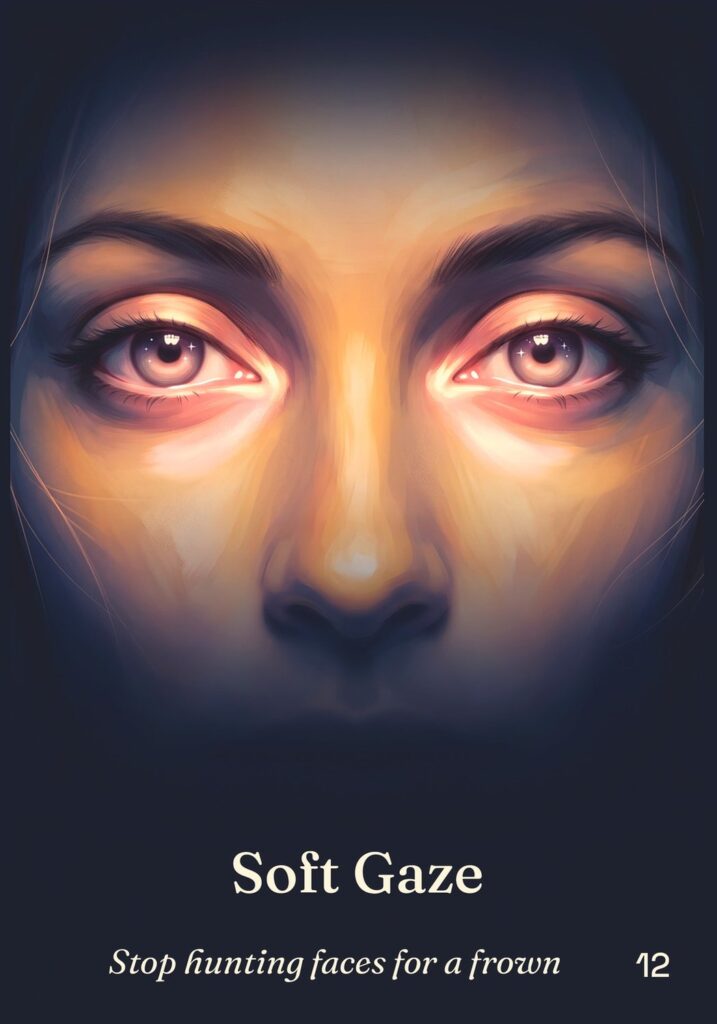
What Soft Gaze means
Scanning faces for the first flicker of disapproval keeps you braced through the whole evening, and a mind hunting for a frown almost always finds one, real or imagined. Hard, darting eye movements can keep the brain oriented toward threat, while a soft, wide gaze sends the opposite cue. Letting your eyes release their focus and rest on the room as a whole tells your system it is allowed to stop searching for danger.
There is a kind of guest who spends the whole evening reading faces, and Soft Gaze is usually drawn by that guest. Did the host's smile tighten? Did a sibling exchange a look with a parent? Was that a frown or just someone chewing? The person is exhausted by nine o'clock and cannot say why. I read the card as a description of vigilance that has become a habit. Somewhere along the way this person may have learned that disapproval was likely and that catching it early felt safer. The card asks whether that is still true at this table, tonight.
Where it goes wrong is swinging to the other extreme and avoiding everyone's eyes completely. Staring at the plate, the phone, the window, is still a response to threat. It trades scanning for hiding, and the room feels no safer for it. The card asks for something between those two: a wide, easy view that takes in the whole table without studying any one face. From there, real eye contact becomes possible again when it is wanted, and the evening stops feeling like a test of your ability to read people.
I let my gaze rest and soften
When Soft Gaze appears in a reading
When this card shows up, I ask the person whose approval they scan for first. There is usually one face. Not necessarily the most critical person. Often it is the most important to them, a parent or a partner or a sibling they admire. Naming that face clarifies the reading. The scanning is not general anxiety. It is a long-running effort to know where one person stands, and that is worth addressing directly, perhaps in a quieter moment away from the table, rather than through a whole evening of watching.
When I catch myself hunting for reactions, I let my eyes go soft and wide. I stop focusing on any single face and let my view rest on the room as a whole, the people and the table and the light all at once, without studying anything. A few breaths of this changes how the evening feels. Faces become part of a scene rather than a series of verdicts, and I can choose to look directly at someone when I want to, instead of because I am checking.
Beside Performance Plate, I read the pair as approval-seeking from both sides: scanning for the verdict and performing to earn it. Beside Unspoken Anchor, the reading suggests that one trusted face might replace the whole search. Where I keep Soft Gaze distinct from Sensory Palette is the danger being tracked. Sensory Palette softens the eyes against noise and light. Soft Gaze softens them against judgment, the frown the mind expects to find and usually manages to locate.
One small move for the table
Ask one person at the table about something specific in their own life, so your attention goes toward their story instead of toward their face.
Soft Gaze in the Ladder Spread
The Table of Connection guidebook’s three-card spread is The Ladder, for a specific trigger or a gathering that already has you tangled. Laid left to right, it moves one situation from raw reaction toward regulated response: notice what the body is doing, name the state, then check what is true now and choose a practice. In each position this card tends to say:
- Notice. As the Notice card, Soft Gaze points at your eyes, moving fast from face to face, looking for the first flicker of disapproval.
- Name. In the Name position, call the scanning what it is: vigilance, an old habit of staying safe by catching the frown early.
- Check and Regulate. In Check and Regulate, it asks whether disapproval is actually here tonight, then softens your gaze until it rests on the room as a whole.
Journal prompts
- Whose approval am I scanning for tonight?
- What eases when I stop searching faces?