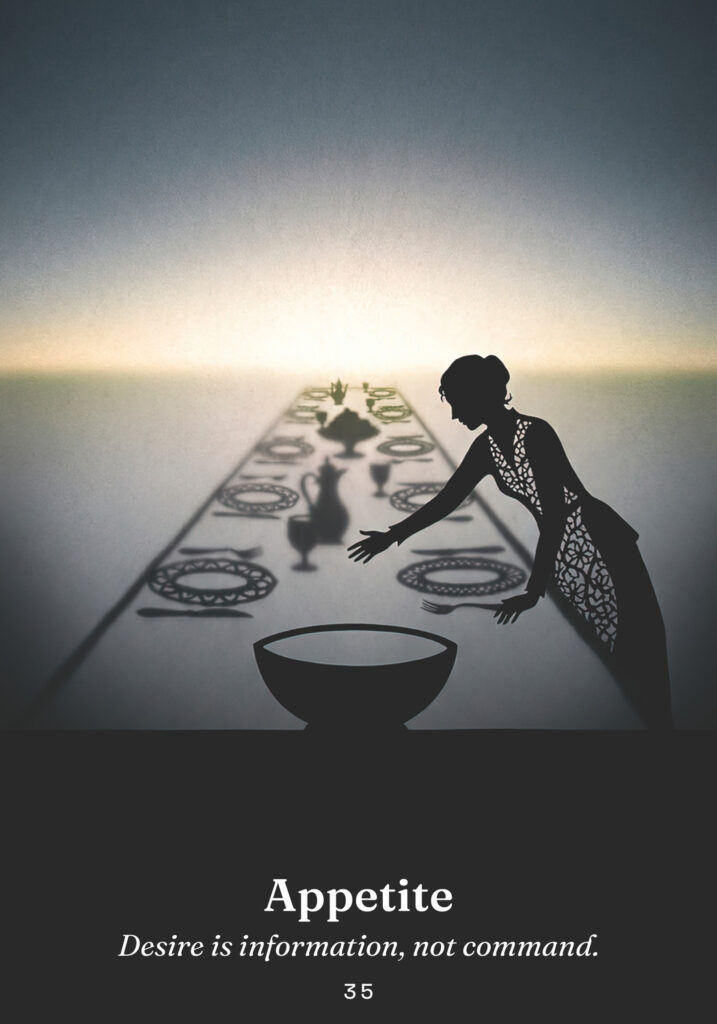
What Appetite means
Coyote, Iktomi, Raven, Reynard, Loki: read enough trickster stories and you notice how many begin with hunger. Appetite is not the villain. It is information about what you need. It becomes dangerous only when it is promoted from messenger to strategist. Look at what you want plainly, without shame. Then decide, with something other than the hunger, what to do about it.
Appetite comes when I want something and have been ashamed to look at it plainly. The card refuses the shame outright, which is rarer than it sounds. What I want is data about what is missing, and covering it over does not remove it, it only removes my access to it. An appetite I will not name still makes decisions. It just makes them out of sight.
In shadow, the card is compulsion, appetite running the whole plan. The hunger has started writing the schedule and I have stopped noticing. The card's practice is two steps: look at what I want honestly, including the wants I would not say aloud, then decide with something other than the hunger. That second step is where the reading lives.
I honor what I want without letting it rule.
When Appetite appears in a reading
Appetite turns up when I have been managing a want instead of examining it. In a reading I say the want in its least flattering form, the one I would never put in an email. That version is the accurate one, and it is the only version worth deciding from.
What I check for is whether I can still say no to the thing today, not in principle, today. A want I can decline is a messenger. A want I can only postpone has already been promoted, and nobody announced it.
Appetite and Winter Coyote are the same warning at two volumes. Coyote is the hunger acting. Appetite is the hunger being looked at, which is the better moment to catch it.
One small sideways move
Delay one thing you want by an hour and notice what the hunger says during the wait.
Appetite in the Crossroads Spread
The Trickster Oracle guidebook’s three-card Crossroads Spread does not find the correct road. It exposes the structure of the choice: the threshold that is actually present, the route you overlooked, and the cost you have not counted. In each position this card tends to say:
- The Threshold. The threshold is a want you have been looking away from. Look at it plainly.
- The Unexpected Route. The route is to treat the appetite as information and let something else decide.
- The Hidden Cost. The cost is compulsion: the hunger quietly writing the whole plan.
Journal prompts
- What am I truly hungry for?
- Where has my appetite quietly become my strategy?