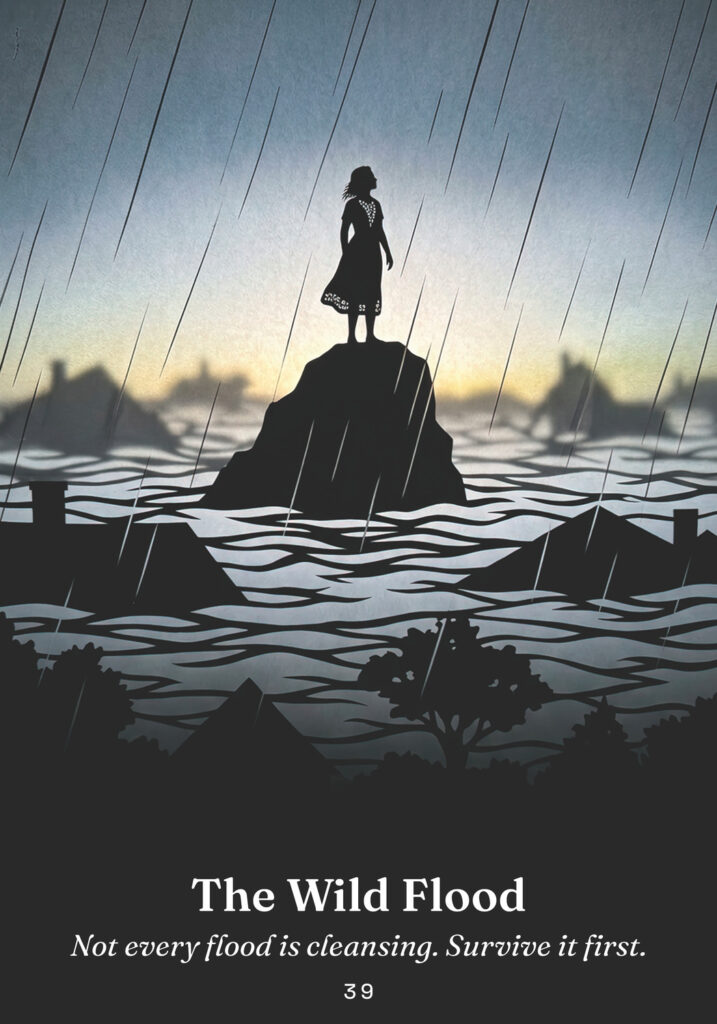
What The Wild Flood means
Flood stories are told all over the world, and the specific ones, like the Anishinaabe flood, belong to their own peoples. This card is the flood itself: water covering the familiar landscape while one high place remains. Something has overwhelmed your old structure. Do not rush to call it purification. Not every flood is cleansing. First survive the water. Then, from the high ground, see what is left.
The temptation the card catches is the urge to call this a cleansing, and it arrives fast, because it is more bearable than the alternative: a thing broke, and no lesson has been issued yet. The card is not against meaning. It is against meaning made at this stage, while the water is still up and I am still in it.
In shadow, the card is romanticizing catastrophe, drowning in your own feeling. The urge to find meaning in the water is strong and it is early. Meaning made while still swimming tends to be wrong. The card asks for three days on high ground, whatever that is for me, a person, a room, a routine, and it asks me to postpone every conclusion until I am dry.
I find high ground first and meaning later.
When The Wild Flood appears in a reading
In a reading, The Wild Flood asks one practical question before any interpretation: what is still above water? A person, a routine, a room, a habit. I name it and I go there. Everything else about the reading waits until I am standing on something solid.
Romance and despair look like opposites and they cost the same thing, which is time I need for staying afloat. What I owe the situation right now is logistics, not interpretation.
The Wild Flood beside The Earth Diver is a sequence, not a contradiction. The flood is the water. The diver is what comes up afterward, and it will not come up while I am still underwater.
One small sideways move
Cancel one nonessential demand today and use the space only to get yourself onto higher ground.
The Wild Flood in the Crossroads Spread
The Trickster Oracle guidebook’s three-card Crossroads Spread does not find the correct road. It exposes the structure of the choice: the threshold that is actually present, the route you overlooked, and the cost you have not counted. In each position this card tends to say:
- The Threshold. The threshold is a flood. The familiar landscape is under water and one place is still above it.
- The Unexpected Route. The route is survival first: high ground now, meaning later.
- The Hidden Cost. The cost is a cleansing declared too soon. Romanticizing the water does not keep you from drowning in it.
Journal prompts
- What is my high ground right now?
- Am I calling this a cleansing before I have survived it?