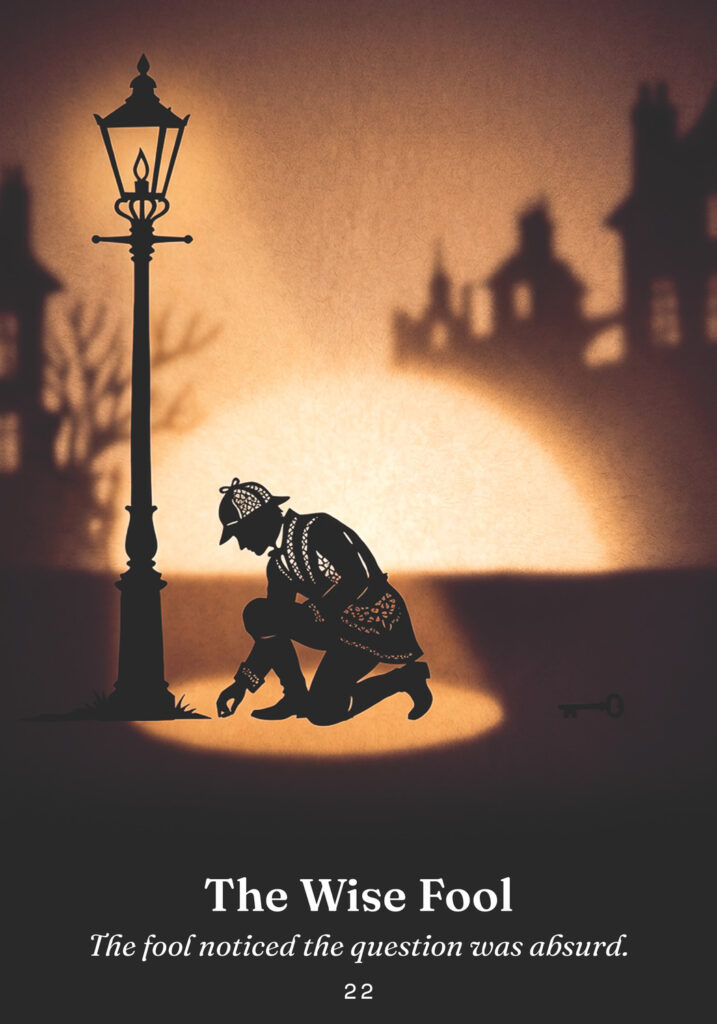
What The Wise Fool means
Nasreddin, whose stories are told across Anatolia, Central Asia, the Balkans, and beyond, once searched for his lost key under a streetlight because the light was better there than where he dropped it. Everyone around you is searching where the light is good. The fool is the only one who noticed the question was absurd. Be that fool. Laugh at the premise, and the answer may fall out.
What makes this hard to spot is that everyone involved is being sensible. Nobody in the story is lazy. They are working hard in the wrong place because the wrong place is where work is easiest to do. The card asks me to be the one who says the key is not here, which costs almost nothing and is almost never said.
In shadow, the card is playing dumb to dodge responsibility, or being contrarian without insight. I know the difference by what comes after the laugh. If the joke opens a real question, it was wisdom. If it only gets me out of the room, it was an exit with a punchline. The fool's job is to see, not to escape.
I let humor show me what argument cannot.
When The Wise Fool appears in a reading
The Wise Fool shows up in rooms where the method is not being questioned because it is the method. In a reading I ask what everyone is assuming the search has to look like, and then I ask where the thing was actually lost. The two answers usually sit in different places and nobody has said so out loud.
My tell for the shadow is whether I have a second sentence ready. A question that stops the room and leaves me with nothing to offer after it was a performance, and I have given that performance more than once.
The Wise Fool is the card I want most in a room full of experts, including when I am one of them. Someone has to say that the key is not under the light, and it is usually the person with the least to lose.
One small sideways move
Tell your most serious problem as a joke to someone you trust and listen for where the laugh lands.
The Wise Fool in the Crossroads Spread
The Trickster Oracle guidebook’s three-card Crossroads Spread does not find the correct road. It exposes the structure of the choice: the threshold that is actually present, the route you overlooked, and the cost you have not counted. In each position this card tends to say:
- The Threshold. The threshold is a search everyone is conducting in the wrong place. The light is good there. The key is not.
- The Unexpected Route. The route is to laugh at the premise. The fool sees the absurdity the experts are too serious to notice.
- The Hidden Cost. The cost is foolishness used as an alibi. Playing dumb gets you out of the room and no further.
Journal prompts
- What obvious absurdity is everyone around me politely ignoring?
- Where am I performing foolishness to avoid being accountable?