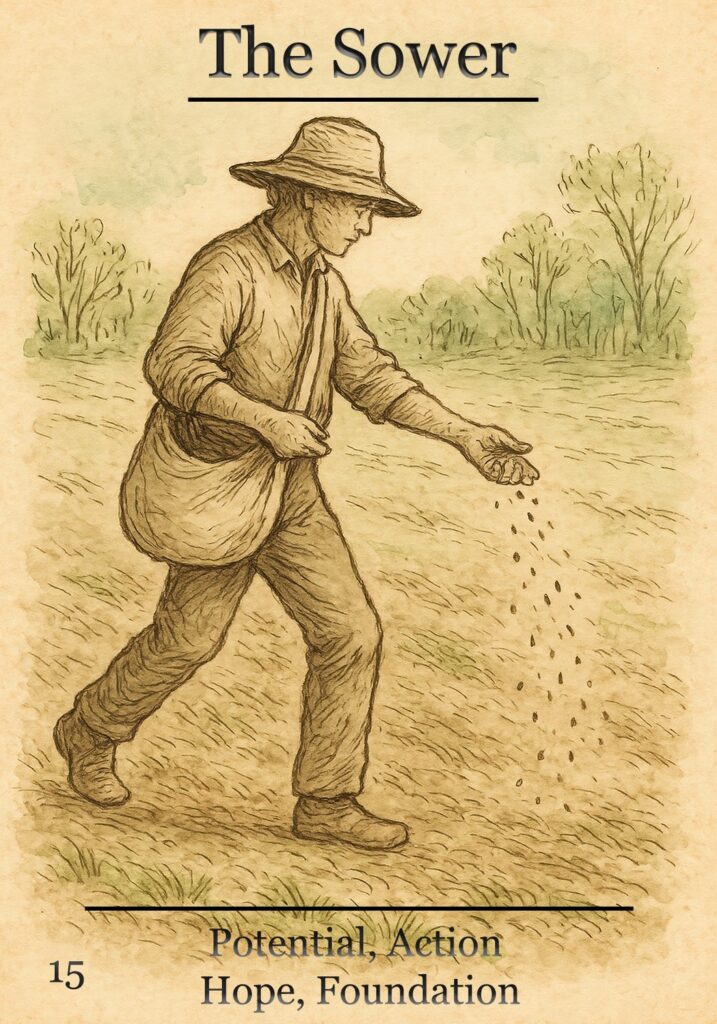
What Sower means
This card is about the act of planting seeds for the future, whether they are new ideas, projects, or personal habits. It emphasizes the importance of intentional action and a belief in the potential for growth. The Sower reminds you that every great achievement begins with a single, hopeful gesture.
Sower tends to show up for people standing at the start of something whose results they cannot see yet: a savings habit, a first class, a friendship being rebuilt, a manuscript with three pages. They want a sign that it will come up, and the card's honest answer is that seed does not give signs. The face shows a figure walking a bare field, scattering by hand, eyes ahead rather than down. I read the card as permission to act before the evidence arrives. The sowing is the part a person controls. Germination happens in the dark, on its own schedule, and digging up the seed to check on it does not speed anything.
Where it goes wrong is scattering without any intention of returning. Some people love beginnings, so they plant constantly, a new hobby each month, a fresh plan each Monday, and never come back to water any of it. The field fills with seed and nothing grows tall. The other failure is clutching the seed until the season passes, waiting for perfect conditions that do not arrive. Sower asks for a deliberate handful thrown into ground the person intends to tend, and then the patience to let it be invisible for a while.
I plant seeds of intention and trust in their future growth.
When Sower appears in a reading
The person who draws Sower is usually asking whether to begin, and my first question back is what they would plant if they knew they had to tend it for a year. That reframing sorts the seeds quickly. Ideas that cannot survive a year of attention fall away, and one or two remain that the person cares about enough to keep visiting. I also ask what has already been planted and forgotten, because the card sometimes points at a seed in the ground rather than one in the hand.
My practice with the card is small and physical when I can manage it. I plant something real, a few seeds in a pot on the windowsill, and let it stand in for the thing I am starting elsewhere. Every time I water the pot I give the other project one small act too: a paragraph, a deposit, a message. The plant is a reminder with roots. If there is no window light to spare, I use a paper calendar instead and mark each day I tended the project, without judging how much I did. A mark is a mark.
Beside Building the Foundation, I read the pair as two kinds of beginning: one that can be checked with a level and one that has to be trusted underground. Beside A Time of Harvest, the card stretches across the year and asks the person to remember that what they gather later depends on what they bother to sow now. Where I keep Sower distinct from The Bean-Field is the moment. Sower is the throw of the hand. The Bean-Field is the long summer of hoeing that follows.
One small deliberate act
Take one five-minute action today toward something you want to exist a year from now, and write the date beside it so you can find that first seed later.
Sower in the Pond Spread
The Walden Oracle guidebook’s three-card spread is The Pond Spread, for any situation that looks one way from the outside and feels another underneath. The cards are laid in a vertical line like layers of water: the surface, the depths, and the bottom. In each layer this card tends to say:
- The Surface. Sower shows a start that looks too small to matter, the kind of beginning the person would rather not be asked about.
- The Depths. It points at hope the person is guarding carefully, afraid that saying the goal out loud will jinx it.
- The Bottom. It names the lesson that every harvest begins as a handful thrown on faith, long before anyone can see a sprout.
Journal prompts
- What "seeds" am I currently planting for my future, and what do I need to nurture them?
- In what areas of my life can I be more intentional about the seeds I am planting?