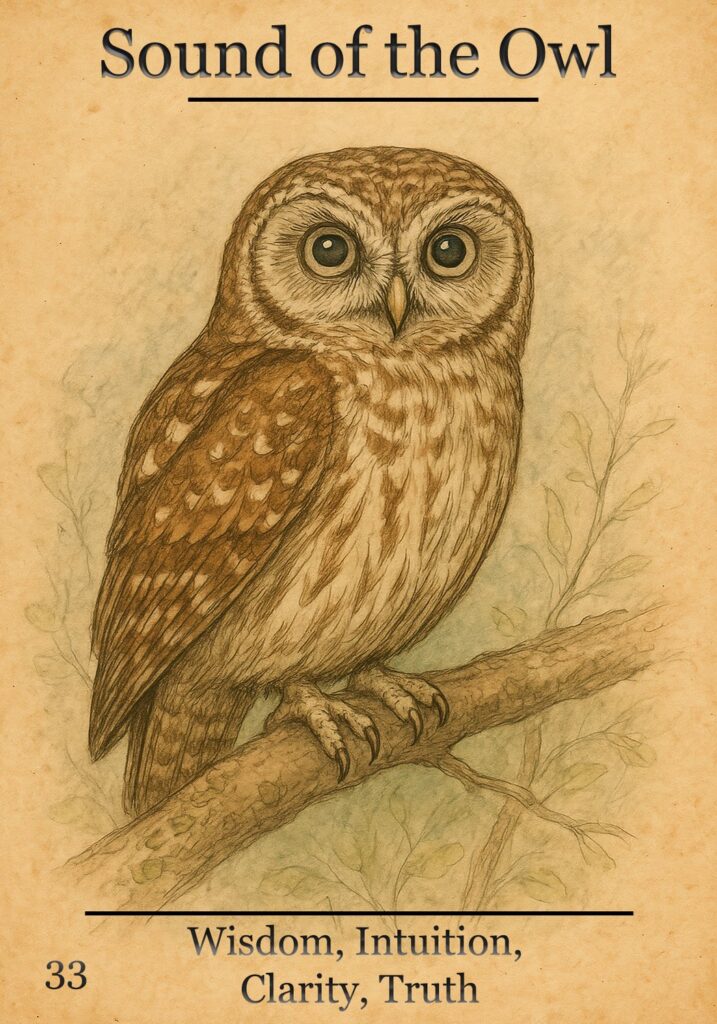
What The Sound of the Owl means
The owl is a symbol of wisdom, introspection, and the ability to see clearly in the dark. This card is an invitation to listen to the wisdom of the night, to find clarity in the darkness, and to trust your intuition when you cannot see your way forward. It encourages you to find your own inner wisdom and to trust it.
The Sound of the Owl tends to come up for someone awake with a question they cannot settle in daylight. It is worth noticing that the card is named for a sound rather than a sight; an owl is usually heard long before it is seen. I read the card as an invitation to listen to what surfaces after the day's noise stops, the steady thought that keeps returning when there is nothing left to distract from it. The card leans toward gladness for a voice that belongs to the dark, rather than resentment of the dark itself.
Where it goes wrong is mistaking three a.m. dread for wisdom. Night thoughts are loud, and loud is not the same as true; the card asks the person to listen for the owl, not for every creak in the house. Another failure is the wise-owl pose: the person who has a calm answer for everyone else's trouble and never turns that attention on their own. Intuition that is never checked against morning light can drift into superstition. The card trusts inner knowing, and inner knowing holds up when it is looked at again.
I trust the wisdom of my own intuition to guide me, even when I am in the dark.
When The Sound of the Owl appears in a reading
In a reading, The Sound of the Owl turns my attention to what the person already knows and has not said out loud. I ask, "When everything goes quiet, what keeps coming back?" Then I listen for the sentence they say quickly and immediately take back, the "I mean, probably not, but…" That retracted sentence is often the owl. My job in the reading is to slow down enough that the person hears themselves say it twice.
My practice with the card is a notebook by the bed. When a clear thought arrives in the night, I write one line in the dark without turning on a light, and leave it there. In daylight I read the line and sort it. Some lines are the owl: quiet, steady, still true at breakfast. Others are the creak in the house: worry that shrinks to nothing once the kettle is on. Over a few weeks I start to recognize the two voices before I have to sort them on paper.
Beside The Unspoken Word, I read the pair as a knowing that has been heard clearly and not yet acted on. Where I keep The Sound of the Owl distinct from Reading the Ice is the light available. Reading the Ice is careful analysis when the details are visible and can be studied. The Owl is the kind of trust needed when the details are not available at all. Thoreau wrote, "I rejoice that there are owls." When this card sits at the bottom of a spread, I read it in that spirit, as company in the dark rather than a warning.
One small deliberate act
Before bed tonight, write down one question you keep circling, leave the notebook closed on the nightstand, and read it once in the morning before you check your phone.
The Sound of the Owl in the Pond Spread
The Walden Oracle guidebook’s three-card spread is The Pond Spread, for any situation that looks one way from the outside and feels another underneath. The cards are laid in a vertical line like layers of water: the surface, the depths, and the bottom. In each layer this card tends to say:
- The Surface. The Sound of the Owl shows a situation that looks murky and leaderless, with nobody sure which way to turn.
- The Depths. It names a quiet certainty the person has been talking themselves out of because they cannot justify it with facts yet.
- The Bottom. The core lesson is that some answers arrive by listening rather than looking, and they deserve a hearing in daylight.
Journal prompts
- What "darkness" (a difficult situation, a period of uncertainty) can I learn from right now?
- How can I practice listening to my intuition more fully in my daily life?