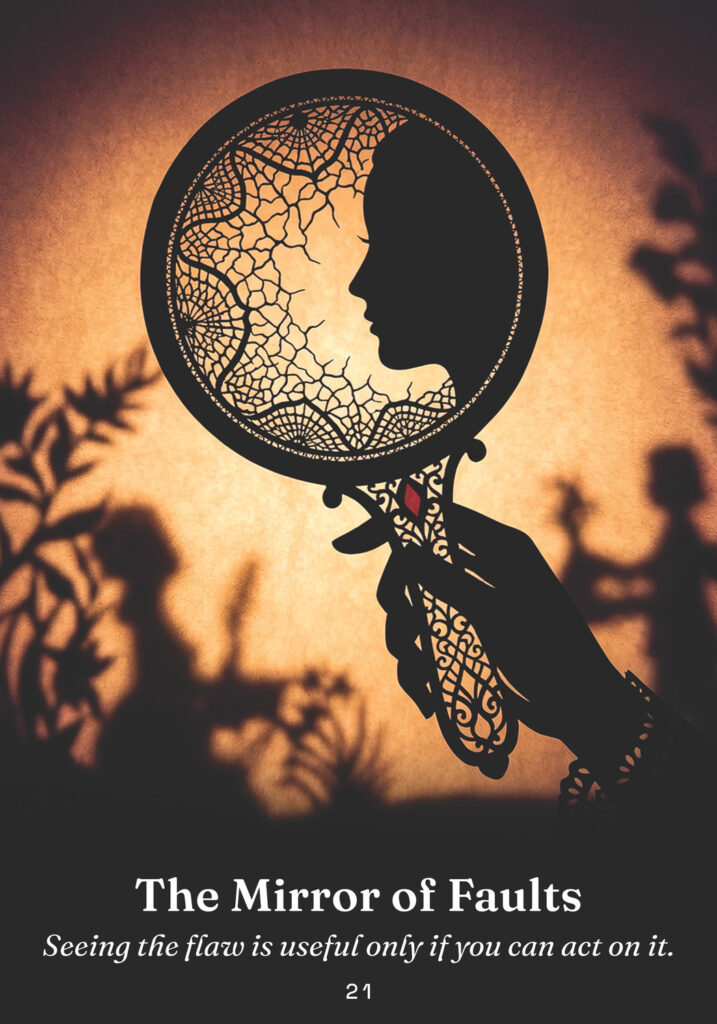
What The Mirror of Faults means
In Greek literary tradition, Momus was the spirit of blame, so quick to find fault that later tellings have him criticizing the work of the gods themselves until they threw him out of Olympus. Something needs unsparing observation right now, possibly in yourself. Look. Name the flaw plainly. Then remember that seeing the crack is useful only if you plan to do something with it.
Often the thing needing that unsparing look is me, which is why the card is uncomfortable to draw. It does not flinch and it does not ask me to. What it will not accept is a softened version of the sentence. Name the flaw in the words I would use if nobody's feelings were in the room, then decide what I am going to do about it, because the naming is only half the instruction.
In shadow, the card is cynicism mistaken for insight, cruelty mistaken for truth. I have used both on myself and called it honesty. The tell is repetition: circling the same flaw, in myself or someone else, with no action attached. At that point the looking has become the habit, and Momus is not a wise critic anymore. He is just a spirit of blame with nowhere to go.
I see clearly and use what I see kindly.
When The Mirror of Faults appears in a reading
In a reading I write the flaw down in one sentence with no cushioning in it, and then I write what I will do about it by a specific day. If the second line will not come, the card has caught me. Observation with no next step attached is a pastime, and a comfortable one.
This is one of the cards I read as shadow work, because the shadow here is subtle. Cynicism arrives dressed as discernment and it is flattering to host. I test it by asking whether my last five observations about a person or a project all ran in the same direction. Nothing real is that consistent.
One thing I ask when this card lands: is the flaw I keep noticing in someone else the one I have not forgiven in myself? It is not always, but it is worth asking.
One small sideways move
For one day, refuse to repeat the criticism unless you are willing to do something about it.
The Mirror of Faults in the Crossroads Spread
The Trickster Oracle guidebook’s three-card Crossroads Spread does not find the correct road. It exposes the structure of the choice: the threshold that is actually present, the route you overlooked, and the cost you have not counted. In each position this card tends to say:
- The Threshold. The threshold is a flaw that needs naming plainly, possibly your own.
- The Unexpected Route. The route is to look without flinching and then act on what you see.
- The Hidden Cost. The cost is criticism that has become a habit. Blame without action is only cruelty in better clothes.
Journal prompts
- What flaw am I circling without acting on?
- Where has my honesty become a habit of blame?