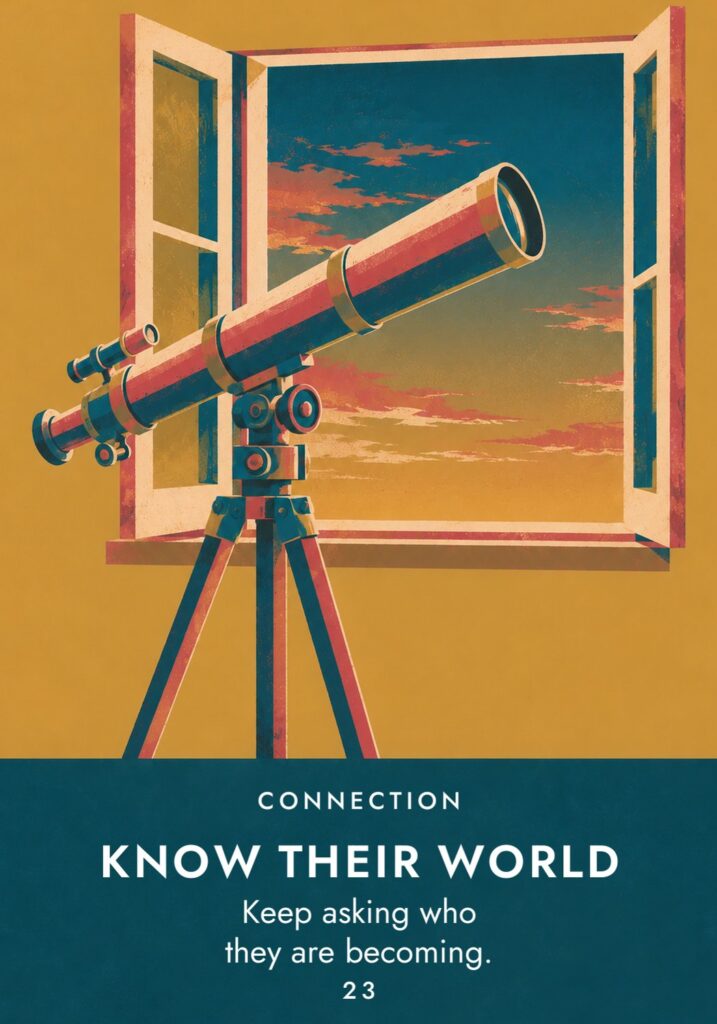
What Know Their World means
Knowing someone means keeping a running picture of what they worry about, hope for, and are living through right now. Long familiarity creates a trap. You know so much about someone that you stop asking who they are becoming. What worries them now? What are they learning? For early dating, it means knowing the person rather than running a compatibility interview. For an ex, it is a reminder that the version you remember is not someone you can know right now.
Know Their World turns up for someone who has stopped being curious and has not noticed. They can tell me their partner's coffee order, their mother's name, the story about the ferry. What they cannot tell me is what their partner is worried about right now, or what they have been reading, or what they have changed their mind about since spring. The familiarity is real and the knowledge is out of date. I read the card as a reminder that people keep happening. The version of someone that lives in your head was accurate once, and the card asks when it was last updated, because the person in the kitchen has had several months of life since then that nobody asked about.
In shadow, this becomes "I already know what they think." Or questions used to extract reassurance rather than to meet someone. The first is the long-relationship failure, and it feels like intimacy from inside. The person finishes their partner's sentences, answers for them at dinner, and is often right, which is the trap. Being right about last year is not the same as knowing someone now. The second is the early-dating failure, the interview conducted with a scorecard, where every question is really "are you going to hurt me" wearing a different outfit. The other person can feel the clipboard. Nobody becomes known under cross-examination.
I can meet the person they are today.
When Know Their World appears in a reading
Where I keep Know Their World distinct from simply paying attention is the direction of time. In a reading, I ask the person to tell me one thing their partner, or the person they are seeing, is currently in the middle of. Not a fact about them. A thing in progress, a worry, a project, a shift in how they see something. The pause that follows is the reading. Then I ask when the person last asked a question they did not already know the answer to, and the honest answer is often "I'm not sure I ever have." That is not a verdict. It is a place to start.
My own practice with this card is one open question a day and a closed mouth afterward. The question has to be one I cannot predict the answer to, which rules out most of my usual ones. "What's been on your mind lately that you haven't said out loud" is one. "What would you change about this year if you could" is another. Then the hard part. I do not interrupt, I do not correct the facts, and I do not turn the answer toward myself. I let it be about them for the whole length of it. The first few times this feels like holding my breath. It gets easier, and the person across from me starts to look less familiar, which is the point.
Beside Novelty and Play, I read the pair as curiosity approached from two sides: this card asks who the other person is becoming, and that one makes room for the answer to surprise me. Where I keep Know Their World distinct from Ask, Don't Assume is that Ask is for a specific assumption that needs testing, usually under some pressure. This card is the slow version, the ongoing habit of being interested in someone I think I already understand.
One small honest step
Ask one person close to you what they have changed their mind about this year, and let the answer run its full length without steering it.
Know Their World in the You, Me, Us Spread
The Second Question guidebook’s three-card love reading is You, Me, Us, the classic layout with the positions changed so that none of them asks for mind reading. The first card is what I bring, the second is what their behavior has actually shown so far, and the third is what the dynamic needs for its next honest step. In each position this card tends to say:
- What I Bring. As What I Bring, the card says you are carrying a finished picture of this person into the connection, and the picture may be a season or two out of date.
- What Their Behavior Shows. As What Their Behavior Shows, it asks whether their actions show ongoing interest in who you are now, questions about your current life, attention to what has changed, or whether they are relating to a version of you from earlier.
- What the Dynamic Needs. As What the Dynamic Needs, it points to open questions, asked without an agenda and received without correction, as the step that would let two familiar people meet again.
Journal prompts
- What might have changed in this person since I last truly asked?
- Am I curious about them, or checking them against a list?