Self-Reliance, in Forty Cards
A four-step practice for the days when everyone else’s opinion is louder than your own, and the deck I built to carry it.
Last spring I stood in my kitchen texting the same question to three different people. I already knew my answer. What I was actually asking for was permission.
That is the small, ordinary failure this practice is for. Not a crisis. Just the quiet moment when your own judgment goes softer than the room. Emerson was writing about exactly this in 1841, and he had no phone in his pocket. You do.
The four-step alignment flow
It takes about ten minutes, and it works on a decision as small as whether to go to the thing on Saturday.
1. Notice
Catch the first reaction before the deliberating starts, and write it down in one sentence. That is the sentence you keep checking your later reasoning against.
2. Pause
Sort the weight: what you know, what you are guessing, and what is only social pressure wearing the costume of a fact. More of it ends up in that third pile than you might expect.
3. Check
Read the option back to yourself and notice whether it opens something or tightens it. You are not asking whether it is easy. You are asking whether it feels true to you.
4. Practice
Do one small, real thing about it today, in five to ten minutes. Send the message. Cancel the thing. Make the call. Conviction that never touches the ground is still just an opinion.
The one-card version
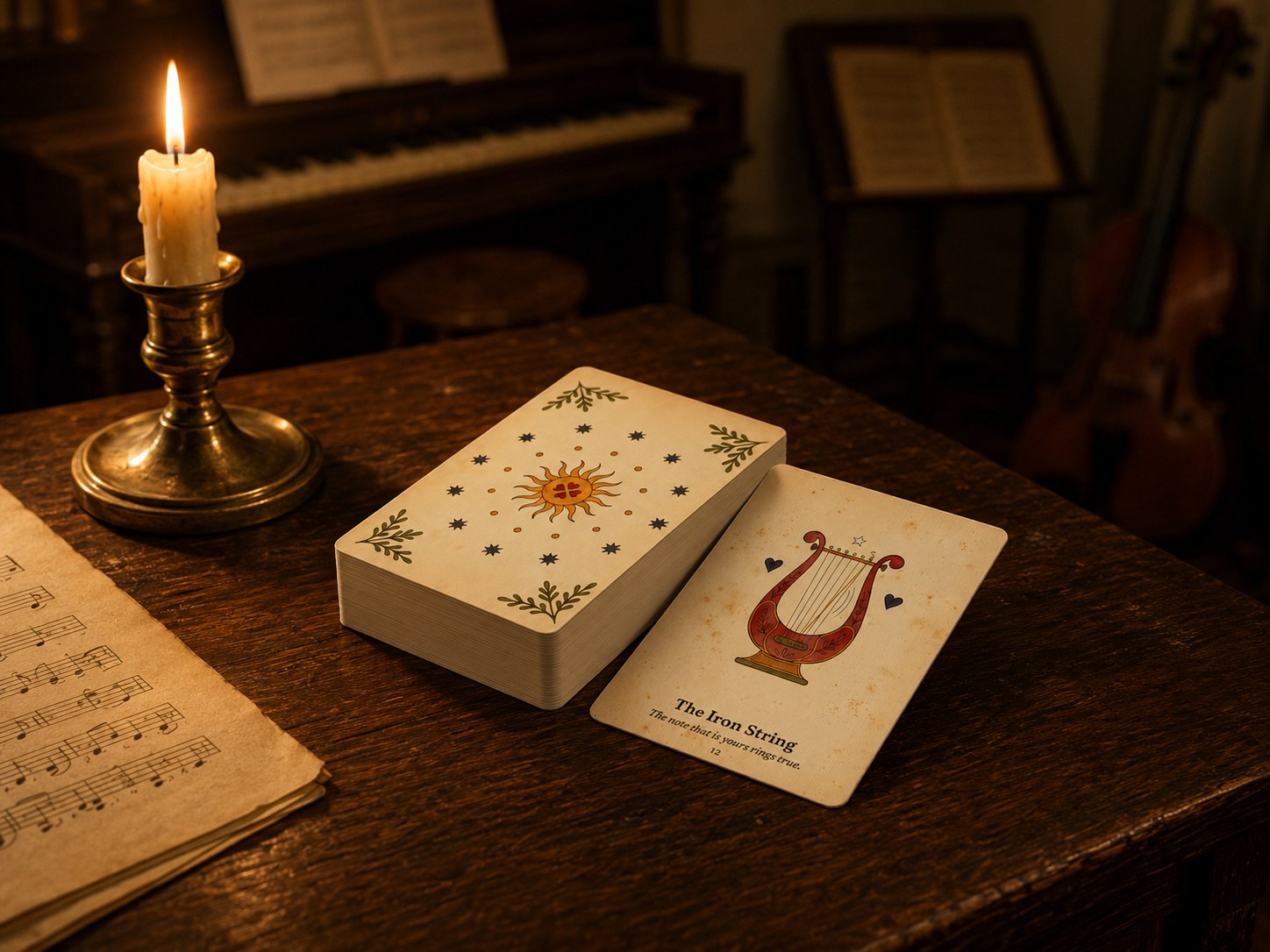
The shortest way in is a single card, what I call the Iron String Spread, named for Emerson’s image of the iron string every heart vibrates to. Shuffle, pull one, and ask:
“Where does my own judgment need to hold right now?”
The card decides nothing. It is a mirror with a sentence on it, and that sentence gives you a place to stand while you run the four steps.
Three I return to often:
- Intuition. Your first quiet answer is usually right. For the day you have collected too many opinions.
- The Hobgoblin. You are allowed to change your mind. For when you are defending a position only because you announced it.
- Nonconformity. Agreement is not the same as truth. For a room where everyone has already nodded.
New to this? Start with my guide to reading oracle cards for beginners. One card and one honest question will do.
Why I made a whole deck out of it
The Emerson Oracle is the deck I built for this practice, forty cards that turn Emerson’s big ideas into things you can actually do on an ordinary Tuesday.
Emerson owned the land at Walden Pond where Thoreau built his cabin. That connection has always felt fitting to me. The Walden Oracle is the how of living deliberately. The Emerson Oracle is the why underneath it.
The cards run in four suits of ten: The Over-Soul (universal law and spirit), Self-Reliance (sovereignty and mind), Experience (everyday life and action), and Society and Relation (connection and culture).
Every card carries an insight, a one-line essence, an affirmation, a short practice, and two journal prompts. A card that only gives you something to think about gets put down in four minutes. One that gives you something to do can change a Tuesday.
Like all the decks I make, this one is a mirror rather than a fortune-teller. It hands you a question and leaves the meaning to you. That is the entire design.
Start with one card, not a purchase
You do not need to buy anything to try this. Try a free three-card reading, or look through all forty Emerson cards in the explorer.
Then tomorrow, notice the nudge. Pause. Check whether it opens or tightens. Do one small thing before lunch.
That is enough to begin.
Zara